Marius
De brief voor de KoningMarius, called the Fool of the Forest Hut, is a solitary woodland figure whose apparent foolishness contrasts with his attentiveness and generosity. When Tiuri is uncertain which path to take and has run out of food, Marius appears, guides him toward his home, and provides provisions. His brief encounter turns a moment of hunger and disorientation into one of renewed confidence, while his claim to know what others do not complicates the name by which people dismiss him.
Identity and Introduction
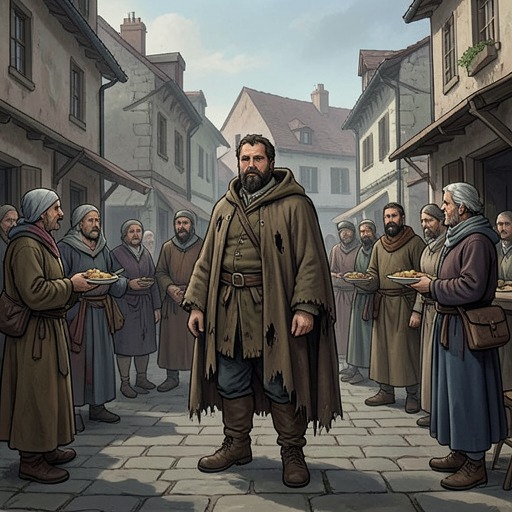
Marius introduces himself as the Fool of the Forest Hut, explaining that this is what everyone calls him, while his mother calls him Marius. His unusual appearance is described in specific, unpolished details: he is broad and stocky, with wild dark hair and a short, curly beard, and wears ragged reddish-brown trousers and a gray sheepskin. Standing with his hands behind his back, he moves his bare toes. The description sets him apart from the ordinary traveler Tiuri expects to meet, but gives him a distinct physical presence rather than reducing him to his reputation.
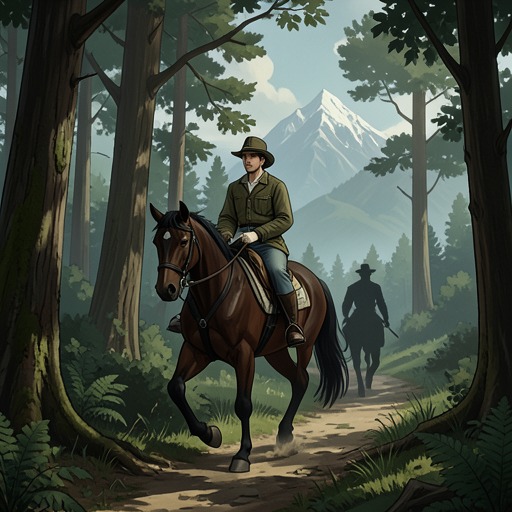
He enters Tiuri’s path at a point of uncertainty. Tiuri has reached a fork and does not know which direction to choose when Marius calls from behind him, addressing the rider and his handsome black horse and insisting that they should take the way to his house, not continue straight ahead. His greeting is as unusual as his appearance: he asks why Tiuri has not said good day, then observes that the horse has already done so. Marius attends to the horse as well as the rider, making the meeting feel less like a formal encounter than an invitation into his own way of seeing the world.
Knowledge and Hospitality
Marius says that people call him a fool because, as he puts it, they say he does not think; he counters that he knows a great deal that nobody wants to know. Tiuri asks what he knows. Marius responds with evident pleasure that nobody ever asks him questions, then tells Tiuri he need not come to the hut and can ride on while Marius brings him food. This exchange joins his claim to hidden knowledge with a more immediate act of care: rather than making Tiuri stay or prove his curiosity, he offers help on Tiuri’s terms.
The offer answers a pressing need. Tiuri has eaten his last apple, has no other food, and is hungry, though he does not want to lose time searching for more. After Marius goes down the left-hand path, Tiuri continues slowly and wonders whether he should have insisted more firmly that Marius keep his presence secret. Marius returns at a run carrying food. He leads Tiuri to a patch of soft grass beside a narrow brook, whose water Tiuri can hear, and lays out two large pieces of brown bread, half a bacon pancake, and a hunk of cheese. He says that everything is for Tiuri and explains that he took it from his mother’s cupboard without her knowing. The food is described from the hungry traveler’s perspective as a treasure, giving the practical gift a weight that the scene’s circumstances have earned.
Farewell and Significance
Before Tiuri leaves, he asks how long he will be away. He cannot say, but fears it will be a long time; he hopes and intends to return. Marius answers with certainty that he will come back, then directs him straight ahead and warns him not to drink from a dark pool farther on, because it belongs only to the forest spirits. The advice combines a concrete instruction about the route with a warning framed in Marius’s own terms. The encounter supplies Tiuri with food and direction, but also gives the landscape a local, uncanny dimension through the forbidden pool.
Tiuri packs the remaining food into his saddlebag, shakes Marius’s hand, mounts, and rides away. He looks back several times and waves; Marius stands in the middle of the path watching him, arms hanging, but has disappeared by the third time Tiuri turns around. Tiuri thinks of him as a good man and not so foolish, although different from other people, and feels strengthened and full of fresh courage. Marius’s significance lies in that understated reversal: the label attached to him by others does not prevent him from noticing Tiuri’s need, sharing scarce food, and offering useful guidance. The episode does not explain his knowledge or the forest spirits; it leaves Marius’s strangeness intact while showing the kindness and encouragement Tiuri receives from him.