Mededogen als kracht
De brief voor de KoningMededogen als kracht is the principle that humane attention can be a form of moral strength, even when an adversary calls it weakness. Near Unauwen Capital, Tiuri initially offers a beggar money while still mounted and in a hurry. The encounter changes when the man makes him confront the distance between giving alms and recognizing another person. Tiuri dismounts, helps the stranger to his feet, and discovers that the apparently helpless beggar is Slupor, the enemy who has long pursued him. Compassion does not make Tiuri invulnerable; it shapes the choice he makes under pressure and the kind of knight he ultimately promises to be.
A gift is not yet an encounter
The beggar objects not to the amount Tiuri gives but to the manner of giving. From the height of his horse, Tiuri can toss a coin without looking at the man’s face, then continue on and forget him. The beggar describes himself as a delay that a hurried traveller can pass and soon leave behind. His words expose how easily generosity can remain detached: money changes hands, but the giver need not pause or acknowledge the person receiving it. The accusation is especially pointed because Tiuri is approaching a city associated with the king and with the claim that no poverty exists there, while poverty is plainly before him at its entrance.
Tiuri does not answer by insisting that his gift should be enough. He apologizes for being in such haste that he failed to stop, explains that he has given the beggar everything he has with him, and says he would help more if he could. The beggar accepts the sincerity of that wish, but Tiuri recognizes that words and money still have not answered the challenge. When Piak lays a hand on his arm and urges him to come, Tiuri chooses to get down from his horse. He helps the old man rise and makes clear that, although he is in a hurry, he is not too hurried to stand before him and know him.
That decision gives the scene its moral distinction. Tiuri’s compassion is not measured by a larger payment: he has no more money to give. It takes the form of time, attention, and physical presence, offered to someone who has just told him how thoroughly other people ignore him. The beggar in turn says that he is thankful not for the money but because Tiuri is now standing before him. The change is small in outward terms—a rider has dismounted—but it transforms an anonymous act of charity into a face-to-face encounter.
Compassion under threat
The encounter also turns on a subtle change in Tiuri’s response. The beggar’s bitter voice first stirs pity. As Tiuri remains with him, pity gives way to curiosity and an unexplained tension: he feels he cannot leave until the man looks at him. The narrative presents this as an instinct whose full meaning Tiuri will only understand later. When the beggar finally raises his face, Tiuri recognizes the cold, false eyes of Slupor. The supposed recipient of his kindness is the enemy he has feared for a long time.
Slupor’s disguise makes the test of compassion literal. He draws a dagger from his staff and thrusts at Tiuri, who is prepared enough to deflect the blow and suffer only a graze. Tiuri forces him to drop the dagger, but Slupor then closes his hands around Tiuri’s throat. Piak cries out Slupor’s name as Tiuri struggles against an opponent he recognizes as stronger. The scene therefore refuses an easy equation between goodness and safety: stopping to help has brought Tiuri within reach of an armed attacker. Yet Tiuri is not simply passive or unaware. He reacts to the attack, resists Slupor’s grip, and tries to overpower him.
Later, Slupor explains how he engineered the danger. He had appeared as a shepherd riding the supposed murderer’s horse and as a messenger bringing Knight Iwijn news that the murderer had been captured. His purpose was to make the toll lord’s attendants abandon Tiuri and his companions, leaving them alone and unprotected. He followed them, but people working in the fields made a daylight attack difficult; at night, a farmer barred his doors and a dog barked at him. Slupor rode on ahead and waited in the road disguised as a poor old beggar. These details show that the encounter was the end of a deliberate pursuit, not an accidental danger Tiuri could have anticipated simply by being more suspicious.
Slupor’s accusation and Tiuri’s answer
Slupor interprets the compassion that brought Tiuri close as weakness. In his account, people feel pity for a poor old beggar, and that pity gives an attacker an opening. He presents himself as stronger than his captives and boasts that his plan should have succeeded. His contempt turns a practical advantage into a moral accusation: to care about a vulnerable stranger is, in his view, to make oneself exploitable. The disguise gives that accusation its force because Slupor has deliberately used the appearance of need to manipulate the very response he condemns.
His final taunt shifts from the ambush to Tiuri’s identity. Addressing him as the son of Tiuri, Slupor asks what he has done by leaving and forfeiting his chance at knighthood. He insists that King Unauwen is not Tiuri’s king and hopes that King Dagonaut will deny him sword and shield. Slupor thus tries to define Tiuri’s choices as both foolish and disqualifying: compassion has exposed him to an attack, while his journey has apparently cost him the conventional recognition of a knight. The town officer cuts off the speech, orders Slupor taken away for punishment, and tells the companions they may go. Tiuri breathes in relief once they are outside. Slupor’s capture ends this immediate danger, but his challenge to Tiuri’s worth remains sharply framed against the ceremony that follows.
The ethic made into an oath
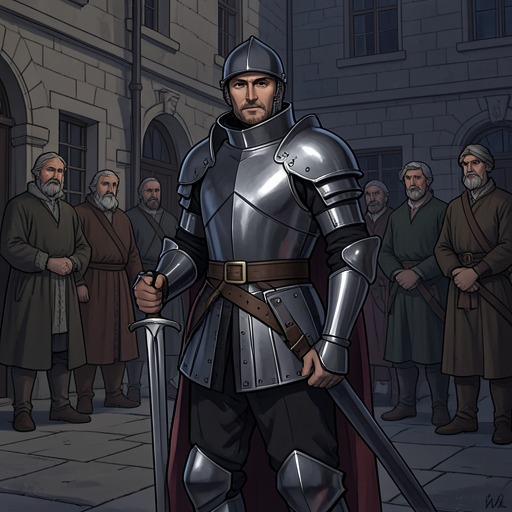
At his knighting, Tiuri receives a white shield from King Dagonaut, at King Unauwen’s request. It marks Tiuri’s service to both kings and recalls the knight whose task Tiuri took over. The significance of the gift lies not only in allegiance or remembrance: Tiuri’s spoken promise gives his conduct toward the beggar a public, formal counterpart. He vows to serve the king and his subjects faithfully, and also every person who calls on him for help. He promises to use his sword only for good against evil and his shield to protect those weaker than himself.
The oath answers Slupor’s claim without pretending that kindness cannot be exploited. Tiuri’s compassion did not prevent the attack, and the narrative has shown the cost of stopping for someone who seemed in need. But the final pledge does not define strength as avoiding every risk or treating every stranger as an enemy. It places the obligation to help at the heart of knighthood, joining aid for anyone who asks with protection for those less strong. When those gathered acclaim Tiuri with the White Shield, he bows his head because his eyes are full of tears. The scene closes not on a boast of victory over Slupor but on an emotion that binds the dangerous roadside encounter to the duty Tiuri has now sworn to uphold.