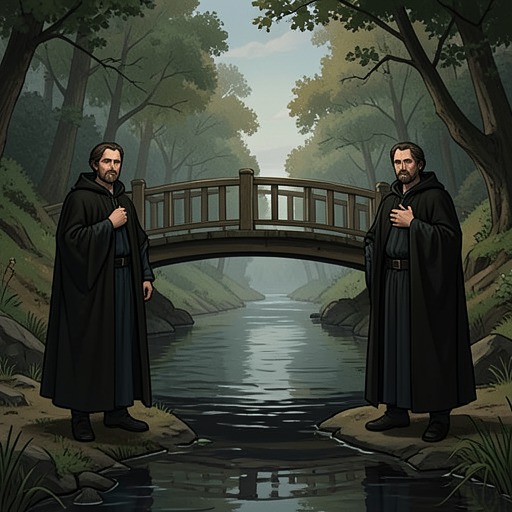
Rainbow River
De brief voor de KoningThe Rainbow River is a former frontier whose bridges connect the Unauwen Realm with the lands beyond it. Its crossings are more than routes through the landscape: they are administered by royal toll lords, carry a history of defense against invasion, and become decisive passages in Tiuri’s journey with Edwinem’s message. The river’s changing political role is embodied in Tolheer Ardian, whose responsibility for the crossing joins the old duties of a border guardian to the immediate need to protect travelers.
A River Made into a Boundary
The Rainbow River once marked the boundary of Unauwen. Its bridges were built to connect the realm with the outside world, and the river’s position made it a place where movement could be watched and controlled. In earlier times, people came from the east hoping to cross; during periods of danger, when invasions threatened from the north, east, and south, the toll lords also served as defenders of the heart of Unauwen.
That military role receded as Unauwen’s territory extended to the Great Mountain Range, but the crossing’s older political meaning did not disappear. The tradition remained that anyone crossing the Rainbow River owed a toll to the king. The river thus continued to mark a threshold even after it ceased to be the realm’s outer border: passage remained subject to royal authority and the obligations attached to it.
Bridges, Toll, and Royal Authority
The toll system is administered by officials appointed directly by the king. As Warmin explains, the office is not inherited from father to son; the king chooses his best knights to serve as toll lords. Tolheer Ardian’s position reflects this rule. Once a wandering knight without a home, he became lord of the toll at the Rainbow River, exercising authority by appointment rather than family succession.
The toll is not due indefinitely from every traveler. A person who has crossed the river more than three times no longer has to pay. The arrangement preserves the king’s claim over the crossing while recognizing repeated passage. Its history also leaves an uneasy possibility in view: should danger return, the toll lords might again have to become strict, unyielding defenders of the river against strangers.
Tiuri’s Passage and the Mission
For Tiuri, the river presents practical obstacles as well as political ones. At one crossing, he and Piak have to consider what they can offer for passage. Tiuri has Edwinem’s ring, a stone that gives light in the dark, hanging from a cord around his neck. He has treated it as something entrusted to his care, not as his own possession, and initially fails to think of it as payment. But the king’s message matters more than the ring, and he brings it out as a possible means of securing their crossing. The episode makes the mission’s priority concrete: even a treasured object can become a resource when delay threatens the delivery.
The river and its bridge also expose the travelers to danger. After hearing of a second messenger from Dangria, Tolheer Ardian worries that the two young travelers may be at risk. When Warmin reports the suspicious man on the bridge, Ardian sends him on horseback with ten armed men to catch up with Tiuri and Piak, accompany them, and protect them if necessary. The crossing is therefore not simply a checkpoint. It is a vulnerable passage along which information about danger can prompt intervention and protection.
Return to the Crossing
Later, after carrying important news to the king, Tiuri and his companions return to the Rainbow River and cross the bridge again. They have money from the king to pay the toll still owed. The guards do not recognize them at first; Warmin’s warm greeting makes their identity clear, and he takes them into the castle to meet his lord.
Tolheer Ardian welcomes them as guests and refuses their payment, explaining that the toll has already been paid, apparently by him. His gesture contrasts with the formal rule that crossing incurs a debt to the king: the system remains in place, but the official who administers it can also choose hospitality. The travelers’ return has changed their standing at the river. They are no longer unknown young men seeking passage but bearers of consequential news, received by an authority who recognizes their importance.
A Frontier’s Uneasy Future
The Rainbow River’s political past reaches into its present. Warmin reports that Tolheer Ardian has begun exercising his fighting men and fears that the castle may again need to become a fortress, as it was centuries earlier. Ardian himself gives the visitors no display of alarm, but his melancholy and his habit of standing on the bridge at evening, silently watching the water, register the weight of what he knows.
The river therefore holds together two different conditions: a crossing maintained by tradition in a realm that has expanded, and a defensive frontier that might be needed again. Its bridge enables travel, but also concentrates authority, risk, and responsibility. For Tiuri, crossing it is part of carrying Edwinem’s mission forward; for Ardian, guarding it means serving both the present travelers and a kingdom whose peace cannot be taken for granted.