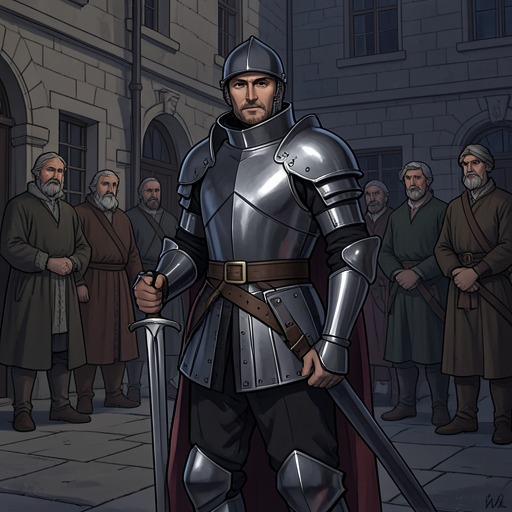
Riddereer en ridderlijke erecode
De brief voor de KoningRiddereer en ridderlijke erecode is the story’s ideal of knightly honor and the standard by which its characters’ conduct is judged. Its sharpest test is the difference between an honorable, declared contest and violence disguised as one: titles, armor, and formal challenges can make a claim look credible, but they cannot make treachery honorable.
Honor as Conduct, Not Appearance
The distinction appears first at an inn, where the Black Knight with the Red Shield demands to see the Black Knight with the White Shield. The latter comes downstairs fully armed, with his visor lowered and the white shield on his arm. The Red Shield knight throws down a glove; the White Shield knight picks it up and asks when. The answer is now. They leave together for the forest without another word, a compact public ritual that appears to establish a formal challenge.
Yet the wounded White Shield knight later tells Tiuri that there was no duel. The Red Shield knight had lured him into an ambush, and the Red Riders had overwhelmed him. They had sought not only to destroy him but also to seize the letter he carried. The contrast makes the glove and the apparent agreement insufficient evidence of honorable combat: the decisive question is what happened beyond the inn door, not how ceremonially the encounter began.
The Code Tested by Conflicting Accounts
Bendoe’s account of confronting the Red Shield knight exposes how easily the language of honor can become a defense. Bendoe found him with about six Red Riders and asked what had happened to his opponent. The masked knight claimed that he had challenged the White Shield knight to a duel, defeated him, and would defeat him again if given the chance. When Bendoe replied that the knight was dead, the Red Shield knight expressed no grief, acknowledged their enmity, and insisted that he would have killed him only in an honest fight.
That claim conflicts with the dying knight’s account of an ambush by the Red Riders. The masked knight also warned that the White Shield knight had many enemies and had known too much, while professing respect and admiration for him. The narrative does not resolve the contradiction by treating a knight’s assertion as proof. Instead, it places the boast of fair combat beside the survivor’s account of a many-against-one attack and Bendoe’s suspicions, making the credibility of the speaker part of the moral test.
Justice Requires Restraint
At Castle Mistrinaut, the code is applied not only to enemies but also to those seeking justice. Lord Rafox admits that he gave Tiuri weapons and was ready to intervene if Ristridin and the other Grey Knights attacked him. He had doubted their assumptions from the beginning. His rebuke turns the code inward: had the knights defeated Tiuri without hearing him, their vengeance could itself have become an unjust act and dishonored their knighthood. Honor therefore requires restraint and a hearing, especially when anger makes punishment seem certain.
Tiuri answers Bendoe’s accusation by recounting his own actions plainly. He had left the chapel where he was keeping vigil before his intended knighting, taken a horse that was not his, found the White Shield knight, and been present when he died. The dying knight had identified his attackers and given Tiuri his ring; later, the Red Riders had tried to kill Tiuri too. Tiuri insists that his conscience is clear, while acknowledging that he cannot swear by a knight’s honor because he is not yet a knight. His unknighted status limits the formal oath he can invoke, but it does not prevent him from appealing to truth and conscience. He refuses to sit until the Grey Knights believe him, making his demand for a fair hearing part of the same ethical standard Rafox defends.
From Personal Feud to Political Treachery
The later disclosure about Edwinem widens the meaning of dishonor beyond a private feud. King Unauwen explains that Edwinem fled Eviellan in black armor and with a black shield, concealing the white beneath it, because he had discovered something dangerous. A knight and riders from Eviellan killed him to prevent him from delivering that knowledge. The letter itself was lost, but its contents survived and exposed the younger prince’s plan to reconcile with his father and brother only long enough to remove suspicion before killing the crown prince and taking the throne.
The king also says that two of his knights had been killed to conceal the plot and warns that, with deception exposed, the Lord of Eviellan may turn to force. The revelation makes honor a matter of public consequence: a false appearance of peace can serve the same treacherous purpose as a false claim of fair combat. Across the story, the code is upheld not by armor, rank, or declarations alone, but by truthful conduct, restraint in judging others, and resistance to violence concealed beneath honorable forms.