Sigirdiwarth Rafox
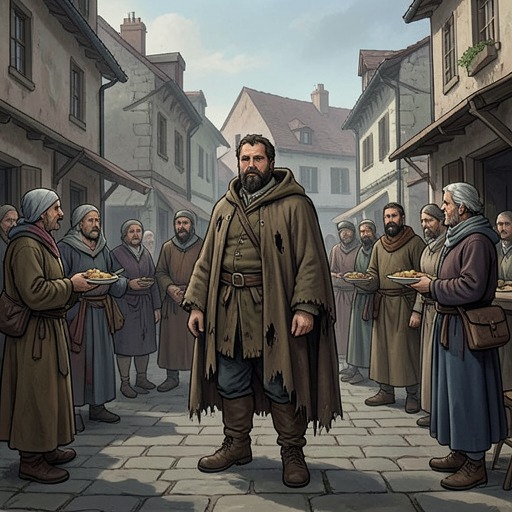
De brief voor de KoningSigirdiwarth Rafox, Lord of Mistrinaut, is both a refugee from war and a lord whose authority was earned by confronting injustice. His defining act in Tiuri’s story is to arm the young man when the Grey Knights, driven by suspicion and revenge, might otherwise have defeated him without hearing his case. Rafox’s intervention protects Tiuri, but it also forces the knights to face the possibility that their own conduct could dishonor the chivalric ideals they claim to uphold.
Identity and Background
Rafox’s full name is Sigirdiwarth Rafox of Azular Northa. According to Ristridin, he was once a knight serving a king in a northern kingdom. War and civil strife forced him to flee, and he reached Mistrinaut only after many wanderings. His history therefore begins not with possession of a stronghold but with displacement: he had to leave his former country before he could establish a new life and authority elsewhere.
By the time Ristridin recounts this history, Rafox has lived at Mistrinaut for a long time and has become one of the knights’ own. The account places his arrival nearly twenty years earlier, when Mistrinaut Castle was held by a wicked lord feared throughout the surrounding region. Rafox took up the struggle against that ruler and defeated him, freeing the district from a great evil. His standing is thus linked not simply to a title or inherited position, but to an act that changed the conditions of life around the castle.
King Dagonaut rewarded Rafox for this service by granting him Mistrinaut Castle and its associated land as a fief, and permitting him to call himself Lord of Mistrinaut. The grant gave formal recognition to what Rafox had accomplished. His authority joins royal favor to local liberation: he holds the land by the king’s grant, but the narrative of his arrival and victory explains why he became its lord.
Intervention at Mistrinaut
When Tiuri demands his weapons back and asks why the Grey Knights questioned and treated him as they did, Rafox emerges from the darkness. Ristridin immediately identifies him as the person who gave Tiuri weapons. Rafox confirms this without hesitation. He says he had doubted the knights’ assumptions from the beginning and had remained nearby, ready to intervene if necessary.
His explanation makes the danger more serious than a misunderstanding between armed men. Had Ristridin and his companions defeated Tiuri in their blind desire for revenge without listening to him, they could have committed an unjust act and dishonored their knighthood. Rafox addresses Ristridin as a champion of peace and justice, then extends the challenge to Bendoe, Arwaut, and Ewijn as well. In his view, their reputations and their obligations as knights are at stake alongside Tiuri’s safety. The weapons are therefore a practical safeguard, but also the means by which Rafox prevents an accusation from being settled by force before the accused can be heard.
Bendoe asks whether Rafox believes Tiuri, and Rafox answers by asking whether Bendoe still does not. The exchange does not supply a detailed account of how the accusation arose, which Tiuri himself does not yet understand. It does show Rafox resisting the group’s certainty: he has treated their judgment as doubtful from the outset, rather than allowing their shared suspicion to stand in for proof.
Lord and Host
After the confrontation, Rafox places a hand on Tiuri’s shoulder and leads him inside, with the Grey Knights and their squires following. The castle is not deserted; curious faces appear around corners as the party passes. In the low hall where Tiuri first met the Grey Knights, a table has been laid and many candles are burning. Rafox seats Tiuri and sets a full cup before him, speaking briefly but not unkindly. The movement from the exposed confrontation into a lit, prepared room changes the immediate terms of the encounter: Tiuri is no longer left alone among armed men, but received within Rafox’s household.
Later, Rafox decides that Tiuri should withdraw for the night and that further questions can wait until after a good rest. He leads him through another part of the castle and up many steps to a room that belongs to his son. The son is away, serving as a squire to one of Dagonaut’s knights. Rafox learns that Tiuri is sixteen and says that his own son, only fourteen, may grow as brave. The comparison is an expression of approval, but it also establishes a personal detail about Rafox: his household is connected to the wider knightly world through his son’s service.
Connections and Significance
Rafox’s connection to Tiuri is expressed through concrete acts rather than a long declaration of trust. He gives Tiuri weapons, stays close enough to protect him, takes him into the castle, offers him a drink, and gives him a place to sleep. His protection does not prevent questioning; instead, it ensures that questioning can continue without immediate violence. This distinction makes his intervention a defense of fair judgment as well as hospitality.
Ristridin also reports that Rafox met Edwinem long ago in the realm of Unauwen. The brief account establishes a past connection between the lord of Mistrinaut and the knight whose mission has placed Tiuri in danger, though it gives no further detail about their meeting. Together with Rafox’s northern exile, his victory at Mistrinaut, and his recognition by King Dagonaut, this link situates him within a history extending beyond the castle. In Tiuri’s encounter, that history acquires immediate force: Rafox uses the authority won through his own past struggle to keep the Grey Knights from turning suspicion into an act that would betray their ideals.