Slupor
De brief voor de KoningSlupor is a feared spy whose shifting disguises make him difficult to identify and whose pursuit of Tiuri threatens the delivery of a secret message to King Unauwen. Known by no confirmed true name, he is recognized less by his appearance than by his treacherous eyes. His pursuit links scattered warnings, mistaken identities, and a fatal attack; even after capture, he tries to make Tiuri doubt the value of the mission for which he has risked his life.
Identity and Reputation
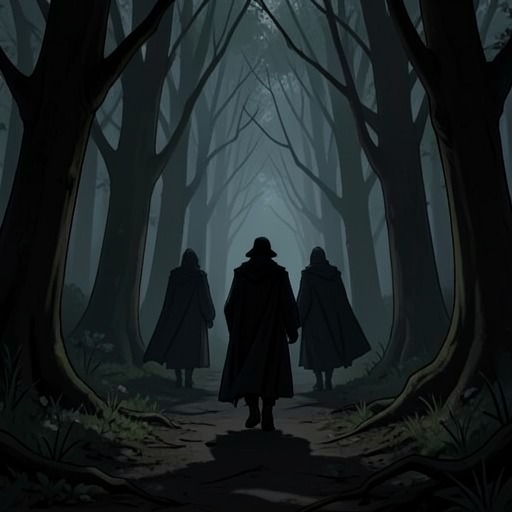
Slupor is a name used by the people who know him, not a disclosed personal name. Jaro tells Tiuri that no one among them knows Slupor’s true identity. He describes a man who can appear as a Red Rider, an ordinary soldier, or a spy, and who may be encountered in many disguises. Slupor is not defined by any stable combination of age, height, or hair color: Jaro says those features cannot reliably distinguish him. His eyes, by contrast, are unmistakable to those who have seen them, seeming false and snake-like.
That description carries the force of shared fear. Jaro says that the others dreaded Slupor and sometimes feared becoming as wicked as he was. He contrasts Slupor with himself: Jaro had turned aside from his orders, whereas Slupor, in Jaro’s account, would have pushed a person back into a ravine after rescuing him from it. The contrast makes Slupor more than a pursuer with a particular assignment; he represents the ruthless limit against which Jaro measures his own capacity for change.
The Pursuit of Tiuri
Slupor’s search for Tiuri emerges through other people’s reports before Tiuri can identify the spy himself. At the Sunset Inn, Leor admits that the Red Riders had asked him to watch for four Grey Knights and their squires, as well as for a young man wearing a fine ring. Leor had been told to warn them if he saw the group. The ring makes the search specific: the Red Riders are not merely seeking an unknown traveler but tracking Tiuri by a visible sign.
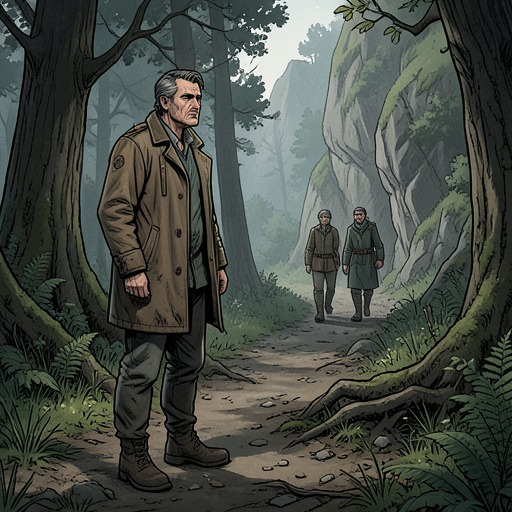
Jaro later explains that another pursuer had been sent after Tiuri and would continue the search, perhaps trying to reach the mountains ahead of him and lie in wait on the far side. Jaro identifies that relentless hunter as Slupor. He also warns that Slupor would not share Jaro’s willingness to spare Tiuri: if Slupor had been the man Tiuri pulled from a ravine, Jaro says, Slupor would have pushed Tiuri in without hesitation. The warning turns the mountains, where Piak is guiding Tiuri, into a place of possible ambush as well as passage. Piak has heard enough to understand the danger and tells Tiuri that Slupor will not catch them in the mountains if he can prevent it.
Disguise, Clues, and the Dead Messenger
The reports from the Rainbow River reveal how Slupor’s disguises can frustrate identification while still leaving a trail of small clues. A stranger crossing the bridge paid three gold pieces, the toll for a first crossing. Later, the stranger asked the toll guard whether a dark-haired, light-eyed youth—perhaps one of two boys—had crossed. He claimed that the young man he sought was a friend from Dangria who was supposed to cross the river with him. His hat was pulled low over his face, its broad brim concealing his features.
The stranger’s manner changed when Warmin mentioned a messenger from Dangria who had arrived the previous evening. According to Imin, the stranger raised his head; seeing his eyes, Imin felt as though he were looking at a snake. The stranger then hurried across the bridge as if pursued. Tiuri recognizes the eyes from Jaro’s description and concludes that the stranger was Slupor. The recognition connects the disguised visitor’s questions to the broader hunt for a young bearer of important news.
Tiuri also infers that Slupor killed the Dangria messenger, whose dark hair and light eyes could have made him a mistaken target, and that the arrow intended for Tiuri killed the clerk instead. In Tiuri’s reconstruction, Slupor then took and read the messenger’s letter, only to discover that it was not the letter he had been seeking. This explanation is presented as Tiuri’s conclusion from the circumstances, rather than as an account Slupor confirms. The episode shows the deadly consequence of pursuing a target through incomplete descriptions: the wrong young man can become a substitute, and the bearer of a message can die before the intended quarry is found.
Capture and the Letter
Slupor’s pursuit ultimately ends in capture at the gate of Unauwen, but captivity does not make him forthcoming. When Tiuri and his companions are brought before the local officer, a knight of Unauwen, the officer says that Slupor has refused to speak and hopes that seeing the young men might prompt him to do so. Slupor is brought in accompanied by two armed guards, but he is neither chained nor bound.
The disguise has changed again. He no longer looks like the old beggar: the gray locks are gone, replaced by short, light-brown hair. Only his eyes identify him. His shock at seeing Tiuri and the others gives way to a cutting performance in which he presents their visit as a celebration of his defeat. He mocks Tiuri’s dangerous journey and reduces the mission to carrying a letter to King Unauwen, asking what it could contain that the king did not already know.
Slupor’s taunt finds an opening because Tiuri does not know the letter’s contents. Earlier, Tiuri broke the last intact seal and read the message, but it was written in a secret code or an unfamiliar language; Unauwen was the only word he recognized. With danger approaching, he tried to memorize the words so the letter itself could be destroyed. He had been ordered to keep the mission secret, and at an inn he likewise concealed the identity of the white-shielded knight who had been murdered by the Red Riders. Slupor’s contempt therefore attacks not only the value of the delivery but Tiuri’s ability to judge what he has carried: the message matters, yet its meaning remains hidden from its bearer.
Narrative Role
Slupor is built through a chain of partial identifications. Leor reports the search for a ring; Jaro supplies the name and the warning; the toll guards recall a disguised stranger and his unnerving eyes; Tiuri joins those clues into an explanation of the messenger’s death; and the prisoner’s altered hair confirms that appearance alone cannot secure recognition. The changing accounts make Slupor’s disguises part of the plot’s information problem: people see him, but only fragments of what they see are reliable.
His capture brings the chase to a temporary close without making him harmless or clearing away uncertainty. He refuses to explain himself, then tries to recast Tiuri’s hard-won delivery as an empty errand. The contrast between Slupor’s certainty and Tiuri’s ignorance sharpens the mission’s central tension: the message’s importance is real, but its contents have not been available to the young man entrusted with it. Slupor’s threat thus survives beyond pursuit. Even in custody, he can attack the confidence on which Tiuri’s work depends.