The Knight's Vigil Rule
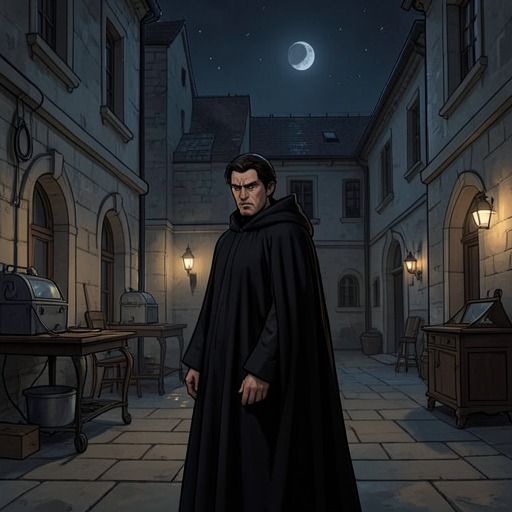
De brief voor de KoningThe Knight's Vigil Rule makes the night before knighthood a test of both discipline and purpose. Candidates must fast and keep silent watch in a chapel, reflecting on the duties they are about to undertake; they must also refuse the call of the outside world. Tiuri breaks that last condition when a voice asks for help. The rule's importance lies in the distinction the story draws between completing a prescribed rite and living up to the ethical obligations the rite is meant to represent.
Purpose and Requirements
The vigil is the final trial before a candidate's formal accolade. In Dagonaut, young people judged worthy are selected once every four years, tested in advance, and bound by rules intended to establish their readiness. For the twenty-four hours before the ceremony, they may neither eat nor drink. They spend the night in a small chapel outside the city walls, dressed in white, with their swords laid before the altar. Kneeling there, they reflect on the task ahead and resolve to serve King Dagonaut faithfully, serve their homeland, act honestly and helpfully, and fight for what is good.
The watch is to last through the night without sleep or conversation. Candidates must also shut themselves off from voices beyond the chapel until seven in the morning, when a delegation of knights comes to escort them before the king. The restriction on listening is therefore not incidental to the fast or the prayer: it defines the test's boundary between the guarded ritual space and whatever may call from beyond it.
Tiuri's Broken Vigil
Tiuri enters the vigil as the youngest of five candidates, at sixteen years old. The ceremonial week promises public recognition and celebration: after the knighting come a cathedral service, a palace meal, a procession through the city, a feast, and later a council and tournament. But before those honors, the candidates must pass the secluded test in the chapel.
Tiuri does not complete it. When an outside voice asks for help, he leaves the vigil rather than ignore the appeal. King Dagonaut later explains that a candidate who will not or cannot keep the rule has broken it and shown that he is not prepared to do everything required to become a knight. By that standard, Tiuri has forfeited the expected knighting. His choice is not presented as a misunderstanding of the requirement; the conflict is precisely between obedience to the vigil and responsiveness to someone in need.
Rule, Worthiness, and Knighthood
The king's judgment makes the rule's formal consequence clear, but Tiuri's subsequent actions complicate what it can measure. He completes the mission and fulfills his promise to Knight Edwinem. King Dagonaut reasons that if Tiuri had ignored the plea, he would have become a knight by completing the vigil; having answered it and carried out the mission, he has demonstrated that he is already one. The king distinguishes the missing accolade from the character the accolade is meant to recognize: Tiuri has not received the expected ceremony, but his conduct has shown him to be a knight.
The king nevertheless performs the formal act, striking Tiuri on the neck with the flat of his sword and naming him Sir Tiuri. He then buckles on Tiuri's sword and presents him with a white shield at King Unauwen's request, marking service to both kings and recalling the knight whose mission Tiuri took over. The ceremony does not erase the broken vigil; it recognizes that the mission arising from that break has supplied a different proof of worthiness.
The Vigil's Return
After the knighting, Tiuri spends another night awake in the chapel. Alone before a candle, he briefly imagines that the events of his journey might have been a dream and that his former companions are still beside him. Instead, he sees that he remains alone and that his white shield hangs above the altar. This later vigil is not another examination for admission to knighthood: it is a moment of reflection after the deeds and recognition that have changed his understanding of the title.
At dawn, Tiuri recognizes that he has become different from the boy who first kept watch there. He considers the trials he has endured and the friends he has made, and promises himself that he will try to be a good knight. The rule thus frames two contrasting nights: the first is interrupted by a call for help, while the later one is completed in reflection. Together they show that the story treats the vigil as a meaningful discipline, but not as the final measure of knighthood.