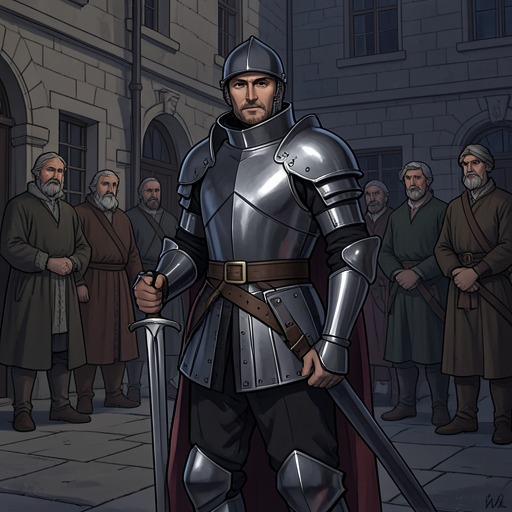
The Knighting Ceremony
De brief voor de KoningThe Knighting Ceremony in the Kingdom of Dagonaut is both a formal passage into the ranks of the king’s knights and a test of whether a candidate deserves that standing. Its rules make the ceremony more than a sword-blow or public celebration: service, honesty, courage, and aid to others are essential qualifications. Tiuri’s story eventually presses that distinction to its limit. He misses the ordinary progression from vigil to investiture, yet King Dagonaut recognizes that the mission he completes has made him a knight in substance before the king names him one.
Qualification and Service
The ceremony belongs to a larger system of responsibility. Dagonaut’s knights help him govern the kingdom and keep order; many hold land in his name and must answer when he calls, bringing their strength and fighting men. Others own no land: young knights may later succeed their fathers, while the Wandering Knights travel through the country offering their service, guarding its borders, and sometimes going beyond them to report what they find. Knighthood therefore confers duties as well as honor, and those duties extend from local rule to the defense and knowledge of the realm.
A candidate must first prove worthy of the accolade through a substantial period of preparation. He serves as a squire to an experienced knight and then spends another year among the king’s fighting men. Skill with weapons matters, as does knowledge of many things, but neither is enough by itself. The candidate must also show loyalty, honesty, helpfulness, and courage. The stated standard is comprehensive: he must be knightly in every respect. The vigil and investiture are the culmination of this assessment, not substitutes for it.
The Vigil Before the Accolade
The final trial begins before the public festivities. For the twenty-four hours preceding the accolade, candidates must fast, taking neither food nor drink. They spend the night awake in a small chapel outside the walls of the City of Dagonaut. Their swords lie before the altar; dressed in white, the candidates kneel and reflect on the task ahead. They resolve to serve Dagonaut faithfully, to serve his kingdom as their homeland, to remain honest and helpful, and to fight for what is good.
The vigil has strict limits. The candidates must keep watch, think, and pray for strength; they may not sleep or speak, and must shut out voices from the world beyond the chapel. At seven in the morning, a delegation of knights comes to lead them before the king. The ritual thus moves from solitary preparation to communal recognition: the candidates first examine the obligations they are accepting, then enter the king’s presence to be received into the order.
The story opens during just such a night. Five young men—Wilmo, Foldo, Jioesipu, Arman, and Tiuri—keep vigil in the chapel before their expected knighting. Tiuri is the youngest, only sixteen. That beginning establishes the ceremony’s rules and expectations before the plot tests them: his vigil will not proceed as planned, and the question of what makes a knight will return after he has faced responsibilities far beyond the chapel.
Public Recognition and Celebration
Every four years, in summer, Dagonaut summons the knights to his city for a seven-day gathering. They report on conditions in different parts of the kingdom and on their own deeds. On Midzomerdag, the young people judged worthy are formally knighted by the king. The investiture is one part of a week that combines royal business, religious observance, public spectacle, and fellowship.
After the accolade comes a service in the cathedral and a meal in the palace. A procession then passes through the city, with the knights in full armor, carrying shields and banners; the new young knights ride at the front. People come from far away to watch. The celebration spreads beyond the palace: a fair fills the market square, music sounds through the streets, and people dance and sing into the night by the light of hundreds of torches. The following day, the newly made knights attend the king’s assembly for the first time; the day after that, they take part in a tournament. The ceremony therefore brings individual achievement into public view and immediately places the new knights among the kingdom’s working fellowship.
Tiuri’s Interrupted Passage
Tiuri’s own path separates the qualification from its expected formal sequence. After he answers a plea for help, completes his mission, and fulfills his promise to Edwinem, Dagonaut explains that Tiuri had misunderstood the king’s earlier suggestion that he would not knight him. Dagonaut had deliberately let him believe it, so that Tiuri would know he would have acted as he did even at a personal cost. The king then identifies the decisive reversal: had Tiuri refused the request for help, he would have been knighted through the ordinary process; by accepting it, he delayed that honor but demonstrated the character it was meant to recognize.
Dagonaut tells Tiuri that, although he has not yet received the accolade, he has shown himself to be a knight and has, in that sense, knighted himself. The king still performs the formal act: Tiuri kneels, Dagonaut strikes his neck with the flat of the sword and calls him a knight, then buckles on his sword and kisses him according to custom. He also gives Tiuri a snow-white shield. At King Unauwen’s request, it signifies that Tiuri will serve Unauwen as well as Dagonaut, and commemorates the knight whose task Tiuri took over. Formal recognition follows proven action, while the shield makes that action part of a wider allegiance.
Meaning and Aftermath
The ending returns Tiuri to the chapel, now keeping a vigil after the adventures that separated him from the other candidates. For a moment, his experiences seem dreamlike: he imagines that his friends are still there and that the voice that began his journey might never have been real. But he is alone, and his white shield hangs above the altar. The image confirms both the reality of what has happened and the change in his status.
Tiuri understands that the person keeping watch now is not the same as the boy who began the vigil many days earlier. He thinks of the people he has met and the friends he has made, regards his experiences as a kind of trial, and promises himself that he will try to be a good knight. He rises only when the first rays of sun make the chapel windows glow. The return to the vigil’s quiet setting gives the ceremony a different conclusion from its public pageantry: knighthood has been conferred, but becoming worthy of it remains an ongoing task.