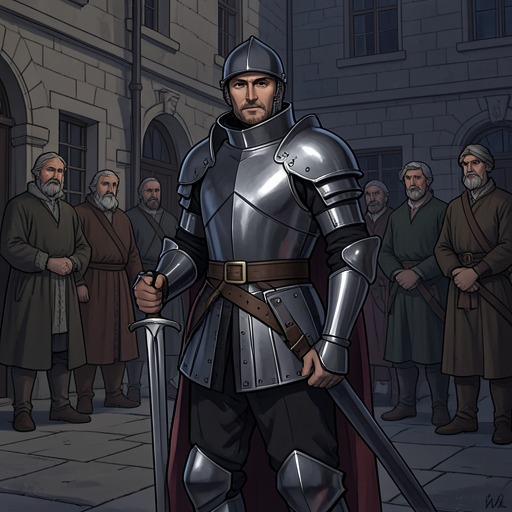
The Vigil Protocol Before Knighthood
De brief voor de KoningThe Vigil Protocol Before Knighthood makes the night before a candidate’s investiture a final test of character, not merely a formal prelude to ceremony. Its requirements demand fasting, wakefulness, silence, prayer, and separation from the outside world; its deeper purpose is to direct the candidate toward a life of loyal service and help. Tiuri’s vigil shows how those rules can be tested against the very duty they are meant to prepare a knight to fulfill.
Requirements and Ritual Setting
In the kingdom of Dagonaut, candidates judged worthy are solemnly knighted by the king on Midzomerdag. Before that public celebration, they must complete a full twenty-four hours without food or drink and spend the night awake in a small chapel outside the city walls. Their swords lie before the altar; dressed in white robes, the candidates kneel and reflect on the task ahead. The vigil is therefore both bodily discipline and inward preparation, joining the candidate’s weapon and future responsibilities within a sacred setting.
The candidates resolve to serve their king faithfully, to serve his realm as their homeland, and to be honest and helpful. They also commit themselves to fighting for what is good. Throughout the night they must keep watch, think, and pray for strength to undertake that work. They may neither sleep nor speak, and must not heed a voice from the outside until a delegation of knights comes to fetch them at seven in the morning and lead them before the king. The closed chapel and the appointed hour give the vigil a clear threshold: until the summons, the candidates are not to leave their attention or allegiance to the world beyond the ritual.
Silence and the Test of the Door
The story opens during this vigil in the small chapel on the hill outside the City of Dagonaut. Five young men—Wilmo, Foldo, Jioesipu, Arman, and Tiuri—are keeping watch; Tiuri, at sixteen, is the youngest. They have locked the chapel door themselves and are not permitted to speak to one another or communicate with anyone outside. Their silence is not simply a ban on conversation: it makes each candidate responsible for holding to the rule without reassurance or discussion.
Tiuri thinks of the approaching knighting ceremony, but turns his attention away from its outward splendor and toward the qualities he must promise to uphold. The five swords wait at the altar beneath the shields. He remembers that his father, Tiuri the Brave, is also a knight, and hopes to become as good a one. He also recalls a story told by Fartumar, whose squire he had been: Fartumar once heard a loud pounding at the chapel door during his own vigil, but he and his three companions did not open it. The apparent disturbance had been a test arranged by a royal servant. This precedent makes the rule’s practical demand unmistakable: even a plausible call must not be allowed to interrupt the watch.
When a quiet knock sounds, the candidates remain still. Later, a voice calls from near the window, “In God's name, open the door!” Tiuri understands that answering would break the rule and could cost him his chance to be knighted. Yet he gets up, moves through the dark chapel, and turns the key. The conflict is not between obedience and careless disobedience: the appeal presents itself as an urgent request for help, exactly the kind of need a knight is expected to answer. The protocol’s silence leaves Tiuri alone with that choice.
A Rule Tested Against Its Purpose
Tiuri’s decision puts the formal test and its ethical purpose in tension. By opening the door, he knowingly forfeits eligibility for the investiture as he understands it. His action is not a misunderstanding of the rule: he explicitly recognizes that he has broken it and believes he must not be knighted the next morning. The ritual’s demand for fidelity is thus tested not by a harmless distraction but by a plea that calls on his compassion and sense of obligation.
The king later explains that he had deliberately allowed Tiuri to believe he would not be knighted, so that Tiuri would understand he had chosen to help even at personal cost. King Dagonaut also clarifies the distinction between receiving the ceremonial accolade and being a knight in conduct. Had Tiuri refused the request, he would have been knighted through the ordinary process; because he answered it, completed his mission, and kept his promise to Edwinem, he had shown himself to be a knight without first receiving that formal recognition. The rule’s apparent failure becomes a measure of its aim: the vigil prepares candidates for service, but the act that demonstrates that service can take precedence over completing the ritual as prescribed.
Ceremony, Recognition, and Return
Tiuri is nevertheless formally knighted. King Dagonaut has him kneel, strikes his neck with the flat of the sword, and declares him a knight. He then belts on Tiuri’s sword, kisses him according to custom, and gives him a white shield. At King Unauwen’s request, the shield signifies that Tiuri will serve Unauwen as well as Dagonaut and remembers the knight whose task Tiuri has taken over. The formal ceremony follows the deed that established Tiuri’s worth, rather than serving as its sole source.
Afterward, Tiuri keeps another night watch in the chapel, now alone, with his white shield hanging above the altar. He recognizes that the ordeal and the people he met along the way have changed him, but also that he stands only at the beginning of his life as a knight. His promise to try to be a good one carries the vigil’s original ideals forward: the ritual’s fast, silence, and separation mattered, yet its final measure is the willingness to serve others when duty becomes immediate.