Tiuri
De brief voor de KoningTiuri is a sixteen-year-old candidate for knighthood whose interrupted vigil becomes the beginning of a perilous mission. He leaves the chapel to answer a plea for help, accepts the dying Edwinem’s charge to deliver a secret letter to King Unauwen, and, in fulfilling that promise, demonstrates the character of a knight before receiving the formal title. His journey turns the ritual he abandons into a test he must live through, then returns him to the chapel changed.
Identity and the interrupted vigil
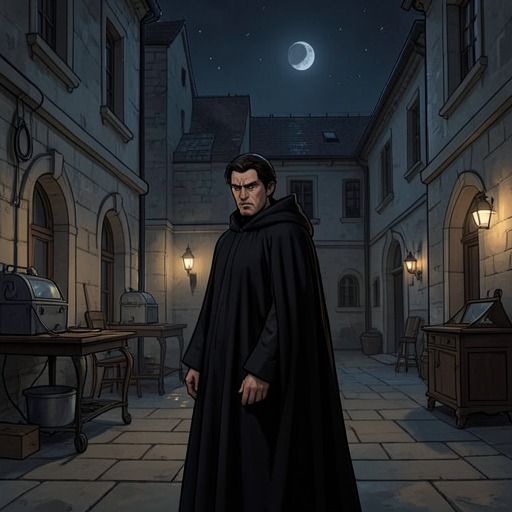
In Dagonaut, candidates for knighthood fast for twenty-four hours and spend the preceding night awake in a small chapel outside the city. Dressed in white, they kneel beside their swords before the altar, reflect on their duties, and promise themselves to serve Dagonaut faithfully, act honestly and helpfully, and fight for what is good. They must neither sleep nor speak, and must shut out voices from the world beyond the chapel until a delegation of knights comes for them at seven in the morning. Tiuri is the youngest of five candidates, and at sixteen he is still on the threshold of the status he hopes to earn.
The story opens with him kneeling on the stone floor and watching the pale candle flame. He is meant to think seriously about a knight’s obligations, but his attention wanders; he wonders whether his companions feel the same difficulty. This ordinary, uncertain beginning matters: Tiuri has not yet acquired a settled understanding of the ideals the vigil asks him to contemplate. When an unknown visitor calls for help and insists that the matter is one of life and death, Tiuri faces those ideals as an immediate choice rather than an exercise in reflection. He breaks the vigil’s silence and opens himself to a duty he did not expect.
Edwinem’s charge and Tiuri’s choice
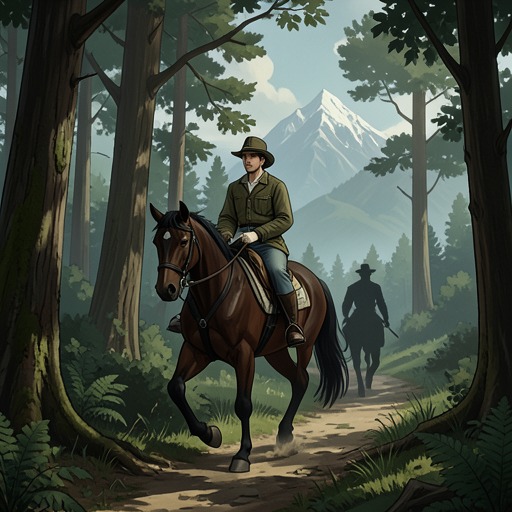
The visitor is Edwinem, a knight carrying a letter of great importance for King Unauwen. Unable to complete the journey himself, Edwinem entrusts it to Tiuri, saying that he trusts him and that no time can be lost. He gives Tiuri his ring as proof for Menaures, a hermit who lives at the source of the Blue River and can help him cross the mountains. The route leads west, first through the forest and then along the river. Edwinem also makes the danger plain: enemies are watching for the letter, Tiuri must keep the mission secret, and he must give the letter only to King Unauwen.
Tiuri accepts, though he knows that leaving the chapel may cost him the knighthood ceremony he has nearly completed. Later, when challenged by Bendoe and Ristridin, he gives a direct account of his actions: he left the chapel, took a horse that was not his, found Edwinem in an ambush, and was present when the knight died. Edwinem told him who had murdered him and gave him the ring. Tiuri says that the Red Riders then tried to kill him, that he escaped, and that he rode west on Edwinem’s horse. He insists that his conscience is clear, while acknowledging that he cannot disclose everything. The account makes the conflict at the center of his story unmistakable: the visible breach of the vigil conceals a choice made in service of another person and of a promise.
A secret carried across the mountains
Tiuri’s duty does not end with carrying the letter. At Menaures’s home, he identifies himself as Tiuri rather than Martijn and presents Edwinem’s ring to establish why he has come. The ring is both evidence of Edwinem’s trust and a practical credential: it allows Menaures to recognize that Tiuri has been sent by the dead knight. When Piak asks how Tiuri came to be travelling on this errand, Tiuri recounts the vigil, the stranger’s appeal, Edwinem’s death, and the mission he accepted. Piak calls him a knight with a task, even though Tiuri doubts whether he will ever be formally made one. Tiuri’s own answer is that he could not have acted otherwise.
The mission requires Tiuri to guard knowledge as carefully as he guards the letter. At the point when he must destroy it, he breaks its last remaining seal and reads it from beginning to end. The writing is in a secret language, or one he does not know; only the word Unauwen is familiar. Since he cannot understand the message, he concentrates on memorizing the words so that the physical letter can disappear. He later tells Piak that he has burned it but knows its contents by heart. Piak does not ask what the message says, despite having helped prevent its loss. The distinction is essential: Tiuri can preserve and deliver the information without possessing the knowledge needed to interpret it.
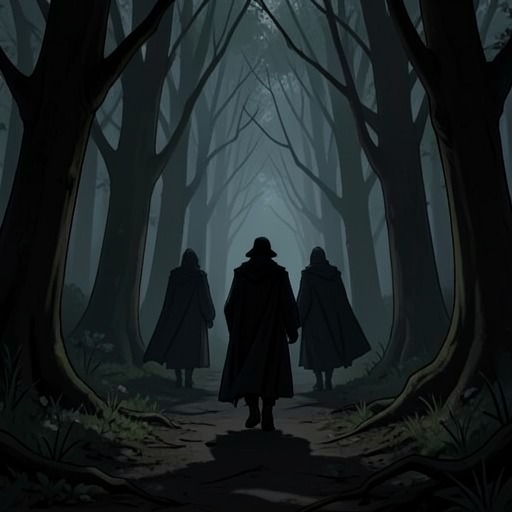
Tiuri’s secrecy is not absolute silence in every circumstance, but a judgment about what the mission permits. At the Rainbow River toll crossing, he tells the toll keeper when and how Edwinem was killed, yet withholds the contents of the letter. He admits that he has already told more than he was supposed to, but trusts the toll keeper because he wears a ring like Edwinem’s. The toll keeper accepts that trust and lets Tiuri and Piak go on. Along the way, Tiuri and Piak wait for the mist to lift before continuing over the Green Ridge; Piak rejects the obvious routes because one ends blindly and the other could reveal their path to a pursuer. Their progress depends on attention, discretion, and mutual reliance as much as on forward movement.
Companions, names, and trust
Tiuri’s relations with other people are shaped by the tension between disclosure and concealment. He cannot tell Bendoe and Ristridin everything, although he tells them enough to defend himself against their suspicions. At a gate, he and Piak give the names Martijn Martijnszoon and Piak Piakszoon, presenting themselves as youths from beyond the mountains who want to see the country. The alias Tiuri rejects at Menaures’s house therefore reappears as part of their cover elsewhere: his identity is something he must reveal to a trusted ally and disguise when the mission requires it.
Tiuri also carries a private sense that Edwinem’s task might more naturally have belonged to Ristridin, Edwinem’s friend and leader of the Grey Knights. During breakfast, Tiuri considers telling Ristridin the truth, but Edwinem had instructed him to speak to no one about the mission. He decides that the promise remains binding even though Edwinem may not have anticipated this particular friend. Tiuri’s restraint is not evidence that he values Ristridin less; rather, he accepts that the mission was entrusted to him and cannot be reassigned simply because someone else seems better suited. His bond with Piak develops differently: Tiuri tells him the story of the mission, and Piak supports the choice that cost Tiuri his expected ceremony. Trust, in Tiuri’s world, is measured both by what someone is given to know and by what they agree not to demand.
Knighthood, return, and narrative significance
When Tiuri returns, King Dagonaut explains that he had deliberately allowed Tiuri to think he might refuse to knight him. The king wanted him to understand that he had chosen to answer the plea for help even at personal cost. Had Tiuri ignored it, he could have become a knight through the expected procedure; instead, by completing Edwinem’s mission and keeping his promise, he has shown that he already is one. The formal act follows that judgment: Tiuri kneels, the king touches his neck with the flat of the sword and names him Knight Tiuri, then buckles on his sword and gives him a snow-white shield. At King Unauwen’s request, the shield marks Tiuri’s service to Unauwen as well as his loyalty to Dagonaut, and recalls the knight whose task he took over.
The ending returns Tiuri to the image with which his story began. He again kneels on the chapel’s stone floor before a candle, and for a moment his experiences seem dreamlike; this time, however, he looks around and finds himself alone. Above the altar hangs his white shield. He recognizes that the Tiuri keeping vigil now is not the boy who began the night many days earlier. The journey has been a trial, and he thinks of the people he met and the friends he made before promising himself that he will try to be a good knight. He remains awake until the first sunlight reaches the chapel windows. Afterward, he walks east toward the City of Dagonaut with Piak beside him and Ardanwen at the reins. The new knight’s story closes not with a claim that his trials are over, but with his recognition that they were a beginning.