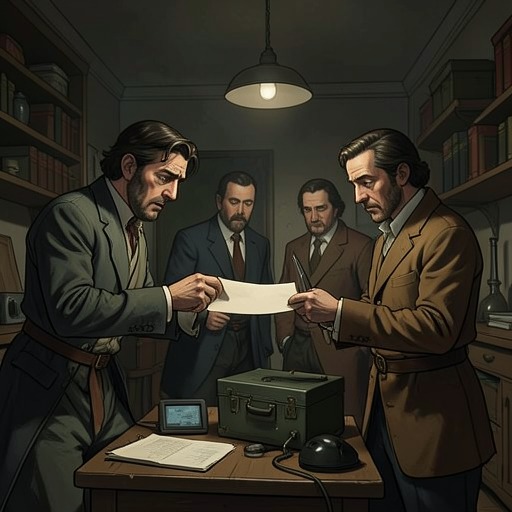
Tiuri Memorizes and Burns the Secret Letter
De brief voor de KoningTiuri Memorizes and Burns the Secret Letter is the moment when Tiuri converts Edwinem's vulnerable parchment into a message held only in memory. Unable to understand the writing, he nevertheless learns it by heart and destroys the document before his pursuers can obtain it. The act protects the message from direct discovery, but does not solve its mystery: afterward, its words remain in Tiuri's head, while he remains a prisoner.
The Letter and the Immediate Stakes
Tiuri prepares to read while expecting that those searching for him will find him. He locks and bars the door through which he entered, then pushes a table against it. A second door opens into a small room with no exits; he leaves that door open. He kneels where he can see both the door and the windows, puts his bow and arrows within reach, and takes out the letter. The precautions make the reading an act performed under immediate threat, not a pause in the pursuit. He is arranging the room to delay entry and watch for danger while dealing with an object that must not fall into enemy hands.
The letter has three seals, but only one remains intact. Tiuri recalls another occasion when he had wanted to read it behind a closed door, then recognizes that the circumstances are different now. He breaks the final seal and unfolds the document. Its condition makes the moment irreversible: this is the last seal, and opening it exposes the message to him, even though it does not yet make that message intelligible.
Reading Without Understanding
Tiuri is so excited that the letters seem to dance before his eyes and at first he cannot make them out. He closes his eyes briefly, looks again, and reads from beginning to end. Yet reading every word does not give him the meaning. The message is in a secret script or a language he does not know. Only one word, Unauwen, is familiar. The one recognizable name offers a point of recognition, but not enough to unlock the letter; Tiuri is left staring at writing whose significance remains beyond his grasp.
That failure changes the task. Tiuri has to preserve a message whose content he cannot explain, and he cannot simply rely on understanding to help him remember it. Footsteps and voices close by startle him into urgency: he must learn the words quickly so the letter itself can disappear. As he works, he listens with half his attention to sounds outside. Someone approaches the door, then moves away. The interruption sharpens the danger without resolving it, and Tiuri returns his full attention to the page.
Memorizing Under Pressure
Tiuri silently mouths the words and, from time to time, closes his eyes to repeat the sentences from memory. He does not know how long he has been at it when he thinks he knows the whole message. Even then, memorizing its sound does not settle whether he has learned it accurately. He wonders whether he also knows the spelling: he may be pronouncing the words wrongly, and he needs to be able to write the message down as well as repeat it. The scene distinguishes possession of the sequence from secure command of it. Tiuri has to retain unfamiliar words without understanding their sense, and is unsure whether his memory will preserve them in a form that can be used later.
Rumbling outside the room interrupts this effort. This time, people try to open the door. Tiuri says nothing. After the sounds at the door and footsteps rapidly recede, he repeats the message once more to assure himself that he really knows it. The final rehearsal gives him a last check before he removes the only written copy. The letter's destruction depends on the confidence he has built through repetition, though the scene does not confirm that he has mastered the message's meaning or spelling.
Burning the Document and Its Aftermath
Tiuri goes to the hearth, where there are logs, and takes out the firestones he had found in Ardanwen's bag and carried with him. He strikes them together to make a fire, then holds the parchment in the flames with a steady hand. He keeps hold of it until the fire almost reaches his fingers. That detail marks the destruction as deliberate and controlled: the letter is not merely abandoned or allowed to burn, but held in the flame until no readable document remains.
After the parchment has burned, Tiuri gathers the ashes, rubs them between his fingers, and blows them away. He extinguishes the fire and sighs. The sequence carries the act beyond destroying the sheet: he reduces what remains to ash and disperses it. The only surviving form of the message is now the set of enigmatic words in his memory. But destroying the letter has not freed him. Tiuri remains trapped, and a voice outside calls for him to open the door. He neither answers nor moves.
Significance
The episode turns safekeeping into a choice between two risks. Keeping the parchment would preserve the message in its original form but leave a physical object the enemy might discover; burning it denies them that document but makes Tiuri's memory its sole repository. His inability to read the letter gives the act its particular tension: he protects information whose meaning he does not know, and must trust repetition in place of comprehension. The one readable word, Unauwen, hints at a connection without disclosing the message itself.
The closing contrast is stark. The letter has vanished, the ashes have been scattered, and Tiuri has repeated the words to himself; yet the danger outside persists and he is still confined. The event therefore secures the message against one immediate threat without resolving either the mystery of its contents or Tiuri's predicament. Preservation and destruction happen together: the paper is gone, but its cryptic words remain with him.