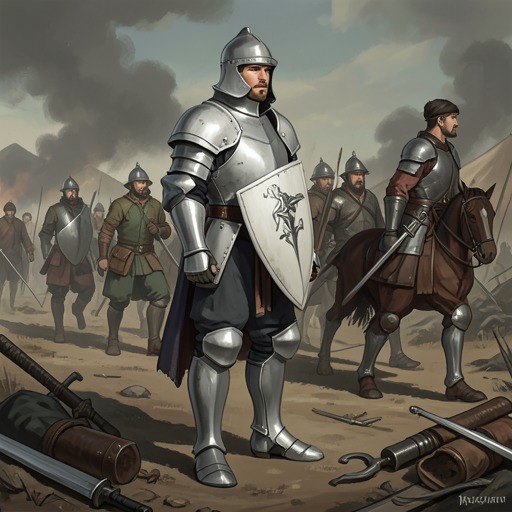
Tiuri's white shield
De brief voor de KoningTiuri's white shield marks the moment when a mission carried out before formal knighthood is recognized as proof that he is already a knight. Dagonaut gives it to him at the ceremony, at the request of King Unauwen, as both a sign of service to Unauwen and a reminder of Edwinem, whose task Tiuri has taken over. Its meaning is therefore at once personal and political: it records the mission Tiuri completed, while setting out the obligations he accepts for the future.
Presentation and investiture
The shield appears at the culmination of Tiuri's formal investiture. After Tiuri kneels, Dagonaut strikes his neck with the flat of the sword and names him Knight Tiuri. The king then buckles the sword around him and kisses him according to custom. Only after these gestures does a servant bring the shield, white as snow. Its arrival completes the ceremony with an object that is not simply part of the display: Dagonaut explicitly connects it to Tiuri's service and to the earlier mission.
That order matters. The king's explanation distinguishes the public sign from the achievement it recognizes. Tiuri has not become worthy through receiving a shield; he has already shown his worth by accepting a request for help, completing his assignment, and keeping his promise to Edwinem. Dagonaut observes that the formal sword-stroke cannot make Tiuri more of a knight than his conduct has already made him. The shield thus accompanies recognition rather than replacing the deeds that earned it.
Allegiance and the knightly vow
Dagonaut presents the white shield at Unauwen's request. It signifies that Tiuri will serve Unauwen as well as Dagonaut, and it keeps Edwinem's inherited task present at the very moment Tiuri enters the order of Dagonaut's knights. The gift makes his allegiance wider than a single ruler: the ceremony still requires a promise of loyalty to Dagonaut, but the shield visibly recalls the second king and the mission undertaken on his behalf.
Tiuri receives the shield and speaks the pledge required of a young knight. He promises to serve Dagonaut faithfully, along with all the king's subjects and anyone who calls on him for help. He undertakes to use his sword only for good against evil and to use his shield to protect those weaker than himself. The object's role is thereby defined through action: it is not only a badge to be carried, but the instrument named in an obligation to defend others. The promise also recalls the principles set out for candidates before their knighting: honesty, helpfulness, loyalty to king and homeland, and a commitment to fight for what is good.
Those principles belong to a demanding ritual, not merely to an idealized speech. Candidates fast for the twenty-four hours before knighting and spend the night awake in a small chapel outside the walls of the City of Dagonaut. Their swords lie before the altar as they kneel in white garments, reflect on the task ahead, and resolve to serve faithfully. They must neither sleep nor speak, and must refuse the distractions of the outside world until a delegation of knights comes for them at seven in the morning. The shield's later association with Tiuri's pledge gives a material counterpart to that earlier preparation: the obligations contemplated in the vigil become public duties accepted in the ceremony.
The shield above the altar
After his investiture, Tiuri leaves the celebratory hall and rides Ardanwen through the quiet streets to the city gate. He returns to the chapel, where he kneels on the stone floor and looks at the candle before him. For a moment, the events seem dreamlike; he imagines that he might look around and find the other candidates beside him again. Instead he is alone, and his white shield hangs above the altar.
The shield's position brings the new object into the place of Tiuri's first ordeal. The chapel had been where he prepared, with the other young men, to receive knighthood; now its stillness gives him room to understand what the journey has changed. The contrast is concrete: the earlier vigil was governed by rules shared with the other candidates, while this later night is Tiuri's alone, and the shield above the altar confirms that what happened beyond the chapel was real. He recognizes himself as different from the youth who began the vigil many days before.
Meaning and narrative role
The shield gathers together three strands of Tiuri's knighthood: tested conduct, formal recognition, and continuing responsibility. Dagonaut's explanation makes the distinction especially clear. Tiuri would have received the title through the ordinary ceremony had he refused the plea for help; instead, he answered it, completed the mission, and honored his promise to Edwinem. The king therefore treats the completed service as the decisive proof of knightly character, while still performing the investiture and presenting the shield.
The crowd's response makes the shield public as well as personal. Those in the hall acclaim Tiuri as the Knight with the White Shield; he bows his head because his eyes are full of tears. Yet the story does not end with the ceremony or with the acclaim. Alone in the chapel, Tiuri thinks of the people he has met, the friends he has made, and the future, and promises himself that he will try to be a good knight. Hanging above the altar, the shield stands at the threshold between achievement and obligation: it commemorates a mission fulfilled, but its association with protection and service points toward the work still ahead.