A burr in my saddle
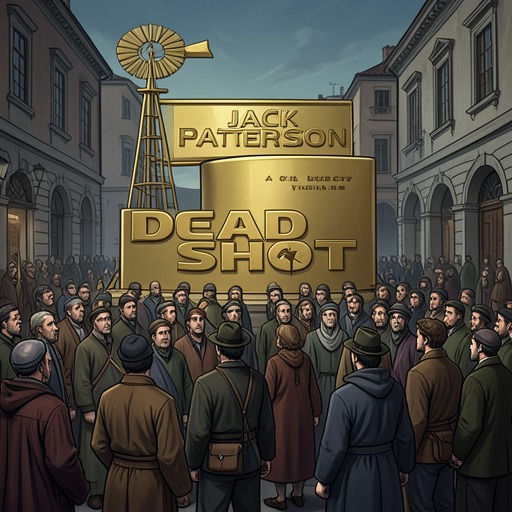
Dead Shot“A burr in my saddle” names a persistent irritation, but the novel makes the expression carry far greater weight than ordinary annoyance. It begins as a metaphor for something that will not stop rubbing against power. By the time Nathan Gold calls Cal Murphy and Kelly Mendoza “the two burrs in my saddle,” the phrase has become an emblem of investigative journalism’s disruptive force and of the violence awaiting those who refuse to leave a protected secret alone.
Definition and First Uses
The image depends on the physical discomfort of a burr caught in a saddle: small enough to seem insignificant, but persistent enough to make movement painful. In the novel’s political and journalistic world, the expression describes an unwanted obstacle that cannot be ignored. A person becomes a burr by continuing to ask questions, pursue evidence, or interfere with an arrangement that depends on silence.
The expression’s underlying logic is visible in the instructions Cal Murphy receives from Guy Thompson. Guy orders him to go to the sheriff’s office, question Sheriff Jones, and report back so they can determine what to do next. The assignment places Cal inside the information struggle that defines Statenville: official accounts are available, but access to the truth is controlled by people with institutional authority. Later, Guy complains that Joseph Mendoza and Hunter Jones claim nobody wants to know anything beyond funeral arrangements and flowers for the dead boys’ families. The question is not merely whether the town is grieving; it is who gets to decide what the public is permitted to know.
Journalism as Irritation and Resistance
The phrase acquires a second meaning through the pressure placed on Cal’s reporting. Guy Thompson orders him to write only a reaction piece, reducing journalism to interviews in which other people’s opinions become the entire story. The assignment crushes Cal’s expectation of producing a major investigative article and demonstrates how editorial power can blunt inquiry without openly banning it. A burr can be removed by force, but it can also be covered over by routine, deadlines, and a safer version of the story.
The same conflict appears in the threatening letter sent to Cal after the attack that introduced him to the hidden forces surrounding the case. The writers call him an important ally while ordering him to keep quiet, invent a cover story, and do his job without asking questions. They promise that later disclosures could place him in the national spotlight, but they also threaten him with “other ways of persuasion” if he refuses. The letter therefore offers fame and danger as paired tools of control. Cal is encouraged to remain useful, but not independent; visible, but not inquisitive.
Cal’s persistence makes the metaphor reciprocal. To the people protecting the town’s secrets, he is an irritation because he keeps converting rumors, deaths, drugs, and evasions into a connected investigation. To Cal, the attempts to stop him become evidence that the story matters. The burr is thus not simply a label applied to a troublesome person. It describes the friction produced when a reporter’s pursuit of truth meets an information system organized around concealment.
Gold’s Threat at Cold River Canyon
The expression reaches its clearest and most dangerous form during the confrontation at Cold River Canyon. Cal Murphy and Kelly Mendoza are brought to the cliff edge in handcuffs after Elliott Mercer’s double-cross. Nathan Gold approaches them with visible confidence, enjoying the fact that the two reporters are restrained and apparently at his mercy. He announces, “At last, the two burrs in my saddle are here with me – and I get to crush them myself.”
Gold’s wording transforms irritation into physical intent. “Crush” is not a figurative extension of editorial frustration; in the immediate circumstances, it is a threat against two trapped people. The saddle image lets Gold present Cal and Kelly as nuisances while the verb exposes the scale of his response. Their supposed offense is asking questions about what killed Gold’s son and doing their jobs, yet Gold treats that inquiry as an intolerable intrusion into his authority.
Cal answers by forcing the metaphor into the open. He asks what Gold means by “burrs in your saddle” and explains that he was trying to determine what killed Gold’s son. Kelly joins him, declaring herself guilty of the same journalistic offense. Their replies reject the shame Gold tries to attach to reporting. The phrase that Gold uses to degrade them becomes a compact statement of their professional purpose: they are troublesome precisely because they refuse to stop investigating.
Gold then broadens the accusation, saying that all reporters are scum and that journalism is among the most debased professions because reporters poke their noses where they should not. His speech reveals the principle behind the metaphor. For Gold, the problem is not that Cal and Kelly have made a mistake in their investigation; the problem is that they have crossed a boundary he believes should protect him. The burr marks the point where private power encounters public scrutiny.
Escalation and Consequences
The canyon confrontation proves that the expression conceals a hierarchy of violence. Gold initially treats the reporters as objects he can humiliate and destroy, while Cal and Kelly pretend to be shocked by Mercer’s betrayal and follow their contingency plan. Their apparent helplessness is part of a struggle over who controls the next version of events. Gold believes he has eliminated the evidence, boasting that he personally destroyed the photographs and the photo card. Cal responds that Gold’s confidence will be his undoing, a warning that the apparent victory is not secure.
Gold’s immediate answer is to draw a handgun and point it at Cal. The action gives the phrase its final literal pressure: the burr is no longer an inconvenience in Gold’s path but a target for elimination. The danger echoes the earlier shooting in which Cal hears a gunshot and feels a bullet tear into his right tricep while Kelly crawls toward him and urges him toward the dock. It also explains why Cal’s pursuit cannot be understood as a harmless professional obsession. His reporting repeatedly places his body in the path of the forces he exposes.
Yet the phrase also carries an intimate countercurrent. While Cal and Kelly flee by motorcycle, Kelly embraces him from the rear seat. Cal’s mind is racing through theories about the deaths, visible drugs, danger, and Elliott Mercer’s connection to their kidnapping, but her embrace briefly interrupts that furious reasoning. Their closeness does not turn the danger into cinematic heroism; the narration explicitly contrasts their situation with an action movie in which music and certainty guarantee a safe ending. Against Gold’s language of crushing obstacles, the moment suggests why the reporters continue: the investigation is dangerous, but it is also shared.
Narrative and Thematic Significance
“A burr in my saddle” links language, information, and power. The novel repeatedly shows authority trying to redirect, narrow, or suppress knowledge: Cal is told to obtain a story from official sources, then told to write a lesser reaction piece; he is ordered through a threatening letter to keep quiet; and the final article appears under his byline in two newspapers the next day. Between those points, the expression names the people who resist the controlled narrative. The burr is the unwanted fact, question, photograph, or reporter that keeps producing friction.
The phrase is especially ironic because Gold regards the reporters as debased while the narrative presents their persistence as the condition of public knowledge. His metaphor attempts to make investigation sound petty and bodily irritating, but its repetition gives the irritation moral force. A burr is not powerful because it is large. It is powerful because it remains present, makes comfort impossible, and cannot be dismissed without acknowledging it.
The expression therefore functions as both threat and accolade. Gold intends it as a justification for violence against Cal Murphy and Kelly Mendoza. Within the larger story, however, it identifies them as agents of exposure. Their questions disturb the settled surface of Statenville, challenge the authority of official explanations, and help move the concealed story toward publication. What Gold wants to crush survives as reporting: the nuisance remains, and the truth travels beyond the people who tried to contain it.