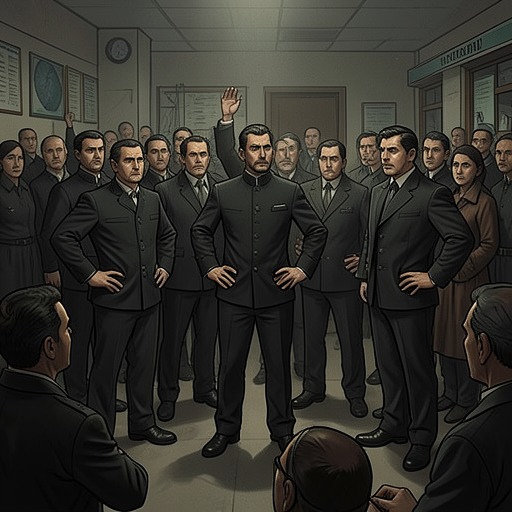
Brooks County Sheriff’s Department
Dead ShotBrooks County Sheriff’s Department is Statenville’s principal local law-enforcement body after the former Statenville Police Department was consolidated with the county sheriff’s organization. Although the merger is presented as an efficient response to economic pressure and a town where most residents obey the law, its enlarged resources and centralized authority also make the department essential to Nathan Gold’s control of the town’s concealed criminal order. Through its sheriff and deputies, the department determines what the public is told, monitors those who ask inconvenient questions, and turns nominal law enforcement into a mechanism for protecting power.
Formation and Institutional Power
The consolidation was the project of Mayor Nathan Gold, who had first assumed office twelve years earlier, when “recession” was rarely part of local, state, or federal decision-making. By the time the policy had operated for more than a decade, Gold was praised by some residents as visionary and criticized by others as controlling. Its practical effects were clear: resources were consolidated, supposedly unnecessary officers were eliminated, and the town gained a city-county law-enforcement department with greater reach. Because Statenville remained prosperous while neighboring communities struggled, few people challenged the arrangement, particularly while Cloverdale Industries was turning the town into a boomtown.
The reorganization also concentrated discretion in the hands of a small group. Hunter Jones, now sheriff, welcomed the additional assets and control. Gold treated that dependence as a political fact rather than a hidden arrangement: Jones owed him everything, and when Gold issued an order, the sheriff’s instinct was to ask where to jump. The department therefore appears both empowered and subordinated—strong enough to control residents and journalists, yet answerable to the mayor who presides over Statenville’s dark secret.
Public Face and Everyday Enforcement
The department’s public face is established in the sheriff’s office, located three storefronts from The Register. When Cal Murphy and Kelly Mendoza arrive after the third suspicious death, Jones sits with his boots on the desk and a toothpick between his teeth, examining the reporters before addressing them as “cub reporters.” The scene makes the office a place where official authority is performed through delay, condescension, and selective disclosure rather than transparent cooperation.
Jones insists that Devin Reid, the son of Jim Reid, died from a simple drug overdose and objects to the reporters’ use of the word “murder.” He acknowledges that methamphetamine was found at all three scenes, but says the toxicology reports will not return from Boise for at least two weeks. This apparently informative answer simultaneously narrows the story and postpones confirmation. The department thus controls not only physical access to crime scenes but also the vocabulary through which deaths can be understood: murder becomes overdose, evidence becomes suspicion, and an unresolved investigation becomes an official explanation.
The same pattern appears at the Reid home. Deputies occupy the property while Elliott Mercer interviews Mr. Reid and Jake Dawkins blocks the reporters’ approach, telling them there is nothing to see and ordering them back to their office. Dawkins is the department’s twelve-year, no-nonsense veteran and its chief deputy, more experienced in Statenville than Mercer despite Mercer’s impressive private-security background. His professionalism is not presented as neutrality. After Cal and Kelly leave, Dawkins speaks into his radio while watching their car, apparently reporting their destination and arranging continued surveillance. Cal’s earlier image of the department as a harmless, small-town force is shaken when Dawkins’s body language reveals an attention far more threatening than his words.
Command Structure and Political Control
The department’s chain of command is formally headed by Jones, but the narrative repeatedly shows Gold directing its operations. Gold enjoys ordering the sheriff around because the department is one of the principal perks of controlling a town and its secrets. Jones privately resents being treated as though Gold himself wore the badge, yet he still accepts the mayor’s authority and calls Dawkins when Gold requires action. The department’s institutional independence is therefore hollow: its personnel retain operational power, but their priorities are set by a civilian political network.
Gold’s control is reinforced by a broader system of concealment. Running Statenville is easy for him because people do what they are told; preserving the town’s secret is harder and requires a complex web of payments, pressure, and violence. When Riley Gold dies after his parents have known for months that he was using drugs, Gold and his inner circle choose to preserve the established explanation rather than confront the consequences. The department’s role in that system is to make the explanation administratively credible and to discourage anyone from testing it.
Suppression, Arrest, and Coercive Practice
The department’s authority becomes openly coercive when it targets Cal Murphy. After Cal receives a threatening letter advising him to keep silent about the previous night’s events and not to tell Kelly or Guy Thompson, Dawkins and Jones greet him in the gravel lot with handcuffs and announce that he is under arrest. The charges—possession of an open container and driving under the influence—are fabricated from Cal’s perspective and are unlikely to survive a real court. Their purpose is not a durable prosecution but an immediate demonstration that the department can convert intimidation into official procedure.
Dawkins books Cal, takes his mug shot, and mocks him throughout the process. Cal has no practical access to a lawyer in a town with few attorneys, and the department places him in a cramped cell normally used for drifters and drunks before serious criminals are transferred to Boise. The arrest changes the meaning of the earlier investigation. Cal had believed he was performing a public service by examining whether someone caused the deaths of three young men; once the department imprisons him on trumped-up charges, he understands that the secret threatens powerful people more than he had realized.
The department also participates in the controlled movement of information beyond the arrest itself. Jones tells reporters that the families want only funeral arrangements and flowers, while Guy Thompson pressures Cal and Kelly to abandon investigative work. In this environment, the sheriff’s department does not need to silence every citizen directly. It can rely on overlapping pressure from the mayor, the newspaper, families, and local officials, with each institution helping define what may safely be asked.
Deputies and the Expansion of the Net
Dawkins’s authority is supported by a hierarchy of deputies capable of turning routine calls into targeted operations. When Jones reports a disturbance at Buddy Walker’s house, Dawkins and rookie deputy Willie Warren respond after eating ribs at Ray-Ray’s. Jones then informs Dawkins that the supposed disturbance is actually the location of Cal Murphy and Kelly Mendoza, now the town’s most wanted fugitives, and that the two reporters are to be arrested on additional fabricated charges.
The operation shows how ordinary police procedure can be repurposed without changing its outward form. Dawkins takes his time leaving the patrol car because he has no reason to believe the situation is dangerous, while Warren circles behind the house to prevent escape. Unfamiliar with the reporters, Warren draws his gun so they will understand that the threat is serious. A disturbance call, a patrol response, a rear approach, and an armed deputy become components of a political search operation. The department’s danger lies not only in spectacular violence but in its ability to make coercion look like routine administration.
Narrative Significance
Brooks County Sheriff’s Department embodies the book’s contrast between Statenville’s prosperous, orderly appearance and the concealed violence sustaining it. Its consolidation is justified by efficiency, reduced waste, and public safety, yet the same concentration of resources enables surveillance, evidence management, selective disclosure, and retaliatory arrests. The department’s personnel exercise street-level discretion—deciding whether deaths are called murders, whether journalists may enter a scene, whether a disturbance warrants armed intervention, and whether weak charges can be used as leverage—but that discretion operates within Gold’s larger system of control.
Its significance extends to the novel’s information economy. The Register’s reporters seek a factual account, while the sheriff’s office supplies partial answers, delays toxicology, redirects public attention, and monitors movement. The department consequently functions as both police organization and gatekeeper of reality. Even the later newspaper story, prepared for publication in two newspapers, stands in opposition to the local institution that tried to prevent the investigation from becoming public. Brooks County Sheriff’s Department is not merely the town’s law-enforcement arm; it is the administrative structure through which Statenville’s “peace” is manufactured and defended.