Cal Murphy
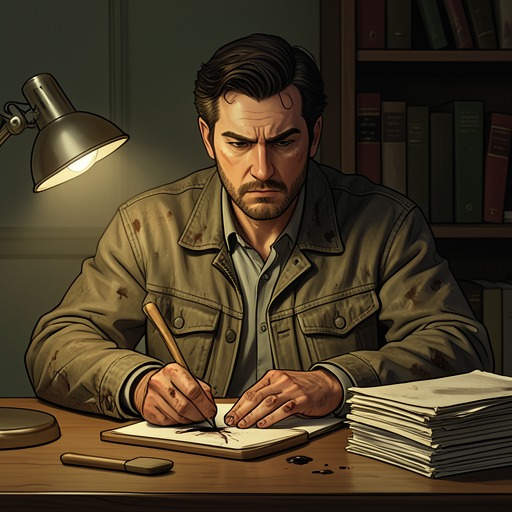
Dead ShotCal Murphy is the general-assignment reporter for The Register in Statenville, Idaho, and the central investigator through whom the novel turns a local mystery into a confrontation with institutional secrecy. He begins as a dissatisfied journalist who has failed to obtain his desired position covering the Mariners for The Seattle Times, but the deaths of three teenage football stars force him to choose between routine employment and the professional purpose he still values. His eventual exposé not only reveals how the deaths were misrepresented but also changes his career, bringing him an offer to become an enterprise reporter on The Times’ sports staff.
Identity and Professional Frustration
Cal is introduced on a Monday morning in the middle of August, reluctantly answering his vibrating iPhone while still in bed. He values the possibility of sleeping late because it is one of the few compensations of working for a newspaper that publishes only once a week, but Josh Moore’s early call destroys that small luxury. The exchange establishes Cal as irritable in the morning, dissatisfied with his circumstances, and close enough to Josh to tolerate—and resent—the interruption.
His dissatisfaction is rooted in professional disappointment rather than simple laziness. Cal had dreamed of covering the Mariners for The Seattle Times, yet the only position he could secure was a general-assignment job at The Register in Statenville. He doubts that anyone could honestly regard reporting from the rural Idaho town as a route to a better career. His friendship with Josh complicates that disappointment: Josh won the single internship in The Times’ sports department straight out of college, defeating more than three dozen applicants and leaving Cal with a jealousy he recognizes but cannot entirely suppress. Cal’s private resentment makes him a rounded rather than purely idealized protagonist; he wants professional recognition, envies the friend who received it, and still remains capable of valuing that friendship.
The Investigation Begins
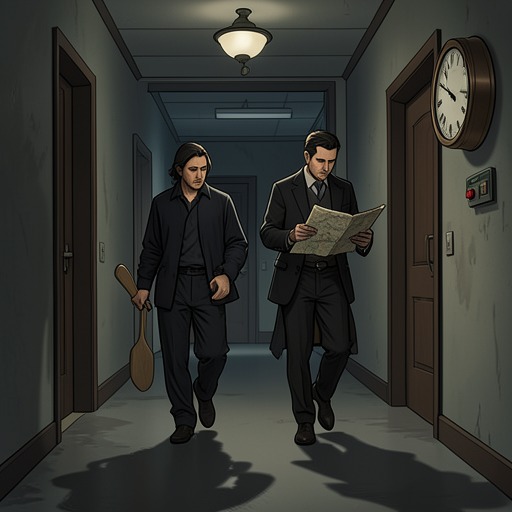
The deaths of three Statenville teenagers alter Cal’s relationship to his work. As he and Kelly Mendoza leave The Register’s back alley in Kelly’s red 2010 Dodge Charger, Cal mentally organizes the sparse facts: three star athletes are dead, and Sheriff Jones claims that all three overdosed. Yet the sheriff appears more intent on concealing information than on confirming the overdose explanation. The immediate value conflict is therefore not merely between a reporter and a difficult police source. It is between an official account that promises closure and physical evidence that refuses to fit it.
Guy Thompson, Cal’s editor, sends him to the sheriff’s office to ask Sheriff Jones for information and orders him to keep Kelly with him so the paper can obtain a dominant photograph for Wednesday’s edition. The assignment shows that Cal’s investigation is initially embedded within ordinary newsroom production, where reporting, photography, deadlines, and visual presentation compete with the search for truth. Guy later redirects Cal toward a reaction piece, a low-level article built from public comments rather than independent reporting. The reassignment crushes Cal because it appears to eliminate the possibility of a Pulitzer-caliber story or even a strong clip for his portfolio. Editorial gatekeeping attempts to convert a disturbing mystery into manageable community reaction.
Cal does not accept that reduction. When Joseph Mendoza and Hunter Jones insist that the town wants only funeral arrangements and information about where to send flowers, Cal questions whether that public mood should be treated as evidence that no deeper story exists. His answer is not immediate certainty; he admits that he does not yet know what he is buying. What he does know is that the publisher and sheriff are pressuring him, and that their anxiety makes the official story less credible rather than more secure.
Physical Evidence and the Fight Over Truth
The body of Cody Murray gives Cal a form of evidence that official language cannot easily neutralize. Kevin Mendoza, examining Cody’s corpse, sees extensive clawlike and scratchlike wounds across the torso, legs, arms, and face. The marks do not resemble an attack by a Mountain lion, despite the rumor circulating through Statenville, but they clearly indicate violent scratching at close range. Kevin is pressured to replace his genuine findings with a false report, and he cancels the victims’ blood-toxicity screens in Boise while retaining the original report for his own investigation.
Cal later picks the lock of the examination-room door and identifies the body by its toe tag: Cody Murray, a football player Cal had interviewed during both football and baseball seasons. The familiar athlete’s face has survived the disfigurement more recognizably than his body, which is barely identifiable. Deep grooves, approximately one to two inches, cross Cody’s upper body; the injuries are not the result of a single casual swipe but of nails gouging repeatedly into the skin. For Cal, the corpse becomes a competing document, one that contradicts the simplified overdose account and the sensational Mountain lion rumor alike.
The forensic evidence also gives the investigation a political dimension. Kevin’s original report records the body’s testimony, while the replacement report is designed for circulation to the Sheriff’s Department and the media. The subsequent cancellation of the toxicology screens removes a potential scientific route to the truth. Cal’s work therefore involves recovering facts that officials have not merely failed to discover but have actively selected, renamed, and withheld.
Threats, Resolve, and Relationships
Cal’s pursuit becomes dangerous when unknown kidnappers send him a warning letter. The letter apologizes for the previous night’s introduction, calls him an important ally, and tells him to keep quiet, create a cover story, and continue doing his job without asking questions. It promises that cooperation may eventually place him in the national spotlight, while warning that refusal will bring other forms of persuasion. The message orders him not to show it to anyone, including Kelly or Guy. The threat attempts to exploit exactly what Cal wants: professional recognition. It offers fame as the reward for silence and danger as the price of independence.
Cal nevertheless decides that the threat confirms the importance of his investigation. After considering the circumstances of a suspicious automobile incident and Jake Dawkins’s questionable account of it, he concludes that an effort may be underway to kill him, disguise an attack as an accident, or hold him temporarily while others suppress the story. He recognizes that the town and the mysterious kidnappers may be concealing different secrets, but instead of retreating he treats the danger as evidence that powerful people have something substantial to lose. His resolve turns journalism from an occupation into a chosen objective: he entered the profession to expose cover-ups, and the present crisis finally gives that principle a concrete test.
Kelly is his investigative partner and the person who remains physically and emotionally closest to him as the danger escalates. Guy’s instruction that she stay with Cal reflects the newsroom’s practical need for photographs, but their partnership develops beyond the assignment. During their flight on the Yamaha VMAX, Kelly embraces Cal from the rear seat. Even while they are running for their lives, the embrace briefly interrupts his frantic theorizing and makes their affection tangible without dissolving the danger into a cinematic fantasy. Cal understands that there will be no convenient Hollywood rescue or assurance that everything will end well; Kelly’s closeness is meaningful precisely because it exists amid uncertainty.
Cal’s loyalty also extends to Guy. After Guy’s death, Cal tells an associate that Guy was an amazing man and insists that his death will not be for nothing. He immediately asks how Gold can be made to confess to murder. The question reveals grief translated into investigative action: Cal does not treat Guy’s death as a private conclusion but as another fact demanding accountability. His relationship with Guy has moved from conflict over assignments and newsroom authority to a moral obligation to complete the work that Guy’s death has left unfinished.
Exposure, Career Change, and Narrative Role
Cal’s understanding of the deaths is finally enlarged by the independent FBI examination reported in his article. The deaths were not caused by meth itself but by markers mixed into the drug. The markers were intended to trigger symptoms resembling a rare disease, alerting the Centers for Disease Control and Prevention and the FBI while allowing undercover agents to track the reach of the drug network. A rogue FBI agent altered the additive so that it became fatal, forcing liver bile into the bloodstream and producing uncontrollable itching beneath the skin. Already high from using meth, the three victims scratched themselves to death. One of them was Riley Gold, the son of Deangelo Gold, whose connection made the cover-up especially consequential.
Cal’s final story records the conflict between this explanation and the public version imposed by local authorities. Residents had been told that the student-athletes overdosed on meth, while law-enforcement officials pressured the coroner’s office to issue falsified reports. Gold and local officials preferred to dismiss the deaths as coincidence rather than draw unwanted attention to Statenville. Cal’s reporting restores causality where the official narrative had supplied coincidence: a drug-marker program, a rogue alteration, a chain of fatal bodily effects, and a deliberate effort to suppress the evidence.
The story appears in two newspapers under the byline “By Calvin J. Murphy” and the line “For The Tribune,” giving Cal public authorship of the investigation and extending its reach beyond The Register. The publication is the material result of his refusal to accept a reaction piece, a falsified report, or a warning letter as the last word. It also resolves the professional tension established at his introduction. Josh presents Cal with an offer to work as an enterprise reporter on The Times’ sports staff, explaining that he had reminded the sports staff of their friendship and of the fact that Josh had beaten Cal for the internship. The sports editor then retrieved Cal’s resume and asked whether he would want the job.
Cal’s arc is therefore both investigative and vocational. He begins by seeing Statenville as a dead end and Josh’s success as a lingering personal wound. He becomes the reporter who refuses to let a town’s preferred story replace the evidence in front of him, even when editors, officials, and anonymous abductors attempt to control what can be printed. His reward is not simply a solved mystery: it is admission to the professional world he had imagined from outside. The offer from The Times does not erase his earlier envy; it demonstrates that his own persistence and reporting have finally produced the recognition he wanted.