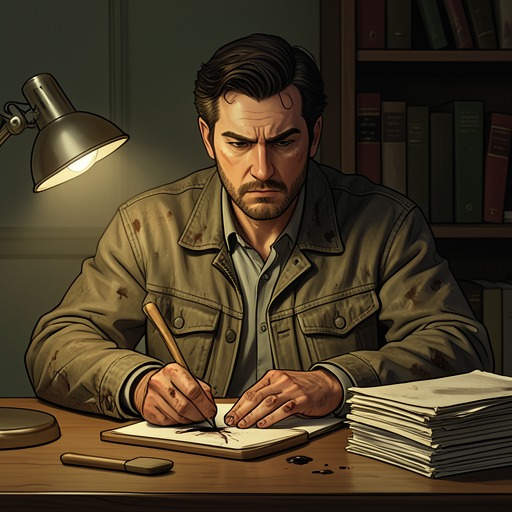
Cal Murphy’s road ambush and kidnapping
Dead ShotCal Murphy’s road ambush and kidnapping is the decisive escalation of his investigation into the deaths of three teenagers. What begins as surveillance on an Idaho road becomes a calculated attack: the black Ford F-250 that has been following Cal rams his Civic, drives it into the woods beside the Snake River, and leaves him vulnerable to abductors who want his reporting stopped. The event changes the value at stake from professional truth-seeking to Cal’s immediate life and freedom, while making clear that the concealed power surrounding the teenagers’ deaths is prepared to use violence rather than argument.
Surveillance and the Ambush
The attack follows a day in which Cal has been absorbed by the possibilities of his investigation and by a planned meeting with Kelly Mendoza. He is driving home through the Idaho farm country at dusk, with his headlights on and his thoughts occupied by the day’s events, when the vehicle that has been following him becomes an active threat. The F-250 does not merely trail him or attempt to intimidate him from a distance; it strikes his car from behind on a winding stretch of road roughly two miles from his apartment.
The first impact jolts both the Civic and Cal forward. When he turns, he sees the truck’s headlights bearing down on the rear of his vehicle, and the truck hits him again. The second collision is more destructive, bringing the truck’s chrome bumper against the Civic’s flimsy metal and sending Cal’s car into a spin. The attack removes every ordinary means of control at once: the steering wheel and brakes can no longer determine where the vehicle goes, and Cal is reduced to bracing for the next blow.
Crash Beside the Snake River
The Civic spins five times before slowing and straightening, only to leave the road and careen down a shallow embankment into a patch of woods by the Snake River. Its descent is rendered as a succession of impacts with the landscape—rocks, trees, a boulder, a shallow stream, bushes, and more rocks—until the vehicle finally strikes an unforgiving obstruction. The physical sequence matters because the crash initially appears to provide a possible escape from the pursuing truck, yet it instead carries Cal into an isolated environment where the attackers can reach him beyond immediate public view.
The wreck leaves the Civic wedged between two pine trees. Steam hisses from its front, mangled metal has replaced a functioning engine, and the headlights become obscure beacons in the dense woods. Cal’s head rests motionless on the airbag, and his body does not move. The damaged car is therefore both evidence of the attack and the first enclosure of his captivity: it stops the assaulting vehicle’s pursuit by stopping Cal himself, while leaving him incapacitated and exposed.
Abduction and Sedation
When Cal regains consciousness, the danger has shifted from a violent road collision to deliberate confinement. He is gagged and bound to a chair with duct tape beneath a solitary light bulb that hangs inches from his face. The dirt floor smells of manure, indicating that he is being held in a farm-related outbuilding rather than in the wrecked car or a conventional detention room. The disorientation is part of the captors’ control: Cal does not know how long he has been unconscious and can only wonder whether an hour, a day, or a week has passed.
His memory reconstructs the transition from crash victim to prisoner. After the airbags deployed, he believed he was physically unharmed and began stepping out of the car. At that moment, two men approached and injected him with a needle. The injection was a sedative, and it explains the missing interval between his apparent survival and his waking bound to the chair. The crash therefore functions as a staged opening to the kidnapping: the attackers use the wreck to disable and isolate him, then rely on chemical incapacitation to complete the abduction.
The Threat Against the Investigation
A masked man questions Cal in a smooth, calm voice, an unsettling contrast to the blunt force used to take him. The questioning confirms that the kidnappers know both his identity and the subject of his work. They warn him to back off from digging into the deaths of the three teenagers, saying that continued investigation will anger powerful people and place both his safety and his life at stake. The threat is not presented as a random demand for silence; it directly connects Cal’s physical danger to the information he is pursuing.
Cal refuses to abandon the inquiry. He recognizes that he is rattling the cage of someone, somewhere, and treats the threat as evidence that his reporting has reached a sensitive point. The masked man counters that Cal will have a lifetime to write about the teenagers’ deaths and should wait a few months before disclosing what he knows. In return for delay, he is promised a reward. This proposed bargain exposes the logic of the opposition: the truth is not denied outright but managed through postponement, intimidation, and the offer of personal advantage.
Consequences and Narrative Significance
The kidnapping makes the investigation inseparable from bodily risk. Before the ambush, Cal’s work could still be understood as a professional pursuit carried out through observation, memory, and reporting. After the truck attack, the hidden structure behind the deaths has shown that it can follow him, engineer a crash, remove him from the road, sedate him, and hold him in an unknown place. His freedom is no longer an assumed condition of inquiry.
The event also creates a sharp contrast between the violence of the method and the composure of the warning. The attackers use a truck, a wreck, duct tape, a gag, and repeated injections, yet the central demand is phrased as a controlled conversation about timing and reward. That contrast suggests an organization seeking to preserve the appearance of order while employing coercion beneath it. The final injection closes the scene by returning Cal to unconsciousness: after the masked man declares the conversation satisfactory, he punctures Cal’s neck with another dose of fast-acting sedative, and Cal’s vision dims before his head droops. The ambush and kidnapping thus end not with resolution but with enforced silence, carrying the investigation into a more dangerous phase in which survival itself becomes a condition of telling the truth.