Cloverdale Industries facility
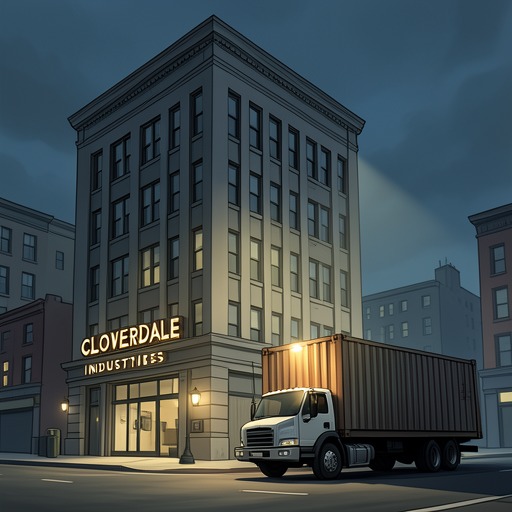
Dead ShotCloverdale Industries facility is the physical center of the novel’s central contradiction: a prosperous, carefully landscaped corporate property that presents ordinary consumer commerce while concealing the manufacture, packaging, and movement of illegal drugs. Its loading docks, wooded perimeter, warehouse, security force, and employee hierarchy transform the facility from a business setting into a controlled zone where corporate secrecy is enforced through surveillance, violence, and planned cover stories. The facility is therefore not merely the site of an investigation; it is the material structure through which Statenville’s prosperity, political power, and criminal economy become visible.
Public Image and Economic Power
Cloverdale Industries facility is designed to make wealth look natural. The company maintains pristine landscaping, investing heavily in the appearance of success because its multi-level marketing business depends on attracting people with the promise of luxury. Its advertised products include organic detergent, household cleaners, liquid magnesium, vitamins, and other apparently respectable goods. That polished surface helps sustain the larger civic story that Cloverdale Industries is Statenville’s major export business and the engine of the town’s boomtown prosperity.
The facility’s economic importance is tied directly to local political authority. Mayor Nathan Gold’s consolidation of the Statenville Police Department with the Brooks County Sheriff’s Department is presented as an efficient response to economic pressure: resources were combined, unnecessary officers were eliminated, and the town retained a comparatively large budget while nearby communities struggled. Cloverdale Industries made that success appear credible. Employment and visible prosperity made Gold seem visionary to some residents, even as the concentration of law-enforcement power also made him controlling. The facility’s public success thus functions as political evidence for Gold’s leadership, while its hidden operation supplies the money that keeps the system intact.
The Facility as a Controlled Space
The property’s southwest corner contains roughly an acre of densely wooded ground, sustained by Cloverdale’s heavy irrigation. The landscaping that advertises abundance therefore also creates concealment. When Cal Murphy and Kelly Mendoza flee across the property, the woods provide cover, but the distance between concealment and exposure remains dangerous: they must reach the corner of an unoccupied loading dock about 200 yards away while armed pursuers search the grounds.
Cal knows the layout because he has covered Cloverdale Industries regularly and has often visited its corporate headquarters for stories. That prior familiarity gives the journalists a narrow tactical advantage, allowing him to direct Kelly toward the loading dock and recognize the most promising route through the property. It does not make the facility safe. When Cal hears the chain-link fence rattle, he realizes that the gunmen have entered the grounds as well. The company’s boundary, normally a sign of private property and organizational order, becomes the line across which the threat follows them.
Inside, the warehouse is unexpectedly sparse. After escaping the sunlight, Cal and Kelly find an open space extending into darkness for at least 300 yards, with stacks of empty wooden pallets along the back wall and a janitor’s closet approximately 30 yards away. Cal’s arm is bleeding, and the closet is close enough to make hiding there preferable to running toward the shelves. The ordinary architectural details of the facility become urgent survival calculations: distance, visibility, cover, and the possibility of a dead end all determine whether the journalists remain alive.
Security and the Shoot-to-Kill Order
Cloverdale security operates less like ordinary corporate protection than like an enforcement arm of the hidden organization. Mel Davis, the head of the company’s security operation, is told that a man and a woman have breached the perimeter and are approaching with hostile intentions. He receives an explicit shoot-to-kill order. The order reveals that the facility treats unauthorized access not as a routine security problem but as a threat warranting lethal force.
Davis is uneasy about the intensity of the security surrounding what appears to be a mid-level marketing company. Whenever he questions the arrangement, managers silence him with the prepared explanation that corporate espionage is real and that proactive protection is necessary. The language of business security supplies a respectable cover for a system designed to protect illegal activity. Davis accepts the orders and continues his work, although he doubts that he could actually pull the trigger if confronted with the supposed corporate spies. His hesitation exposes a moral limit within a structure otherwise built to suppress hesitation.
While Cal and Kelly hide, the facility continues functioning as a commercial warehouse. For more than 30 minutes, they remain motionless as ordinary footsteps approach and recede, forklifts move, and mysterious deliveries are prepared for shipment. The contrast is central to the facility’s menace: commerce does not stop for the intended killing. The warehouse can absorb the possibility of murder without changing its rhythm, treating the movement of product as more urgent than the lives concealed inside the janitor’s closet.
The Warehouse Revelation
Cal’s impatience finally overcomes caution. Pressing his face to the cold concrete floor, he searches for feet beneath the door and sees a stack of boxes only 10 feet away. Without warning Kelly, he leaves the closet, takes a small box bearing the Cloverdale Industries logo, and returns before resecuring the door. He opens it with his house keys, sliding them along the packing tape to keep the investigation as quiet as possible.
The box produces the decisive material revelation. It contains a bottle labeled “Clean and Clear,” but the supposed cleaning liquid has been replaced by white crystals. Kelly identifies the substance as crystal methamphetamine. The packaging is not an accidental disguise or an isolated suspicious container: it demonstrates how Cloverdale’s legitimate product branding can be used to move drugs through the same commercial channels that support the company’s public reputation.
The discovery changes Cal’s understanding of the danger. Before opening the box, he and Kelly know that Cloverdale security is trying to silence them, but the reason remains uncertain. In the closet, Cal hears employees discuss shipments bound for Seattle, Portland, and San Francisco and refer to the contents as “product.” They are instructed to travel discreetly, obey speed limits, and avoid attracting attention. The following command is unmistakable: if the reporters are seen, they are to be shot, after which a team will clean up the scene and create a cover story. Cloverdale Industries is revealed as a distribution network whose routine logistics extend beyond Statenville and whose secrecy depends on coordinated violence and narrative control.
The facility also connects the drug operation to the deaths of Statenville’s young athletes. Rumors had circulated that Cloverdale used cleaning products and vitamins as a cover for drugs, but relatives of employees had dismissed the possibility because the workers appeared to be ordinary people. The warehouse evidence removes that comforting distance. The illegal operation is embedded in familiar labels, ordinary jobs, and the town’s prosperity, making innocence itself part of the cover.
Institutional Network and Consequences
Cloverdale Industries facility is protected by more than walls and armed employees. Nathan Gold’s background checks are designed to ensure that workers understand the secret and fear the consequences of disclosure, including the loss of their paychecks and long federal prison sentences. Yet the system also demonstrates its own vulnerability when Buddy Walker, posing as a basketball coach who needs extra work to support his elderly mother, passes the checks and gains access to every room. Gold believes that his screening process has secured the facility, but the presence of a federal agent inside it exposes the limits of a secrecy system based on purchased loyalty and controlled information.
Gold’s response depends on the broader network he has built around Cloverdale Industries. He has placed local law-enforcement personnel on the company payroll, paying them weekly in cash from laundered money delivered in unmarked envelopes. The facility consequently joins corporate management, municipal government, and law enforcement in one operating structure. Gold can use the police not simply to protect the town but to protect the company’s hidden business, while the company’s money helps preserve the appearance of civic stability.
The facility also becomes the scene where an FBI operation collides with reckless experimentation. Walker and Elliott Mercer have spent five years undercover gathering evidence on Gold’s organization and its interstate drug distribution. Walker, who has a minor in chemistry, revives the idea of placing CPZ markers in drugs so that unusual cases might alert the Centers for Disease Control and Prevention and help trace a dealer’s network. The FBI program had already been abandoned after field tests in Seattle, Los Angeles, and Phoenix produced deaths, and animal testing had shown horrific consequences: monkeys tore at themselves, while dogs scratched and clawed themselves to death. The method was judged theoretically useful but ethically unacceptable for human testing.
Walker ignores that boundary. He first inserts insufficient quantities into drug batches, then chooses a batch found in Riley Gold’s car in the hope of observing Riley and other teammates. He does not adequately consider that the compound may kill its users. The facility’s drug operation therefore becomes the meeting point of two forms of institutional wrongdoing: Cloverdale’s deliberate trafficking and the unauthorized human experimentation carried out by an undercover agent seeking a dramatic result. The branded bottle Cal retrieves is part of the evidence chain that joins the warehouse, the CPZ program, the deaths of the students, and the larger conspiracy.
Narrative Significance
The facility makes Statenville’s governing mythology tangible. Gold and his inner circle justify concealing the town’s secret by claiming that secrecy preserves employment, prosperity, and a future better than economic collapse. Cash payments buy the silence of officials, workers, and intermediaries; violence is reserved for those who cannot be persuaded or purchased. Cloverdale’s grounds embody that arrangement in miniature. The landscaped exterior promises a perfect life, the warehouse moves profitable goods, the security force eliminates intruders, and the hidden product turns the town’s economic success into blood money.
For Cal Murphy and Kelly Mendoza, entering the facility transforms investigation into direct confrontation. Cal’s knowledge of the property helps them navigate the woods and loading docks, but the building’s hidden contents provide the evidence that makes retreat impossible. The warehouse is both archive and trap: it contains the physical proof of the drug operation, yet anyone who removes that proof becomes a target of the organization’s shoot-to-kill policy. By exposing what lies inside a bottle labeled as household cleaner, the facility strips away the distinction between legitimate business and criminal enterprise. Its most important function is not simply to house contraband, but to show how a whole civic order can make criminality look like ordinary prosperity.