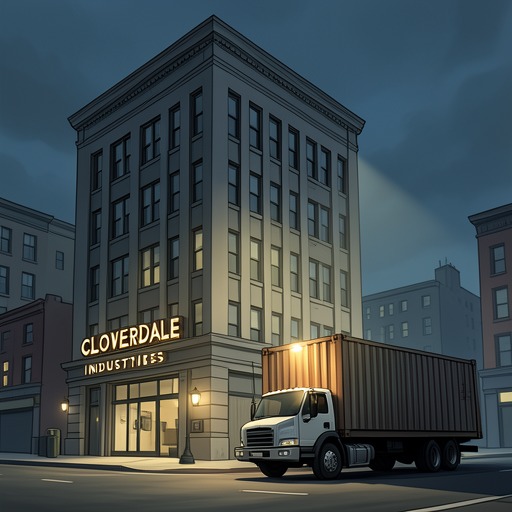
Cloverdale Industries under federal seizure
Dead ShotCloverdale Industries under federal seizure marks the decisive collapse of the company’s protected drug operation. After the investigation connects the facility to the distribution of tainted methamphetamine and to deaths caused by the CPZ marker scheme, FBI officials take control of Cloverdale Industries and shut down its operations pending investigation. The closure is not merely an administrative measure: it publicly reverses the company’s apparent legitimacy and makes its alleged criminal function subject to federal scrutiny.
Causes and Background
The seizure follows the discovery that packages associated with the case concealed crystal methamphetamine. A bottle labeled “Clean and Clear” was found to contain white crystals rather than cleaning fluid, and Kelly identified the substance as crystal meth. That physical evidence linked the investigation’s suspicious deaths to a wider drug network rather than to isolated overdoses.
The deeper mechanism involved CPZ, a chemical marker originally pursued as a way to identify drug users and map substantial dealers’ distribution networks. The proposed system would generate an alert to the Centers for Disease Control and Prevention, allowing the Federal Bureau of Investigation to obtain basic information about the spread of a dealer’s network. Yet the program had already demonstrated a fatal danger: field tests in 2008, conducted by undercover operatives in Seattle, Los Angeles, and Phoenix, involved tainting individual doses, and the users died. The program was consequently disbanded, officially because its results created unacceptable publicity and risk.
That abandoned research was revived outside its ethical limits. FBI agents Buddy Walker and Elliott Mercer had been placed in Statenville under deep cover to gather evidence against Deangelo, later known as Gold, and the Cloverdale Industries network. Walker nevertheless experimented with chemical formulas after learning that professional testing had produced catastrophic results. Monkeys tore at themselves and died, while dogs scratched and clawed themselves to death; officials concluded that the idea could not ethically be tested on humans. Walker’s improvised use of the marker therefore transformed a discarded federal technique into an unauthorized human experiment.
Walker eventually mixed the chemical into drugs found in Riley Gold’s car, reasoning that Riley and other team members who had begun using drugs would provide an observable test group. He failed to account for the possibility that the compound would kill them. The resulting deaths tied the company’s drug supply to a chain of decisions involving covert federal work, reckless experimentation, and the Cloverdale operation’s distribution system.
Federal Takeover and Shutdown
Once the case reached its climax, FBI officials seized control of Cloverdale Industries and suspended the company’s operations until the bureau completed its investigation of the alleged drug-making plant. The wording preserves the procedural status of the action: the facility is treated as an alleged criminal site while the investigation proceeds, but its ability to continue operating is removed immediately.
The shutdown changes the company’s position in the community. Cloverdale Industries had been embedded in Statenville’s public and economic life, while information about its illegal activity was restricted by local authorities, editors, and people connected to its power structure. The federal takeover breaks that local containment. A company once protected by silence becomes an object of official examination, and its physical premises become evidence rather than an unquestioned source of local prosperity.
The closure also carries a geographical consequence beyond Statenville. Cal Murphy’s published account explains that drugs were flowing from Cloverdale Industries into Salt Lake City, and both the Salt Lake City newspaper and The Seattle Times expanded the story’s reach. The facility’s shutdown thus interrupts a network whose effects crossed state lines and places the company within a regional, rather than merely local, investigation.
Consequences for Statenville and The Register
The federal seizure is accompanied by a search for institutional complicity. When Cal Murphy and Kelly Mendoza return to The Register, employees applaud them, but FBI agents are combing the publisher’s office for material connecting Guy Thompson to Gold and Cloverdale Industries. The newspaper that had been expected to print a special edition cannot do so because its own internal structure has been destabilized by the investigation.
Joseph Mendoza is expected to lose control of the paper because of his ties to Gold, while Sammy Mendoza is likely to face jail time. The consequences reach beyond the company itself: Cloverdale Industries’ exposure threatens the local media ownership that helped control what Statenville was allowed to know. The seizure therefore reveals a system in which industrial power, criminal enterprise, law enforcement, and publishing authority had become entangled.
The newsroom is proposed for restructuring. Daniel Richardson offers Kelly the position of publisher and Cal the title of executive editor, suggesting that The Register might become a trusted source of information again. That possible reorganization contrasts sharply with the paper’s earlier suppression of Cal’s investigation. Guy Thompson had ordered Cal to write only a reaction piece, reducing journalism to a safe collection of public responses; earlier, Cal had been sent to the sheriff’s office for usable information while local officials insisted that the three deaths were simple drug overdoses and discouraged broader questions. The federal seizure makes such gatekeeping harder to sustain because the company and the network behind it have become the subject of a public investigation.
Significance
Cloverdale Industries under federal seizure is the material form of the story’s exposure of Statenville’s hidden order. The discovery of meth in a deceptively labeled bottle, the history of the abandoned CPZ research, the deaths in the animal trials, and Walker’s decision to contaminate drugs all show how “facts” were produced through overlapping institutions rather than revealed by one clean investigation. Federal authority finally converts those scattered indications into a case with operational consequences.
At the same time, the seizure does not erase responsibility. The FBI’s undercover operation supplied the setting in which Walker could continue dangerous research, while Walker’s impatience and Mercer’s compromised participation helped cause the deaths that later became evidence against Gold and Cloverdale Industries. The company’s closure is therefore both a law-enforcement victory and the aftermath of institutional failure: the same investigative apparatus that exposes the drug network had previously allowed its own discarded experiment to escape ethical control.
For Cal and Kelly, the shutdown validates the journalistic pursuit that local power tried to redirect or silence. Their reporting appears in two newspapers, and its publication helps connect Cloverdale Industries to the flow of drugs into Salt Lake City. Yet the ending remains unsettled. Cal can imagine rebuilding The Register with Kelly and investigating corrupt politicians and governments together, but he is unsure whether he wants to remain in Statenville. The company’s federal seizure ends Cloverdale Industries’ visible operation, while leaving the survivors to decide whether the town and its newspaper can be rebuilt on a different relationship to truth.