Cloverdale Industries warehouse shooting
Dead ShotThe Cloverdale Industries warehouse shooting transforms Cal Murphy and Kelly Mendoza’s investigation from a dangerous inquiry into an immediate struggle for survival. After entering the facility, Cal is hit in the right arm, the reporters are hunted through the building, and Cloverdale security operates under an explicit shoot-to-kill order. Their narrow escape does more than preserve their lives: it links the company’s secrecy, distribution network, and apparent drug operation to organized violence, while forcing Cal and Kelly to become fugitives from both corporate security and the authorities protecting Statenville’s established order.
Causes and Background
The shooting grows out of Cal and Kelly’s attempt to investigate the deaths of three young men in Statenville. Sheriff Jones insists that Devin Reid and the other victims died from ordinary drug overdoses, even though all three deaths occurred within a twenty-four-hour period. He tells the reporters that methamphetamine was found at each scene, but simultaneously limits the significance of that information by saying that the toxicology reports will not return from Boise for at least two weeks. The official account therefore appears settled before the available evidence can properly support it.
That pattern is not confined to the sheriff’s office. Kevin Mendoza is told that the victims overdosed on drugs even though the toxicology screens have not yet established an overdose as the cause of death, and he is pressured to cancel the tests. Cal’s later arrest follows the same logic of administrative control. He is charged with possession of an open container and driving under the influence, charges he knows will not withstand scrutiny because he had not been drinking or driving with an opened alcoholic container. In Statenville, however, the arrest functions as intimidation rather than as a credible prosecution. Cal recognizes that his pursuit of the deaths has threatened people with enough power to manipulate both evidence and law enforcement.
The warehouse is the physical center of the secret Cal is approaching. Cloverdale Industries presents itself as a company producing cleaning products and vitamins, but Cal and Kelly discover indications that those products may conceal a drug operation. A rumor repeated through local children says that Cloverdale uses its legitimate business as cover for distributing drugs; the rumor is dismissed by people with relatives working for the company, which shows how economic familiarity and civic dependence help protect its public image. The investigation thus moves from suspicious deaths and controlled reports to a place where the hidden enterprise can be seen and touched.
The Shooting and the Hunt
Cal hears the shot and feels the bullet strike his right arm almost simultaneously. The wound sends him sprawling, and the pain in his tricep immediately changes the investigation’s stakes from exposure and proof to life and death. Kelly dives to the ground as well, then crawls toward him on her stomach and urges him toward the dock, only about fifteen yards away. The open bay offers a possible escape, but the gunfire makes clear that the opportunity may close at any moment.
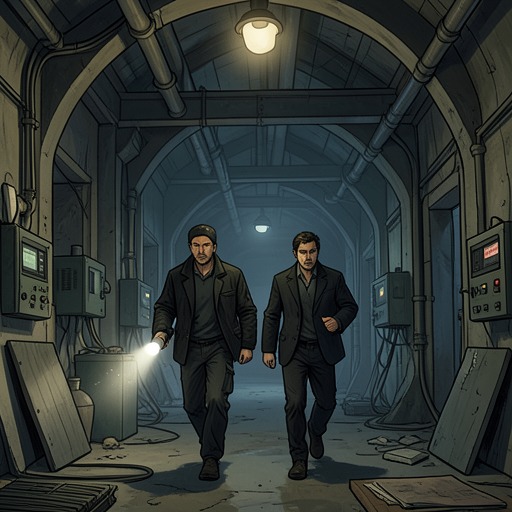
Cal must choose between running toward racks of pallets and hiding on top of a shelf or taking refuge in a janitor’s closet roughly thirty yards away. Because his arm is burning and the closet is close, he chooses concealment. The decision is practical rather than heroic: survival depends on reducing movement, suppressing pain, and making the smallest available space serve as protection. Inside the closet, Cal and Kelly hear presumed security guards racing through the facility. They do not dare speak or even breathe normally, and the unseen search becomes as threatening as the initial bullet.
The danger intensifies when the guards reach the closet. One tests the doorknob, but after noting that the door is locked and that there is no visible blood, he decides that retrieving a key would not be worth the effort. The guards leave, and the footsteps recede from immediate threat to faint sound and finally silence. The escape is therefore produced by a small failure of diligence rather than by the collapse of the security operation. Cal and Kelly remain still even after they can whisper, aware that safety is provisional.
The operation’s intended violence becomes explicit when another group passes nearby. A supervisor warns the workers that reporters have broken into the facility and invokes The Golden Rule, instructing them to follow it that night. The men are then assigned destinations: Seattle, Portland, and San Francisco. Their directions, combined with the warning to keep a low profile and avoid attracting attention to the product, reveal that the facility is not merely guarding trade secrets. It is coordinating the movement of concealed merchandise through a wider network.
Evidence Inside the Facility
When the immediate search has passed, Cal opens a taped box with his house keys. Inside is a bottle labeled Clean and Clear, but it contains white crystals rather than cleaning liquid. Kelly identifies the substance as crystal methamphetamine. The mislabeled bottle is a compact physical expression of Cloverdale’s method: an ordinary consumer product is used as a container for an illicit one, allowing the legitimate company image to travel alongside the concealed drug.
The discovery gives Cal and Kelly evidence more concrete than rumor, incomplete toxicology, or a disputed theory about the three deaths. It also explains why the company’s security is so disproportionate to its public identity. Mel Davis, the head of Cloverdale’s security operation, is told by an executive that a man and a woman have entered the facility with bad intentions. He is ordered to search for them under a shoot-to-kill directive. Davis has previously questioned why a mid-level marketing company needs such heavy security, but managers silence him with the prepared justification that corporate espionage is real and requires proactive protection.
Davis’s response exposes the distance between the language used to authorize the violence and the conduct it actually produces. The order is described as protection against corporate spies, yet the targets are reporters investigating suspicious deaths, and the search takes place in a building containing concealed crystal methamphetamine. Davis accepts the paycheck and follows instructions, although he doubts that he could pull the trigger if directly confronted with the people he has been told to kill. His hesitation does not cancel the danger; it shows how lethal institutional power can depend on ordinary employees carrying out commands they have not fully examined.
Consequences and Significance
The shooting confirms that Cal’s investigation has crossed a boundary that the local authorities and Cloverdale Industries will defend together. Before the warehouse, Cal can still imagine that the deaths might be explained through official evidence and that his arrest is merely an overbearing local tactic. Inside the facility, a bullet, a concealed drug shipment, and a lethal security order align those suspicions. The value of the investigation shifts from uncertain public information to directly witnessed criminal evidence, while the reporters’ freedom becomes increasingly fragile.
The event also clarifies the relationship between Cloverdale’s corporate secrecy and Statenville’s law-enforcement system. Sheriff Jones has already recast suspicious deaths as overdoses, withheld meaningful answers behind procedural delays, and used trumped-up charges against Cal. Cloverdale security now attempts to eliminate the reporters rather than answer them. These actions differ in appearance—bureaucratic suppression, arrest, and armed pursuit—but they produce the same consequence: information is controlled by threatening the people who seek it.
Cal and Kelly’s survival does not resolve the case. Instead, it leaves them hidden in a cramped closet, injured, terrified, and holding the first material proof of the operation. Their fear is not abstract: they hear the words shoot to kill while armed men search only a door away. Yet the same scene that strips away their physical security gives their investigation its strongest foundation. The warehouse shooting is therefore both an assault and a revelation, the moment when Cloverdale Industries’ hidden commerce becomes inseparable from the violence used to preserve it.