Cloverdale exposé
Dead ShotCloverdale exposé is the investigative reporting effort through which Cal Murphy and Kelly Mendoza convert Statenville’s buried drug conspiracy into a public case. What begins with a bottle of “Clean and Clear” filled with white crystals develops into a documented account of chemically tainted crystal methamphetamine, three dead high-school football stars, a falsified overdose narrative, and a federal operation that had itself crossed an ethical boundary. The resulting story gives evidence a route out of the institutions that suppressed it: from Cal and Kelly’s investigation, through photographs and forensic findings, to front pages in Salt Lake City and Seattle.
Assignment, Suppression, and the First Evidence
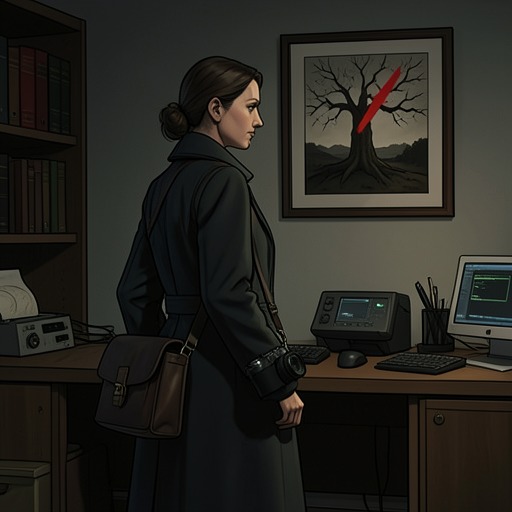
Cal’s investigation develops under pressure from both the newspaper and the town’s power structure. Guy Thompson first orders him to go to the sheriff’s office and ask Sheriff Jones for information, then report back so they can decide what to do next. He insists that Kelly Mendoza remain with Cal and produce a dominant photograph for the Wednesday paper, even if the available image is merely Sheriff Jones looking forlorn. The assignment places journalism inside a compromised information system: the reporter must seek facts from officials who are implicated in controlling the story, while the photographer’s images will help determine what the public is allowed to see.
The pressure intensifies when Guy says that nobody in Statenville wants anything except funeral arrangements and information about where to send flowers to the dead boys’ families. Cal argues that investigating something strange is precisely what reporters are supposed to do, but Guy warns that the publisher and the sheriff are already “crawling all over” him. Later, after Cal and Kelly return to The Register, Guy reassigns Cal to a reaction piece. The assignment reduces reporting to transcribing public responses and crushes the prospect of a substantial investigative article. The exposé therefore begins not as an authorized project but as a struggle over whether the facts can be pursued at all.
The suppression is reinforced by direct intimidation. After an attack, Cal reads a letter addressed to Mr. Murphy that calls him an important ally while ordering him to keep quiet, invent a cover story, and continue his job without asking questions. The writers promise information that could place him in the national spotlight, but threaten other forms of persuasion if he refuses. They specifically demand that he tell neither Kelly nor Guy about the letter or the preceding night’s events. The threat attempts to convert Cal’s ambition into a restraint: the same promise of a nationally important story that later motivates publication is first used as bait to secure silence.
From Tainted Meth to a Scientific Trail
A decisive physical clue appears in a box Cal opens with his house keys. Inside is a bottle labeled “Clean and Clear,” but it contains white crystals rather than cleaning liquid. Kelly identifies the substance as crystal methamphetamine. The object’s deceptive label gives the investigation its central pattern: ordinary appearances are being used to conceal a dangerous process, and the truth must be recovered by testing what official descriptions leave out.
Kelly then photographs the formulas covering the walls of Buddy Walker’s research laboratory, which also functions as an occasional prison. She emails each image to her personal account, preserving the material beyond the immediate scene. Her photographs reveal that Walker had been experimenting with crystal methamphetamine by adding chemicals. When Cal shows Guy photographs taken at the coroner’s office, the images expose the gruesome nature of the teenagers’ deaths. Kelly concludes that if Walker laced Cloverdale crystal methamphetamine with a chemical, the deaths were not accidental. She also insists that the investigators must determine what Walker was adding and stop another shipment from entering the distribution network.
The scientific explanation comes through FBI research into CPZ. The earlier program was intended to use CPZ as a marker in drugs, allowing investigators to identify users and major dealers’ distribution networks. The unusual cases were supposed to alert the Centers for Disease Control and Prevention, after which the Federal Bureau of Investigation could obtain basic information about the reach of a dealer’s network. Field tests in 2008 in Seattle, Los Angeles, and Phoenix involved undercover operatives tainting individual doses; each time, the drug user died. The program was disbanded, although the FBI’s report did not specify the cause of those deaths.
The earlier failures clarify the difference between an investigative marker and a lethal contaminant. Federal officials had judged the program theoretically useful but ethically unacceptable for human testing after animals suffered horrific deaths: Monkeys nearly tore themselves apart, while Dogs scratched and clawed themselves to death. Walker nevertheless believed his minor in chemistry gave him enough knowledge to challenge the bureau’s professional chemists. He eventually inserted the marker chemicals into drug batches, but the amounts were initially too small to track an entire shipment and too difficult to control. The investigation thus uncovers not a simple laboratory accident but a chain in which an abandoned institutional experiment becomes an unauthorized human trial.
Reconstructing the Deaths and the Network
Walker’s most consequential decision was to mix the marker chemical into drugs found in Riley Gold’s car. The coaching staff knew that several players had recently begun using drugs, making Riley an accessible target. Walker expected to observe Riley and other teammates and track the distribution of the marked drugs. He did not anticipate that the compound could kill them, despite Elliott Mercer’s rational warnings. The result was the death of Riley and the deaths of two other local high-school football stars, whose fatalities were initially represented as methamphetamine overdoses.
The exposé places those deaths within the larger Cloverdale Industries operation. FBI officials identify Deangelo as the architect of a drug enterprise extending north to Vancouver, Canada, and east to Denver. Deangelo had remained beyond the FBI’s attention for nearly fifteen years before a known dealer’s body was found in Portland in 2005 with a nineteenth-century gold coin in the victim’s mouth, the signature associated with Deangelo’s alleged murders in Boston. That history explains why the FBI sent two deep-cover agents to Statenville: the goal was not merely to identify the immediate source of the tainted drugs but to build a prosecutable case against Deangelo and Cloverdale Industries.
The local version of the story had been deliberately narrowed. Residents were told that the student-athletes had overdosed on methamphetamine, while local law-enforcement officials pressured the coroner’s office to issue falsified reports. An independent examination by FBI officials on Tuesday changed the meaning of the deaths: the cause was the marker chemicals added to the methamphetamine, not the methamphetamine itself. The markers had been designed to produce what appeared to be the sudden onset of a rare disease, thereby alerting the Centers for Disease Control and Prevention and the Federal Bureau of Investigation. They were never intended to be fatal, and the deep-cover agents were supposed to place them in random drug batches only to trace the operation’s reach.
The reporting also exposes how the conspiracy is sustained beyond the laboratory. Nathan Gold and his wife had known for months that Riley had begun experimenting with drugs, but they ignored it and never expected him to die. Guy Thompson had accepted a monthly brown paper bag containing exactly one hundred twenty-dollar bills in exchange for treating Statenville as a peaceful town and refusing to pursue its secret. Nathan Gold could direct city affairs because people obeyed him, while concealment required a more intricate web of paid participants, suppressed grief, falsified records, and occasional bloodshed. The investigation’s achievement is therefore structural: it connects the bottle, the formulas, the deaths, the coroner’s reports, the drug routes, and the people who benefited from keeping them separate.
Turning Evidence into Publication
Once the evidence is assembled, Cal and Kelly’s work requires a second investigation into how to publish it safely and effectively. Guy tells Cal to write the story, combine it with Kelly’s best photographs, and send the package to The Salt Lake Tribune and The Seattle Times. He promises that the editors will receive the work because he has vouched for Cal’s trustworthiness. The route matters: The Register has become too vulnerable to local pressure, so the story must travel beyond Statenville’s gatekeepers before it can return as a public fact.
Cal’s article appears in both newspapers under the byline “By Calvin J. Murphy.” Its account explains that the FBI deployed two agents to Statenville to work undercover against Deangelo and Cloverdale Industries, but that the plan went awry when the first of three local high-school football stars was found dead on Sunday evening. It records the official overdose story, the falsified autopsy reports, and the Tuesday FBI examination that identified the fatal markers. By placing the federal explanation beside the local cover-up, the article makes the contradiction itself evidence.
Kelly’s photojournalism gives the written investigation a visual counterpart. Her images capture the people and places involved, strengthening the article’s front-page impact in both cities. The publication consequently does more than announce an accusation: it makes the conspiracy legible through names, locations, bodies, laboratory traces, institutional actions, and photographs. The story’s authority comes from the convergence of these forms rather than from a single anonymous assertion.
Consequences and Significance
The exposé produces immediate institutional consequences. Federal officials seize control of Cloverdale Industries and shut down its operations while the investigation continues. Cal’s reporting also reveals that drugs from Cloverdale Industries were flowing into Salt Lake City, giving the story regional significance rather than leaving it as an isolated account of corruption in a small Idaho town. The Seattle newspaper follows the same connection, allowing the investigation to travel along the same geographic routes as the drug network it describes.
The publication changes the position of its reporters as well. Dave Youngman praises Cal and Kelly’s work and offers both former Register employees jobs. Their reporting has crossed the boundary between local reaction piece and nationally consequential investigation, but the offer arrives after three days of sustained danger and adrenaline, when both are exhausted and promise only to consider it. Their achievement is therefore not simply professional advancement. It is the recovery of journalism’s investigative function from editorial intimidation, official concealment, and a scientific program whose evidence-making apparatus had been turned against the people it was supposed to protect.
Cloverdale exposé ultimately exposes two linked systems of control. The first is the drug operation, organized through production, distribution, money, and violence. The second is the information system that makes the operation appear to be a series of accidental overdoses, private tragedies, or facts too dangerous to print. Cal and Kelly break that system by preserving material evidence, questioning the official account, tracing the chemistry, using images as corroboration, and publishing outside the reach of Statenville’s authorities. The decisive revelation is not only that Cloverdale’s drugs were tainted, but that the town’s version of reality depended on deciding in advance which evidence would be allowed to exist.