Cody Murray
Dead ShotCody Murray is Statenville’s greatest football star in fifty years, a six-foot scrambling quarterback whose athletic promise makes his death both a personal tragedy and the opening symptom of Statenville’s larger drug conspiracy. His story links the town’s sports culture, the pressure to convert physical ability into a future beyond rural Idaho, and the institutional decision to conceal how he died. What begins as a private pursuit of a little extra energy becomes a grotesque death that authorities misrepresent, while the truth eventually gives Cody the posthumous recognition that the town had denied him.
Identity and Athletic Promise
Cody is introduced at home on a Sunday afternoon, trying unsuccessfully to relax with his favorite sports magazine. Stillness does not suit him: he lives as he plays, in constant motion, and his imagination is fixed on athletic achievement. He dreams of appearing on the magazine’s cover, a seemingly improbable ambition for a six-foot quarterback on a rural Idaho eight-man team, yet his performance has already earned him several major scholarship offers. His physical stature and mobility distinguish him in a small-school football environment where even assembling a full roster is difficult, and his projected future gives his death an importance beyond the immediate grief of his family and teammates.
Cody’s opportunities are specific rather than merely aspirational. Later accounts state that he had received offers from Eastern Washington and Boise State, while Oregon State and Washington were rumored to be interested in him. Coach Miller tells Cal Murphy and Kelly Mendoza that Cody had a good chance to start at Washington State the following year. The range of schools attached to Cody’s name shows how close he was to leaving Statenville through football, making his death the destruction of a plausible future rather than the end of an undefined dream.
Drug Use and the Death Scene
Cody understands that steroids are dangerous and difficult to obtain in a rural town, so he does not use them. Instead, he seeks what he regards as a smaller, more manageable aid: a little help and a little kick during workouts. At first he treats the substance as harmless, but the narrative notes that he has recently begun using it more casually, sometimes for pleasure rather than strictly for training. This shift matters because it shows his risk becoming normalized before the fatal crisis begins; the boundary between performance enhancement and recreational use has already weakened.
The catastrophe arrives through the body before Cody can reason about it. A slight itch above his elbow rapidly becomes an eruption of red welts across his arms, chest, and back. In less than a minute his muscular body is covered. He leaps from the deck, runs twenty yards to an Aspen tree, digs his fingernails into his chest, and rubs his back against the trunk, but the attempt intensifies the irritation. He tears off his Statenville workout shirt, empties a tube of anti-itch cream over his chest and back, and still finds no relief. The sequence turns the athletic body—normally an instrument of speed, strength, and aspiration—into the immediate site of uncontrollable suffering.
Cody then runs outside again, falls onto the grass, and scratches both forearms while rolling and crying out. The itching feels like fire on the surface of his body. His efforts are futile, but he refuses to stop trying to obtain relief. By the end, his body is covered with bleeding welts. After one final convulsion, the itching stops because his breathing stops as well. The blood across his chest and the body lying in the Idaho sun produce an image so violent that the narrator observes that no one would believe Statenville’s premier football star had scratched himself to death. The scene establishes the central contradiction of Cody’s death: the evidence is physically unmistakable, yet the explanation is so grotesque that it invites disbelief and concealment.
Misreading and Institutional Silence
Cody’s death is initially folded into the deaths of Devin Reid and Riley Gold, the other two local high-school football stars who die within the same twenty-four-hour period. The town is told that the student-athletes overdosed on meth, and local law-enforcement officials pressure the coroner’s office to release falsified reports. That official story reduces three distinctive deaths to a familiar explanation and prevents the public from asking why the victims’ symptoms and injuries were so unusual.
The sports culture around Cody helps make the false account believable. Coach Miller says that promising athletes use drugs, while parents and the wider town appear unwilling to care. He recalls warning Cody’s father that Cody might be using drugs and receiving laughter in response; Cody’s father reportedly treated any substance that helped his son get ahead as acceptable. Miller also explains that meth seemed useful to an athlete because it provided energy for longer workouts, while college coaches were perceived as caring more about how an athlete looked getting off the bus than about whether he was intelligent. Cody’s death therefore emerges from more than an individual decision. It is connected to a setting in which physical appearance, endurance, and the hope of athletic escape can outweigh caution, education, and honest intervention.
The cover story also serves Statenville’s interests. Local authorities and Carmen Deangelo, the town’s mayor and the concealed architect of the Cloverdale Industries drug operation, do not want attention drawn to the deaths. The town’s prosperity and public image depend on suppressing information that might expose its criminal economy. Cody’s death is consequently transformed from a warning into a piece of civic damage control: the more ordinary the official explanation, the less likely outsiders are to investigate the conditions that produced it.
The Hidden Cause and Broader Conspiracy
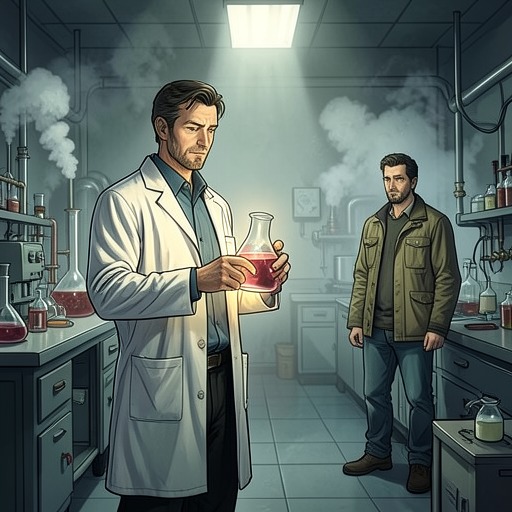
The later FBI account radically changes the meaning of Cody’s death. Federal agents had placed a marker in random batches of drugs so that the spread of the operation could be tracked. The marker was intended to produce symptoms resembling the sudden onset of a rare disease, thereby alerting the Centers for Disease Control and Prevention and then the Federal Bureau of Investigation; it was not supposed to kill anyone. An FBI deep-cover operation in Statenville had already been designed to build a case against Deangelo and Cloverdale Industries, but the deaths of the football stars disrupted that plan.
A rogue FBI agent engineered the additive to have a deadly effect by forcing liver bile rapidly into the bloodstream. The result was uncontrollable itching beneath the skin. Because the victims were already high on methamphetamine, all three scratched themselves to death. Cody’s frantic movements, bleeding welts, and sudden collapse thus become retrospectively legible as the effects of a deliberately corrupted marker rather than a simple overdose. The discovery does not erase Cody’s drug use or his vulnerability to the town’s athletic pressures, but it establishes that his death was also the product of an intentional alteration within the federal operation.
Riley Gold’s identity adds another layer to the conspiracy: one of the three victims is the son of Nathan Gold, whose interests are tied to Statenville’s corrupt power structure. The deaths are therefore not random tragedies in the final account. They expose the collision between a federal tracking strategy, a rogue agent’s lethal intervention, Deangelo’s criminal network, and a local system determined to dismiss the victims as casualties of their own bad choices.
Legacy and Posthumous Recognition
Cody remains present after his death through the investigation conducted by Cal Murphy and Kelly Mendoza and through the story Cal eventually publishes in two newspapers. Cal later accepts a radio invitation from the Mitch in the Morning show on 950-AM KJR in Seattle specifically because it offers the opportunity to discuss Cody’s death from a sports angle. He had wanted to tell the story of an outstanding quarterback whose future was unexpectedly large for an eight-man player, and the broadcast finally gives him a venue to celebrate Cody rather than let the conspiracy consume his identity.
An email to Cal also thanks him for finding out the truth about Cody, Devin, and Riley. Its writer says that the boys deserved the truth to be known even though their own senseless actions had contributed to the way they died, and imagines that the few people who love Statenville for what it was will grieve them. This response preserves the complexity of Cody’s legacy. He is neither reduced to an innocent symbol untouched by drugs nor condemned as merely responsible for his own death. He is remembered as a talented young athlete whose choices, ambitions, family environment, local culture, and the hidden violence of the drug-marker operation converged in one fatal event. The final public recognition of Cody’s promise restores the future that his death had abruptly taken away, even though it cannot restore Cody himself.