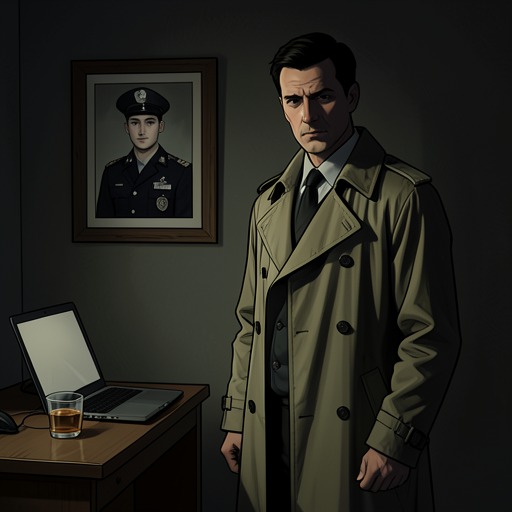
FBI Statenville undercover operation
Dead ShotThe FBI Statenville undercover operation is the federal investigation that infiltrates Statenville and Cloverdale Industries through Buddy Walker and Elliott Mercer, who pose as ordinary residents while gathering prosecutable evidence against Nathan Gold and the wider network supporting his drug business. The operation begins as a patient effort to penetrate an insulated criminal system and ends by exposing its reach, its political protection, and the disastrous CPZ marker experiment that killed three young athletes.
Origins and Target
The operation grows out of the FBI’s pursuit of Nathan Gold, whose former identity was Carmen Deangelo. While working in Boston as a captain for the Scarelli family, Deangelo was associated with more than a dozen murders marked by a distinctive nineteenth-century gold coin placed in each victim’s mouth. The FBI assumed for roughly twelve years that he had disappeared or been killed, but the signature resurfaced in Portland when the nineteen-year-old son of Senator Tom Brazenworth was murdered. That victim was not a rival mob member, making the case too prominent to dismiss, and investigators traced the signature back to Deangelo’s new identity in Statenville.
Rumors then connected the town to an industrial-scale drug operation whose products moved through the Pacific Northwest, as far north as Vancouver, Canada, and east as far as Denver. Statenville’s apparent ordinariness helped protect it: most federal personnel in the Salt Lake field office barely knew where it was, and its public reputation centered on agricultural life, drunk-driving arrests, and occasional meth labs rather than commercial drug production. Once the FBI confirmed that Deangelo was living as Gold, it selected Statenville as the site for a deep-cover investigation into both the Cloverdale Industries operation and the people who sold and transported its drugs across state lines.
Infiltration and Evidence Gathering
Buddy Walker and Elliott Mercer entered Statenville with carefully manufactured identities, impeccable apparent résumés, and backgrounds vetted by the FBI. Their files even contained a few minor encounters with the law so that Nathan Gold would not find them unnaturally clean. The deception worked because Gold enforced rigorous background checks and believed that every Cloverdale employee understood the organization’s protected secret. Walker, presented as an innocent basketball coach who needed extra work to support his elderly mother, passed scrutiny without raising suspicion.
The two agents spent five years accumulating information about the location and movements of Cloverdale Industries. The operation was not designed merely to arrest Gold. The FBI wanted a case against the entire network, including the people who distributed Cloverdale’s drugs on city streets and carried them across state boundaries. That objective explains the investigation’s deliberate pace and its emphasis on evidence rather than rumor. It also made the agents dependent on continued access to a town whose institutions, employees, and paid enforcers were organized to prevent outsiders from learning how the system worked.
Elliott Mercer advanced the operation by manipulating the search for Walker after Walker became endangered. He supplied a misleading tip that sent the search party across the county and then learned the procedures of the Statenville Sheriff’s Department, including its response to a major security breach. After passing a deliberately designed trust test, Mercer gained access to increasingly sensitive information and eventually learned the central secret of Statenville. He and Walker concluded that the town’s leaders were functioning as a mob-like drug organization and resolved to expose it rather than allow Cloverdale Industries to remain the Pacific Northwest’s dominant supplier.
The Marker Program and Its Ethical Collapse
The investigation becomes entangled with CPZ, a chemical marker once considered for use in tracing drug distribution. The proposed federal program would place CPZ in selected drug doses so that unusual medical cases could alert the Centers for Disease Control and Prevention, allowing the FBI to gather information about the geographic spread of a dealer’s network. Field tests in Seattle, Los Angeles, and Phoenix in 2008 ended after the tainted users died, and the program was officially abandoned.
The earlier research also carried a warning that the agents did not adequately respect. Animals subjected to the chemical suffered extreme reactions: monkeys nearly tore themselves apart, while dogs scratched and clawed themselves to death. Officials judged the method theoretically useful but ethically unacceptable for human testing. Walker nevertheless believed his chemistry training gave him enough understanding to improve on the bureau’s conclusion. He persuaded Mercer to let him insert chemical markers into Cloverdale drug batches, even after Mercer warned him about the risks.
The first attempts were ineffective because Walker used too little chemical to trace an entire shipment or trigger the desired alert. He then found a batch of drugs in Riley Gold’s car and treated it as a more controllable opportunity. Knowing that several members of Riley’s basketball team had begun using drugs, Walker selected Riley as an easy observation point and expected to track him and other teammates. He failed to account for the possibility that his compound could kill them. The result was the death of three Statenville high-school football stars, whose deaths were publicly described as meth overdoses even though the marker, rather than methamphetamine itself, caused the fatal reactions.
Exposure, Breakdown, and Aftermath
The deaths brought the undercover operation into direct conflict with Statenville’s protective machinery. Nathan Gold controlled the town through obedience, money, and fear, while local officials helped preserve the appearance of accidental overdose. The FBI’s investigation eventually established that the coroner’s office had been pressured to issue falsified reports. Independent examination later identified the chemical markers as the actual cause of death and clarified that the intended marker was supposed to produce an apparent rare disease and an investigative alert, not fatal poisoning.
Walker’s impatience damaged the operation at precisely the moment when it needed discipline. His attempt to create an unmistakable federal signal turned an intelligence-gathering technique into an unauthorized human experiment, and the resulting deaths threatened both the victims’ families and the agents’ cover. Mercer, who had participated in the marker work, became the surviving source of incriminating information about Gold and the only living person who had played a role in the death of Gold’s son. He tried to distance himself from Walker and sought Cal Murphy’s help in shaping the public account so that Mercer would appear as a hero rather than as a participant in the wrongdoing.
The operation finally reaches its violent climax in the FBI’s covert attempt to obtain a confession from Gold. Gold killed Elliott Mercer with two gunshots and pushed him from a cliff into Cold River Canyon. Rather than face charges, Gold then plunged into the canyon himself. The federal investigation nevertheless achieved its central institutional result: FBI officials seized control of Cloverdale Industries and shut down its operations while the bureau continued investigating the alleged drug-making plant. Through the subsequent reporting by Cal Murphy and Kelly Mendoza, the operation also connected Statenville’s hidden drug economy to distribution in Salt Lake City and to a broader regional network.
Significance
The FBI Statenville undercover operation exposes a criminal structure that survives not because it is invisible, but because local prosperity, institutional silence, and purchased loyalty make its visibility seem harmless. Gold pays people to preserve the town’s sleepy image, and even Guy Thompson accepts regular brown paper bags containing one hundred twenty-dollar bills in exchange for not investigating Statenville’s secret. The federal operation therefore confronts more than a single drug manufacturer: it confronts a social system in which employment, public order, law enforcement, and civic pride have been made dependent on concealment.
Its moral significance is deliberately unstable. The FBI enters the town to gather evidence and dismantle a criminal network, yet one of its own agents revives a discontinued chemical program and places civilians at lethal risk. The operation reveals the truth about Gold and Cloverdale Industries, but it also reveals how easily an investigative purpose can be corrupted by institutional ambition, impatience, and the desire for an “epic headline.” Its final achievement is consequently double-edged: the conspiracy is exposed and Cloverdale Industries is shut down, but the evidence is inseparable from the deaths caused by the methods used to obtain it.