Ford F-250
Dead ShotThe Ford F-250 is more than transportation in the novel: it is a recurring material sign of pursuit, coercion, and organized concealment. Its black body, powerful engine, pickup bed, toolbox, tarp, and rope make it both an ordinary rural work truck and a portable apparatus of violence. Across several decisive scenes, the vehicle links the open roads and remote canyons around Statenville to the hidden operations of the town’s corrupt power structure.
Appearance and Spatial Context
The Ford F-250 enters a landscape where distance protects wrongdoing. The Reid house stands on a ridge overlooking the Snake River, reached by a long dirt driveway, while Devil’s Canyon spreads into rolling dirt hills, caves, and rough ground where four-wheeled vehicles struggle. In that setting, the truck belongs to the same material world as dirt roads, livestock property, and isolated back-country routes. Its usefulness depends on the terrain: it can move through spaces that are difficult to monitor, carry people and equipment beyond public view, and approach remote locations without attracting the institutional attention that a marked law-enforcement vehicle would bring.
The truck’s repeated movement also makes geography part of the plot. At Devil’s Canyon, Cal Murphy relies on his dirt-bike skills because ordinary vehicles have difficulty crossing the terrain, and the canyon’s caves offer concealment. By contrast, the Ford F-250 can bring Yukon Grant toward secluded roads and later carry captives away from public sight. The vehicle therefore connects spaces with different functions: the visible roads of Statenville, the hiding places of Devil’s Canyon, the killing ground near Cold River Canyon, and the rural routes used by the men protecting the town’s secret.
Yukon Grant’s Vehicle
Yukon Grant is the character most directly identified with the Ford F-250. After the killings at Walker’s barn, he climbs into the truck and roars away, leaving Buddy Walker dead over the steering wheel and Willie Nelson staged beside the road. The truck is thus present at the point where murder becomes fabrication. The bodies, weapons, and drugs are arranged to support a false explanation, while Yukon’s departure in the Ford F-250 carries the perpetrator away from the scene and helps separate the act from its eventual public account.
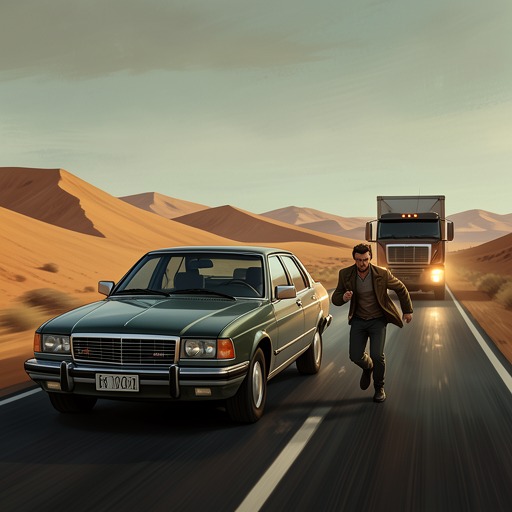
Later, Yukon rolls down the window and adjusts the mirror of his black Ford F-250. Blood remains on his hands, and he scans approaching headlights for the motorcycle carrying Cal Murphy and Kelly Mendoza. The truck’s ordinary road-going form contrasts with the extraordinary purpose behind the journey. It is not merely taking Yukon somewhere; it is participating in a search meant to eliminate the last witnesses who might expose Statenville’s hallowed secret.
When the familiar engine roar reaches the north parking lot, Cal recognizes it from the night his car went careening off the road. The sound becomes an auditory signature of danger before the truck itself is fully encountered. A long-haired muscular man emerges from the Ford F-250, and Cal immediately understands that the earlier threat has returned in bodily form. The vehicle’s identity is established through recurrence: its engine transforms a common mechanical noise into a warning that collapses past ambush and present danger into the same pattern.
Mobile Prison and Instrument of Abduction
The Ford F-250 becomes most visibly oppressive when Yukon uses it to seize the reporters. He approaches Cal Murphy while clutching Kelly Mendoza in one hand and holding a crowbar in the other. After forcing Cal around the restaurant parking lot, Yukon takes them toward the truck, where resistance is futile. The pickup is not simply the destination of the abduction; it is the space that makes the abduction operational.
Yukon lifts Kelly into the pickup bed, tears away her backpack, and confiscates the evidence it contains. He then removes rope from the truck’s toolbox, binds Kelly’s feet, secures her hands against her sides, and gags her. Cal receives the same treatment. The details make the truck’s material organization significant: its toolbox supplies the restraints, its bed becomes a detention compartment, and its cargo-covering equipment allows the captives to disappear from ordinary view. A vehicle designed to transport objects is repurposed to transport bound people as concealed cargo.
Yukon covers Cal and Kelly with a tarp and fastens all four corners with bungee cord. The gesture completes the transformation from pickup to mobile prison. The tarp blocks visibility, while the bungee cords convert a temporary cover into a sealed surface that prevents escape and conceals the captives from anyone who might see the truck in transit. Yukon’s private satisfaction at preserving his way of life exposes the ideological meaning of the act: the reporters are treated as obstacles to a social order whose prosperity depends on secrecy.
Escape, Pursuit, and Failed Control
The Ford F-250 appears to offer Yukon complete control, but that control proves fragile. When he meets Nathan Gold to deliver the supposedly captured reporters, four sacks of potatoes are holding down the lower tarp and the upper tarp is gone. Cal and Kelly have escaped. The truck has carried them far enough to make their disappearance alarming, yet its very use as a concealed enclosure has not guaranteed possession. The missing tarp turns the vehicle into evidence of failure rather than proof of power.
Yukon cannot explain how the escape occurred. His long day of driving, compounded by the four beers he has consumed since the capture, has blurred his timeline and left him unable to reconstruct the route. The Ford F-250 therefore carries a second value shift: what looked like an instrument of domination becomes the scene of an operational breakdown. Its capacity, speed, and concealment cannot compensate for the fallibility of the man controlling it.
The truck nevertheless remains dangerous after the escape. Its engine brings Yukon back into Cal and Kelly’s vicinity, and the sight of the Ford F-250 forces Cal to abandon his plan to wait for instructions from Guy Thompson. The vehicle’s recurring arrival repeatedly interrupts attempts at safety. Even when it fails to contain the reporters, it continues to function as a moving extension of the threat against them.
Connection to Concealed Violence
The Ford F-250’s strongest narrative association is with the principle that a quiet crime is the best crime. Its mobility helps organize the separation between what happens and what can be reported. At the roadside, Yukon’s truck leaves behind a staged murder scene; on the road, it carries the people who are meant to disappear; in the search that follows, it becomes the instrument of a final cleanup effort. The truck allows violence to travel between spaces while leaving the public story behind in a form designed to mislead.
This function becomes especially stark beside the other concealed spaces in the novel. The Reid property appears as a vast brick ranch above the Snake River, but the arrival of Brooks County Sheriff’s Department vehicles reveals that domestic and institutional life can suddenly become a crime scene. Devil’s Canyon offers caves and open dirt terrain for concealment. Walker’s barn contains a rustic tack room whose dry-erase boards are covered with chemical equations, exposing a hidden technical operation behind an apparently ordinary rural structure. Cold River Canyon, at the edge of the Idaho wilderness area, provides another remote setting for coercion and betrayal. The Ford F-250 moves through this network of spaces, making concealment portable rather than fixed.
Its physical details also make the novel’s violence deliberately concrete. The truck has a mirror, a toolbox, a pickup bed, tarps, bungee cords, and enough room to carry two bound adults. These objects are initially functional and familiar, but under pressure their uses become sinister. The toolbox no longer suggests repair; it yields restraints. The bed no longer suggests cargo; it becomes a place of captivity. The tarp no longer protects a load from weather; it erases human presence from view. Through these reversals, the Ford F-250’s materiality becomes impossible to ignore.
Narrative Significance
The Ford F-250 is a recurring threshold object between public visibility and hidden action. It appears in motion, at the edge of roads, near remote wilderness, and in the aftermath of killings. That pattern gives the vehicle a structural role: whenever it arrives, the story approaches a change in the value of freedom, safety, or life itself. Cal and Kelly’s recognition of its engine turns sound into foreshadowing; Yukon’s use of its bed turns transport into imprisonment; its arrival at the meeting with Nathan Gold turns the truck into the anticipated delivery system for two deaths; and the empty covered bed reverses that expectation through escape.
The vehicle also embodies the contradiction at the center of Statenville’s prosperity. The town’s public order depends on appearances, while its private order depends on the controlled movement of people, bodies, drugs, evidence, and threats. The Ford F-250 looks like a work truck belonging to the rural economy, yet it repeatedly serves the criminal economy beneath that surface. Its apparent ordinariness is precisely what makes it effective: it can move through a community that is accustomed to trucks without announcing the extraordinary violence concealed inside it.
By the time the story reaches Cold River Canyon, the Ford F-250 has become inseparable from the novel’s chain of ambush, abduction, murder, and attempted cover-up. It does not possess motives of its own, but its repeated repurposing reveals how ordinary infrastructure can be absorbed into a corrupt system. The truck’s decisive significance lies in that conversion. It is the vehicle that carries the secret, hides the victims, transports the threat, and ultimately exposes the human limits of those who believe that control of roads and information can make violence disappear.