Joseph Mendoza
Dead ShotJoseph Mendoza is the publisher of The Register and the father of Sammy Mendoza, as well as Kelly Mendoza’s uncle. His position places him at the center of Statenville’s information system: he controls the paper that should expose the town’s wrongdoing, yet increasingly uses that authority to contain scandal. Through Joseph, the newspaper becomes not merely a workplace but a contested inheritance and a battleground over who may define reality for the community.
Publisher and Family Authority
Joseph is described as the person who currently publishes The Register, a paper that has belonged to Kelly’s family for years. Kelly possesses a gift for reporting and hopes eventually to take over the newspaper, while Joseph could instead leave it to his son Sammy if Sammy ever becomes more ambitious than chasing women and drinking beer along the Snake River. The succession question gives Joseph’s authority a personal dimension: Kelly’s investigative ability threatens to make the paper a force for accountability, whereas Joseph’s preferences determine whether it remains a profitable Statenville institution or becomes an instrument of confrontation.
Joseph’s relationship with Kelly is therefore shaped by both kinship and control. Kelly wants to inherit the paper and use it to turn over every rock until Statenville’s corrupt figures are behind bars, but Joseph has the power to decide whether that future will exist. His later willingness to dismiss her makes clear that family loyalty does not outweigh his desire to preserve his position and the interests attached to it.
Editorial Gatekeeping and Suppression
Joseph’s influence operates alongside that of Guy Thompson, the editor who assigns Cal Murphy and Kelly to pursue the deaths of three local boys. Guy tells Cal to visit the sheriff’s office and obtain information from Sheriff Jones, but the newsroom’s pursuit of facts soon meets resistance from both the sheriff and the publisher. When Cal continues investigating, Guy cites Joseph and Hunter Jones as evidence that nobody in town wants to know anything beyond funeral arrangements and where to send flowers. The claim reduces a public mystery to private mourning and turns apparent community indifference into a justification for withholding inquiry.
The Register’s editorial pressure becomes explicit when Guy orders Cal to write only a reaction piece. Instead of permitting an investigative article, the paper demands a shallow article built from ordinary people’s responses, leaving the issue without sustained examination. Joseph is not the speaker in that exchange, but his role as publisher makes the newsroom’s hierarchy part of the larger system that disciplines Cal and Kelly. The paper can publish, but its leaders decide which forms of knowledge are considered acceptable.
Joseph’s control also appears in the warning sent to Cal after the attack connected to the investigation. The letter tells Cal to create a cover story, keep quiet, and avoid asking questions, while warning that the people behind the message can apply other forms of persuasion. It specifically instructs him not to show the letter or reveal the truth to Kelly or Guy. The threat is directed at Cal, but it reveals the environment in which Joseph’s newspaper operates: information is treated as leverage, and silence is presented as professional prudence.
Complicity in the Statenville Cover-Up
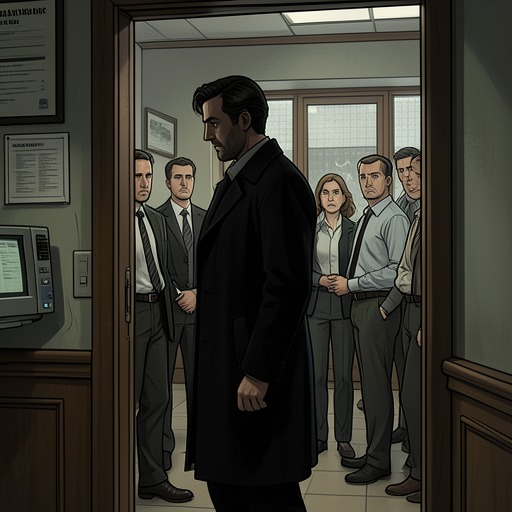
Joseph’s decisive moral turn is stated directly when he looks from his office into The Register’s newsroom. He once cared about the truth, but no longer does because lies pay better. The contrast defines him more sharply than a simple description of corruption would. Joseph is not merely uninformed or passive; he understands the value of truth and has abandoned it because deception is more profitable.
His phone conversation with Gold shows that this change is connected to the town’s power structure. When Gold complains that the newspaper’s employees are interfering, Joseph promises that they will no longer be employed once he finds them. Asked whether this includes Kelly, he responds that it especially includes her and insists there is no chance he will give her the paper. His threat against his niece joins economic control, family betrayal, and information suppression in a single decision. Kelly’s investigative ambitions make her not only a difficult employee but a direct danger to the succession Joseph wants to control.
The forensic evidence surrounding Cody Murray’s death shows what Joseph’s silence helps conceal. Kevin Mendoza examines Cody’s mutilated body after three teenage boys die within twenty-four hours. Although the wounds resemble claw marks, the official account is shaped into something less alarming. Kevin prepares a false report for the Sheriff’s Department and the media, while canceling the victims’ toxicology screens in Boise. Later, an independent FBI examination determines that the deaths were caused by markers added to methamphetamine, not by the meth itself. The markers were intended to track the reach of a drug network, but a rogue FBI agent made the additive deadly, causing severe itching that led the already intoxicated victims to scratch themselves to death. Joseph’s newspaper exists in the exact space where such competing accounts can either be exposed or buried.
Public Image and Narrative Significance
Joseph embodies the newspaper gatekeeper who converts journalism from a search for truth into a mechanism for protecting institutional stability. The final published story by Cal appears in two newspapers, indicating that the suppressed investigation eventually reaches a broader public audience beyond The Register. That outcome throws Joseph’s earlier conduct into relief: the facts can survive local control, but only after reporters and outside institutions challenge the authority that kept them contained.
His importance lies in the contradiction between the paper’s civic function and his private calculation. The Register is a family business, a source of local influence, and a potential vehicle for investigative journalism. Joseph treats it primarily as an asset whose value depends on managing information. By rejecting Kelly and threatening employees who disrupt the approved account, he attempts to preserve both the paper’s profitability and Statenville’s official story. His arc therefore illustrates how corruption is sustained not only by police reports or political power, but also by the people who decide what a community is allowed to read.