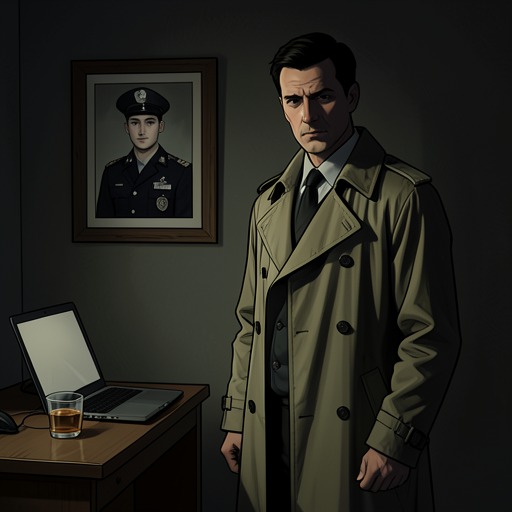
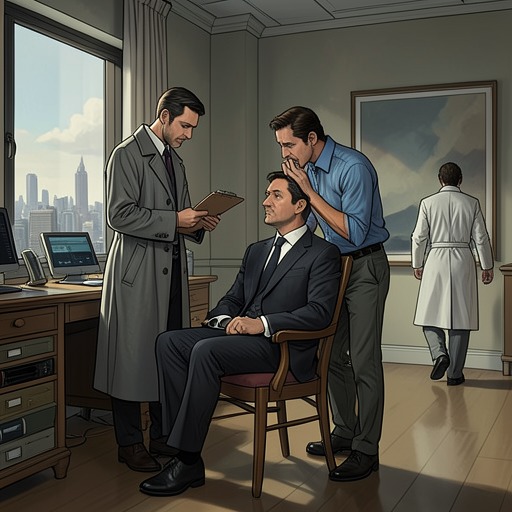
Mercer's double-cross
Dead ShotMercer's double-cross is the decisive reversal in the operation intended to bring Mayor Gold to justice. After presenting himself as an ally who would help Cal Murphy and Kelly Mendoza secure a confession for Guy Thompson's murder, Mercer secretly changes the objective: rather than deliver the reporters safely to Statenville, he drives them toward a death arranged by Gold. His betrayal reveals that the conspiracy's corruption reaches beyond the town's political leadership and drug network into the federal investigation itself, where an agent willing to sacrifice innocents imagines that the resulting violence will make him a hero.
The Apparent Rescue Plan
Mercer first approaches Cal and Kelly with a proposal that appears both practical and morally purposeful. He says he can bring them into Gold's presence without arousing suspicion, arrange a private conversation in which Gold admits that he killed Guy, and then arrest the mayor. The plan promises the evidence Cal needs, the arrest Kelly wants, and a form of justice for Guy, whose death has left Cal grieving and determined to complete his story.
The proposal also carries a second promise: Mercer says he wants to protect the reputation of his former partner, Walker. He acknowledges that Walker was wrong to lace the drugs that killed the boys, but insists that Walker had been trying to do the right thing. Mercer therefore presents the operation as more than an arrest. He frames it as a way to expose Gold while preserving the idea that Walker fought for justice rather than becoming remembered simply as a killer. That appeal helps make Mercer credible to Cal and Kelly, both of whom accept his assistance because they cannot see another plausible motive for it.
The Hidden Network Behind the Betrayal
Mercer's apparent cooperation takes place within a wider system of secrecy. Guy Thompson had accepted regular payments to ignore Statenville's hidden crime, receiving a brown paper bag containing exactly one hundred twenty-dollar bills each month. His silence made him complicit in the town's protected image of a sleepy, prosperous community, while Mayor Gold treated the same silence as an instrument of political control. Gold could command Statenville because people obeyed him, and he defended the town's secret through money, intimidation, and, when necessary, violence.
Gold's organization also relied on the apparent respectability of Cloverdale Industries and on a disciplined employee-screening system. New and existing employees were checked, and Gold warned them at closed corporate gatherings that disclosure could cost them their paychecks and send them to federal prison. Yet the system failed to identify Walker, who entered as an apparently ordinary basketball coach seeking extra hours to support his elderly mother. His access to every room made him a dangerous breach, particularly because he was working with Mercer, another undercover federal agent.
The federal operation itself had been built around Gold's earlier identity as Deangelo. The FBI linked him to a distinctive series of murders in which victims had a nineteenth-century United States gold coin placed in the mouth. The signature resurfaced in Portland when Gold killed the nineteen-year-old son of Senator Tom Brazenworth, a victim whose identity ensured that the murder would receive serious investigation. Agents traced Deangelo to his Gold alias and then embedded Walker and Mercer in Statenville under carefully constructed identities. For five years they gathered information about the location and movement of Cloverdale Industries and about the wider distribution network, not merely to arrest Gold but to bring down everyone moving the drugs through the Northwest.
The Turn in the Car
Cal and Kelly trust Mercer while waiting for him, though Cal's experience has made him increasingly cautious. His status changes from an inexperienced reporter into someone learning to test every explanation against the possibility of deception. He and Kelly prepare their own precautions, hoping they will be enough if Mercer is not what he claims. Even so, they enter Mercer's squad car in handcuffs and accept the story that he has won Gold's confidence by telling him that the reporters were captured through a random tip from Salt Lake City.
The drive back to Statenville is fast but outwardly uneventful. Mercer offers condolences for Guy and repeatedly explains the plan so that all three participants know their parts. Ten minutes outside town, Cal and Kelly review the operation again. Kelly reaches over and squeezes Cal's leg above the knee, a small gesture of reassurance as he says he will make Guy proud. The scene briefly restores the value of trust: the reporters believe they are moving toward a dangerous but shared purpose, and Mercer's custody appears to be the means of reaching Gold.
That expectation collapses when Mercer locks the doors and sharply turns the steering wheel away from Statenville. The change is not spontaneous. Mercer has realized that Cal and Kelly know everything, and he concludes that their survival would leave no heroes in the story he wants to tell. His betrayal therefore begins not with a shouted declaration but with control of the vehicle itself: the locked doors remove their freedom, and the sudden turn converts a supposed escort into an abduction.
The Intended Sacrifice
Mercer does not plan to kill Cal and Kelly personally. He knows that Gold wants to oversee their deaths, and he treats the reporters as expendable collateral damage in a larger design. Gold has arranged for their bodies to reach the bottom of Cold River Canyon through what will appear to be a rock-climbing accident. Mercer drives them toward that outcome because he expects their deaths to create the opening he needs.
His intended sequence is calculated. After Gold kills the reporters, Mercer will move against the mayor and present himself as the single agent who has exposed and arrested the mastermind of the Northwest drug ring. The same operation would elevate him as both an investigator and a public servant: Gold would be captured, Cloverdale's network would be broken, and Mercer's role in allowing the sacrifice would remain hidden. The plan depends on converting other people's deaths into proof of his courage.
Justice as Self-Justification
Mercer's double-cross echoes the rationalizations already sustaining Statenville's criminal order. Gold tells himself that secrecy preserves the town's prosperity, even though he knows that his actions are not really for Statenville or its people. Guy tells himself that accepting money is preferable to moving elsewhere without a retirement nest egg. Walker claims to be pursuing justice through CPZ drug markers despite evidence that the method is lethal.
The CPZ program had originally been conceived as a way to mark users and distribution networks so that unusual cases would alert the Centers for Disease Control and Prevention and allow the FBI to map a dealer's reach. Earlier field tests in Seattle, Los Angeles, and Phoenix had ended with each tainted drug user dying, and the program was abandoned. Animal testing had been still more plainly catastrophic: monkeys tore at themselves and died, while dogs scratched and clawed themselves to death. Walker nevertheless forced the chemical into drug batches and finally placed it in drugs found in Riley Gold's car, treating Riley and his teammates as targets whose exposure might produce the evidence the FBI wanted.
Mercer condemns Walker's conduct enough to distance himself from it, but his own betrayal reproduces its central logic. He also claims a greater good: Gold's arrest, the reputation of the FBI, and the construction of a heroic public narrative. The difference is not that Mercer rejects sacrifice, but that he wants to control its meaning. Cal and Kelly are not people to him at the moment of betrayal; they are obstacles to the story in which Mercer alone becomes the savior.
Mercer's double-cross consequently transforms the investigation's moral structure. The reporters set out believing that the truth can be secured through a dangerous alliance with law enforcement. They discover instead that both the criminal network and the supposed rescue operation are organized around information control, selective disclosure, and the willingness to spend human lives for institutional or personal advantage. The sharp turn away from Statenville makes that principle visible: the road to justice has been redirected into a plan for murder, and the man holding the keys intends to call the result a victory.