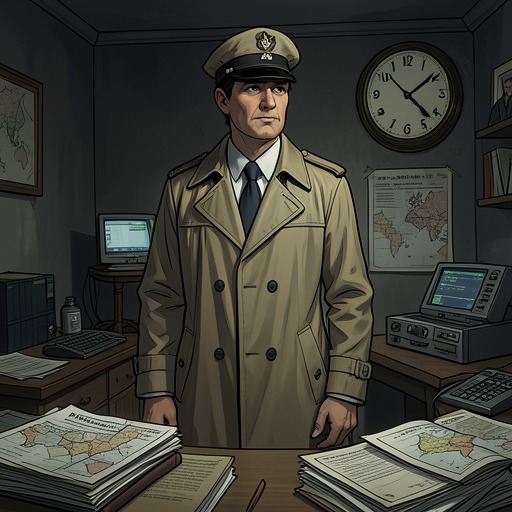
Operation Fuego
Dead ShotOperation Fuego is the Federal Bureau of Investigation’s planned strike against Cloverdale Industries and the concealed drug network that sustains Statenville’s prosperity. The operation is significant because it converts years of covert observation into an intended public takedown, while also exposing how thoroughly Nathan Gold’s organization has infiltrated local institutions and prepared to erase evidence when the raid begins to fail.
Origins and Strategic Purpose
Operation Fuego grew out of an investigation into Nathan Gold, who was actually Carmen Deangelo, a former captain in the Scarelli crime family. After a gold coin appeared in the mouth of the nineteen-year-old son of U.S. Senator Tom Brazenworth, federal investigators connected the murder signature to Gold and traced his new identity to Statenville. Rumors described the town as the site of a drug plant capable of commercial production, with vehicles moving product throughout the Northwest while remaining largely undetected. The Federal Bureau of Investigation therefore wanted more than Gold’s arrest: it sought prosecutable evidence against the wider operation, including the people who sold and transported Cloverdale’s drugs across state lines.
Buddy Walker and Elliott Mercer were placed in Statenville under deep cover. Their FBI-created identities included carefully constructed histories and even minor encounters with the law, details intended to satisfy Gold’s scrutiny. Over five years, they assembled what Walker regarded as a small library of information about the location and movement of Gold’s Cloverdale Industries operation. Walker’s assignment had become intolerable to him, but the prospect of an enormous public exposure kept him moving forward. He imagined television crews descending on Statenville and wanted the operation’s collapse badly enough to disregard recognition or personal credit.
Gold’s system was designed to prevent precisely this kind of penetration. He imposed rigorous background checks on Cloverdale employees and warned them that exposure would cost them their paychecks and could send them to federal prison. Yet Walker, presenting himself as a basketball coach who needed a few hours of work to support his elderly mother, passed the screening. His apparent ordinariness became the weakness in Gold’s security structure: the man admitted into every room was the federal threat Gold had failed to identify.
The Operation Moves Into the Open
The operation’s active phase begins when Walker’s scanner, tuned to the local sheriff’s office, announces an “Code Enfuego” alert along with a description of Walker and his car. The signal confirms that his cover is collapsing and that local authorities are mobilizing against him. Walker is not alone; Elliott Mercer is beside him, and their partnership gives the pursuit a second layer. Mercer has already learned how the Statenville Sheriff’s Department responds to a major security breach, first by sending a misleading tip that pulls Walker’s search party across the county and then by passing a trust test that opens access to deeper local secrets.
By this point, Mercer and Walker are no longer merely collecting information. They have resolved to expose the secret and end Statenville’s position as a major Northwest drug center. Mercer’s knowledge of security procedures and Walker’s familiarity with Cloverdale’s cameras and blind spots allow them to approach the rear of the facility without being seen. They crouch up the ramp, reach a back entrance, and use Walker’s keys to enter. The careful movement gives the scene the logic of a raid: surveillance has been studied, access has been prepared, and the investigators believe the evidence is finally within reach.
The Empty Warehouse and the Collapse of Fuego
The decisive reversal comes inside the warehouse. Walker opens the door, turns on the lights, and drops his keys; the clank echoes through a space that should have contained the material proof of the operation. Instead, the building is completely bare. The shelving units, boxes, packing tables, forklifts, and every other visible sign of production have disappeared. The warehouse has become not a crime scene crowded with evidence but a cavernous absence.
Walker screams that his plan is disintegrating and insists that “Tonight was the night!” The reaction is more than frustration over a missed arrest. Years of work have been placed on the single moment when the FBI could seize the operation, and without a raid supported by hard evidence, Cloverdale Industries may remain beyond federal reach. Walker and Mercer slump onto the floor, fearing that their field status will be withdrawn and that they will return to analysis and paperwork. Their failure also threatens the larger case, because the FBI wanted to dismantle Gold’s network rather than capture only its visible leader.
Mercer responds practically rather than surrendering. He proposes dividing the facility, with Walker searching for a place capable of housing the missing transformation while Mercer examines the other end of the plant. This decision keeps the operation alive after its central assumption has been disproved. The emptied warehouse indicates that Gold has anticipated the strike, moved the evidence, and turned the FBI’s timing against it. The operation’s title therefore becomes ironic: the planned blaze has not yet consumed Cloverdale; it has illuminated the sophistication of the concealment surrounding it.
Gold’s Counteroperation
Gold does not wait to discover whether the agents have sent usable evidence to their superiors. He replaces Operation Fuego with Operation Cleanup, a contingency plan prepared for the moment federal investigators breach the network. He assumes that any evidence the agents possess may not have reached the FBI or may be ruled inadmissible in court, and he acts to ensure that no later discovery can repair the case.
Gold’s response reveals the relationship between the town’s political order and its criminal machinery. Running Statenville is easy for him because people obey his instructions, but preserving its secret requires a more intricate web of payments, silence, threats, and violence. Even the regular money delivered to Guy Thompson’s back porch—one hundred twenty-dollar bills in a brown paper bag each month—belongs to this same system of managed complicity. The town’s apparent stability rests on making witnesses passive, employees fearful, and outsiders vulnerable.
The cleanup operation is also a form of evidence manufacture. After Gold’s men secure Walker and Mercer with plastic zip ties, they force both FBI agents to take methamphetamine. Gold intends to plant a narrative that will discredit them: a drugged janitor and a coach accused of giving drugs to students would appear unreliable even if they claimed to be federal agents. The tactic is designed to turn the investigators’ identities into liabilities and to make the state’s own victims appear culpable. Operation Cleanup thus attacks not only bodies but credibility, using manufactured contamination to destroy the evidentiary chain that Operation Fuego was meant to establish.
Narrative Consequences
Operation Fuego fails as an immediate raid but succeeds as a structural revelation. Its collapse shows that Cloverdale Industries is protected by advance warning, employee secrecy, local law-enforcement access, and a leadership capable of moving an entire warehouse before federal agents arrive. It also exposes the limits of a conventional operation against a network whose criminal activity is embedded in the economy and government of Statenville.
The event connects the federal investigation to the town’s earlier concealments. The same culture that pays Guy Thompson to pretend Statenville is sleepy, suppresses knowledge of Riley Gold’s drug-related death, and treats public prosperity as justification for silence now mobilizes to neutralize federal agents. The white crystals hidden in a bottle labeled “Clean and Clear,” recognized by Cal Murphy and Kelly Mendoza as crystal methamphetamine, provide a related image of deceptive packaging: the surface promises cleanliness while the contents reveal contamination. In Operation Fuego, the warehouse reverses that image. There is no visible contamination because the evidence has been removed, but the emptiness itself proves how deeply the corruption has spread.
The failed raid also forces the conflict into more dangerous spaces. Walker and Mercer’s infiltration, the empty warehouse, Gold’s seizure of the agents, and the later movement through locations such as Devil’s Canyon, Walker’s barn, and Cold River Canyon turn the investigation into a struggle over who controls access, evidence, and escape. In the barn, dry-erase boards covered with chemical equations suggest the technical infrastructure behind the drug operation; in the remote canyon, the agents’ authority and safety become vulnerable to Gold’s counterattack. Operation Fuego is therefore not a completed victory but the hinge between investigation and open survival conflict. Its failure gives Gold the initiative, while the knowledge gathered by Walker and Mercer keeps the truth from disappearing with the warehouse’s contents.