Riley Gold
Dead ShotRiley Gold is the son of Nathan Gold and one of the three Statenville student-athletes whose deaths drive the central investigation. His death is initially presented as an ordinary drug overdose, but the supposed overdose becomes the book’s decisive contradiction: Riley’s body is not merely evidence of reckless drug use but the consequence of a hidden chemical experiment, a compromised law-enforcement operation, and a town’s deliberate refusal to confront what happened. Through Riley, the novel turns a local tragedy into the point where family loyalty, civic prosperity, journalism, and institutional corruption collide.
Identity and Circumstances
Riley is identified alongside Cody Murray and Devin Reid when Guy Thompson tells Cal Murphy that Statenville has suffered a double murder, then adds that Devin is the third victim. Sheriff Jones insists that the deaths should not be called murders, explaining that all three supposedly died from simple drug overdoses. Cal immediately notices the suspicious concentration of deaths within a twenty-four-hour period. Riley therefore enters the narrative not through a developed personal history but through a contested public description: to local authorities, he is an overdose statistic; to the reporters, he is a possible victim of something organized and concealed.
The later account supplies the missing circumstances. Nathan Gold and his wife had known for several months that Riley had begun dabbling in drugs, but they chose to ignore it and never expected that he would die. That knowledge makes the family’s grief inseparable from its earlier denial. Riley’s drug use gave the perpetrators an easy route into his life, while the Gold family’s awareness gave the town’s ruling circle a reason to treat the death as an unfortunate private matter rather than a public crime.
The Deadly Marker Experiment
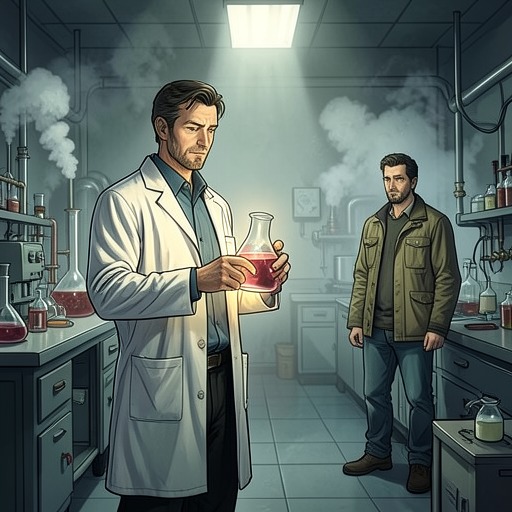
Riley became the target of an experiment devised by Buddy Walker, a rogue FBI agent working with Elliott Mercer. The FBI’s original marker program was intended to place a chemical additive in random drug batches so agents could track the reach of a distribution network. The compound was not supposed to kill anyone; it was designed to produce symptoms resembling the sudden onset of a rare disease, thereby alerting the Centers for Disease Control and Prevention and eventually the FBI.
Walker rejected the limits established by the bureau’s earlier research. That program had been abandoned after experimental animals suffered horrific deaths: monkeys tore at themselves, and dogs scratched and clawed themselves to death. Walker nevertheless believed his chemistry training gave him enough knowledge to continue. After ordinary quantities proved too difficult to trace across an entire shipment, he found drugs in Riley Gold’s car and mixed the marker into that batch. Riley was an easy target because the coaching staff knew that several players had recently begun using drugs, and Walker expected to observe Riley and other teammates who took the contaminated supply.
The experiment escaped Walker’s intended control. Mercer had warned him that the compound could kill, but Walker did not adequately account for its effect on people already high on methamphetamine. The marker forced liver bile rapidly into the bloodstream, producing uncontrollable itching beneath the skin. Riley and the other two victims scratched themselves to death. The deaths were thus caused by the additive in the meth, not by the meth alone, overturning the official explanation and revealing that Riley had been caught inside an unauthorized human experiment.
Family, Cover-Up, and Power
Riley’s death also threatens Nathan Gold’s carefully built public world. Nathan runs Statenville through obedience and money, presiding over a town whose unusually large budget supports an image of prosperity. His private grief is genuine enough to unsettle him, but it does not immediately overcome his commitment to the secret that sustains the town’s wealth. Gold and his inner circle have long justified concealment by arguing that most residents are employed, comfortable, and happy. The people of Statenville, however, were never allowed to decide whether that prosperity was worth its source; the decision was made for them by those who controlled the information.
The official cover-up depends on Riley’s death being interpreted as coincidence. Residents are told that the three student-athletes overdosed on meth, while local law-enforcement officials pressure the coroner’s office to issue falsified reports. Gold’s circle treats secrecy as a practical necessity, reasoning that fewer informed people mean fewer conscientious objectors and that generous payments are less conspicuous than further bodies. Riley’s death becomes one of the costs absorbed by a civic order that presents itself as a small-town success story.
Yet Riley remains emotionally present in Nathan’s private reflections. Gold fingers a picture of his son and wonders whether the secret is worth its cost. The question does not produce a moral reversal. He looks instead at the boomtown he has created and decides that the prosperity is worth preserving. Riley’s photograph becomes a silent counterweight to that calculation: the son is loved and mourned, but the system responsible for the concealment continues to command his father’s allegiance.
Discovery and Narrative Consequences
Cal Murphy and Kelly Mendoza refuse to accept the coroner’s report and move from the apparent pattern of three overdoses toward the possibility that the victims received the same contaminated batch. Their investigation gives Riley a significance beyond the circumstances of his death. The case is explicitly not about selling newspapers; the whole town consumes the coverage because the deaths expose what its prosperity has been built upon. Riley’s death is the fact that makes the town’s hidden economy impossible to keep entirely private.
Riley’s connection to Nathan also makes the investigation dangerous. Once Cal becomes an exception to Statenville’s paid silence, Nathan recognizes that the reporters are not merely asking inconvenient questions but threatening the structure that protects his family, business, and criminal history. The planned response is not revenge for its own sake but the removal of witnesses and evidence before an outside murder investigation can take shape. Riley’s death therefore generates a second wave of violence: the effort to suppress the people who insist on naming its true cause.
An independent FBI examination eventually establishes that the marker, rather than the meth itself, killed the three youths. The discovery also clarifies the divided responsibility behind Riley’s death. Walker engineered the additive’s fatal effect, while Mercer remained the surviving source of information connecting the experiment to Gold’s operation and to the death of Gold’s son. The investigation thus links Riley’s personal identity, his father’s criminal network, and the FBI’s compromised attempt to map that network.
Memory and Significance
Riley is remembered at the end as one of three young people whose deaths deserved an honest account. A Statenville resident thanks Cal for finding out the truth about Cody, Devin, and Riley, acknowledging both the victims’ own destructive choices and the larger machinery that turned those choices into fatal opportunity. The message distinguishes between the Statenville loved for the work of ordinary men and women and the newer town built around a drug scheme. In that contrast, Riley’s death marks the loss of the town’s innocence as well as the exposure of its corruption.
Riley never receives the opportunity to explain his own actions or decide what risks he was willing to take. Others define him first as a drug user, then as a victim, a son, a student-athlete, and evidence. That imposed sequence is central to his narrative role. The town’s institutions try to reduce him to an overdose so that responsibility will end with the dead; Cal’s reporting restores the chain of causes that the cover-up erased. Riley consequently functions as both an individual loss and the moral center of the investigation: his death reveals how private vulnerability can be exploited by institutions that claim to serve the public, and how truth-telling can return agency to those who can no longer speak.