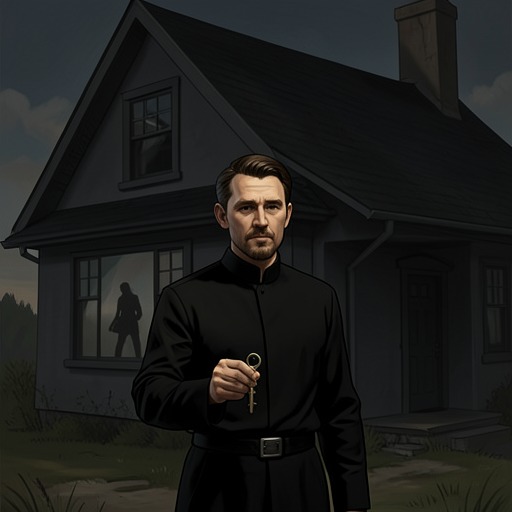
Scarelli family
Dead ShotThe Scarelli family is the criminal organization behind the past and present of Nathan Gold, whose respectable Statenville identity conceals his former life as Carmen Deangelo, a senior Scarelli captain. Although the family is rarely shown directly, its reach defines the novel’s larger crime network: it supplies Gold’s history of violence, explains why the FBI pursues him across states, and remains a threat even after his local empire begins to collapse.
Gold’s Scarelli Identity
Gold’s connection to the Scarelli family is revealed as part of the FBI’s long effort to locate Carmen Deangelo. When Deangelo worked in Boston, he was a rising captain in the Scarelli mob family. He later disappeared so thoroughly that, for roughly twelve years, the FBI assumed he had been quietly killed and buried. Instead, he reconstructed himself as Nathan Gold in Statenville, a small Idaho community whose isolation made it an ideal hiding place.
Gold’s new life depended on distance, concealment, and control. Most personnel in the FBI’s Salt Lake field office had scarcely heard of Statenville, even though the town lay only a short drive away. Its ordinary agricultural reputation, where drunken driving and occasional meth labs seemed to constitute the worst local crime, helped disguise the commercial drug operation Gold had built through Cloverdale Industries. The Scarelli past therefore does more than identify Gold as a former mobster; it explains the deliberate architecture of his second identity.
Violence and the Gold-Coin Signature
The Scarelli family’s most concrete link to Gold is the murder signature associated with Deangelo. In Boston, he placed a United States gold coin from the late nineteenth century in the mouth of each victim. The FBI had identified at least a dozen murder victims marked in this way, but proving that Gold had personally committed the killings was difficult. Many of the dead belonged to a rival mob, and the killings could be treated as useful underworld violence rather than pursued as ordinary murder cases.
That signature returned after a twelve-year absence in Portland, where Gold killed the nineteen-year-old son of United States Senator Tom Brazenworth. The victim was not a rival mob member but a young man caught up with the wrong crowd, making the killing too politically prominent to disappear into the usual pattern. Investigators recognized the coin as Deangelo’s calling card and traced the vanished Boston captain to his Statenville alias. The old symbol thus became the mistake that ended Gold’s anonymity.
Gold understood the danger of repeating it. While disposing of the consequences of the three suspicious deaths, he resolved not to carry gold coins in his pocket, fearing that another signature would bring the FBI into his backyard. His preferred method was the opposite of theatrical mob branding: a quiet crime, with bodies removed and evidence suppressed before an outside investigation could begin. The Scarelli legacy remained visible not only in what Gold had done, but also in the precautions he took to prevent his former self from resurfacing.
The Family’s Reach and the Statenville Network
The Scarelli family belongs to a wider structure connecting organized crime, local government, law enforcement, paid employees, and Cloverdale Industries. Gold told himself that protecting the drug empire preserved Statenville’s prosperity, but the narrative makes clear that this justification mainly softened his conscience. He maintained secrecy through money, threats, and selective violence. Guy Thompson, a newspaperman who suspected that Statenville possessed a dangerous secret, received a brown paper bag containing one hundred twenty-dollar bills every month in exchange for looking away. Guy’s silence made him complicit and brought him into the town’s protected circle.
The same system disciplined workers inside Cloverdale Industries. Gold subjected employees to rigorous background checks and warned them at closed corporate gatherings that exposure would cost them their generous wages and likely send them to federal prison. His organization’s secrecy policy was therefore enforced through both reward and fear. Even people who did not understand the full operation were placed inside an economy where silence appeared safer than resistance.
When Cal Murphy and Kelly Mendoza investigated the deaths of three young men, the local machinery moved against them. The official account called the deaths drug overdoses, and methamphetamine was found at all three scenes, but the concentration of deaths within a single twenty-four-hour period made the explanation suspicious. Authorities controlled the evidence by treating the conclusion as settled before toxicology results returned, while Cal’s arrest on fabricated open-container and driving-under-the-influence charges turned law enforcement into an instrument of intimidation. The pressure placed on the reporters shows how a network associated with the Scarelli family operates without requiring the family itself to appear at every scene.
FBI Infiltration and the Threat of Exposure
The FBI eventually placed Buddy Walker and Elliott Mercer inside Statenville under deep cover. Their identities were constructed and vetted by the bureau, and each carried enough manufactured legal trouble in his background to pass Gold’s scrutiny. Walker entered Cloverdale Industries as an apparently harmless basketball coach seeking a few hours of work to help support his elderly mother. Gold’s background-check system detected nothing suspicious, allowing a federal agent access to every room in the facility.
Walker and Mercer spent five years gathering information about the location and movement of Cloverdale Industries’ operation. Their assignment was broader than arresting Gold: the FBI wanted the entire network, including people who sold and transported the drugs across state lines. The Scarelli connection transformed a local investigation into a federal campaign against an organized criminal structure. Mercer eventually diverted Walker’s search party away from Cloverdale, studied the procedures of the Statenville Sheriff’s Department, passed a trust test, and learned the town’s greatest secret. He and Walker then sought to expose the operation and end Statenville’s position as a major Pacific Northwest drug distributor.
Gold interpreted the undercover operation as an existential threat. He had survived curious residents, disgruntled employees, and trespassers through cash or intimidation, with a remote rocky quarry available for people who could not be persuaded. A federal agent inside Cloverdale was different. The danger was not merely that one employee might talk; it was that the entire Scarelli-derived structure could be mapped, prosecuted, and dismantled.
Final Pressure and Narrative Significance
By the time Cal learned Gold’s true identity, the Scarelli family had become the force that made Gold’s capture more dangerous and more consequential. At the FBI offices in Salt Lake City, Cal learned that Gold was Carmen Deangelo, a ruthless former captain who had vanished from Boston. He also learned that Walker had died and that Mercer was being investigated as a possible mole. Cal suspected that the FBI wanted to control the public story because one of its agents had been connected to the deaths of three high-school student-athletes, but the bureau also needed Gold captured and the Cloverdale drug ring destroyed.
The family’s lingering power becomes explicit when Cal threatens to send a letter revealing Gold’s location to the Scarelli family, allowing its members to take Gold back to Boston with the FBI’s approval. The threat turns Gold’s past into a weapon against him. He had escaped the Scarelli world by manufacturing a new name and ruling Statenville, yet the old organization remains capable of reclaiming him.
Gold refuses to submit to that future. After Cal tells him that imprisonment would be safer than being returned to Boston, Gold leaps into Cold River Canyon and dies alongside Mercer. The Scarelli family does not need a final onstage appearance to determine the ending. Its remembered violence, investigative history, and threat of retribution close the circle around Gold, showing that the criminal identity he tried to bury was never truly separated from the town he built.