Statenville tainted-meth deaths
Dead ShotThe Statenville tainted-meth deaths are the central crime that turns Statenville’s apparent prosperity and small-town calm into a crisis of concealed violence. Three local high-school football stars die in gruesome circumstances after using methamphetamine, and officials initially present the deaths as ordinary overdoses. The later discovery that the victims were killed by a chemical marker added to the drugs—not by the methamphetamine itself—reframes the deaths as the unintended result of an undercover operation corrupted by a rogue Federal Bureau of Investigation agent. One victim, Riley Gold, is also the son of Deangelo, the criminal figure behind Cloverdale Industries, binding the deaths directly to the town’s drug network and its most powerful family.
Causes and Background
The deaths arise from a culture in which athletic ambition makes drug use appear practical rather than exceptional. Cody Murray, a six-foot scrambling quarterback from a rural Idaho eight-man team who had earned several major scholarship offers, wanted help sustaining his workouts without using steroids. He regarded his chosen stimulant as harmless at first, even though he increasingly used it for pleasure as well as performance. The pressure surrounding young athletes is made explicit by Mike Miller, who says that Cody’s father laughed when warned about his son’s drug use and replied that if it helped Cody get ahead, he supported it. Miller also explains that methamphetamine seemed attractive because it gave athletes energy to train longer, while college coaches often valued the appearance of physical success more than academic effort. The deaths therefore grow out of a sporting environment that rewards endurance, bodily display, and escape from Statenville, while treating the risks behind that performance as somebody else’s problem.
The immediate technical cause is the FBI’s CPZ marker program. The intended marker was supposed to be inserted into random batches of drugs so that an apparent disease response would alert the Centers for Disease Control and Prevention, allowing the FBI to gather information about a dealer’s distribution network. The program had already been tested in 2008 by undercover operatives in Seattle, Los Angeles, and Phoenix. In each field test, the drug user died, although the report did not identify the cause, and the program was discontinued because of the danger and the publicity it threatened to create.
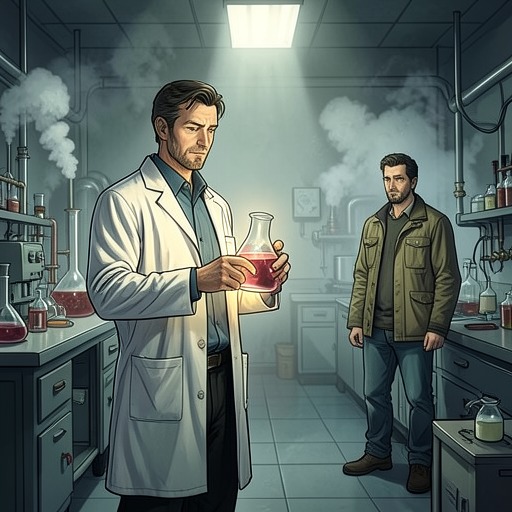
The abandoned research had also revealed a profound ethical warning. Animals exposed during the testing died in horrific conditions: monkeys nearly tore themselves apart, while dogs scratched and clawed themselves to death. Officials concluded that the idea might work in theory but could not ethically be tested on humans. Despite that conclusion, Walker continued experimenting. His minor in chemistry gave him enough confidence to challenge the bureau’s professional chemists, and Elliott Mercer eventually relented after urging him to find another approach. The deaths are thus not simply the result of an accidental laboratory error; they follow a decision to override known evidence about the marker’s lethal potential.
What Happens
Walker first struggled to make the marker strong enough to trace an entire shipment. He then found a more dangerous opportunity in a batch of drugs inside Riley Gold’s car. Because the coaching staff knew several players had recently begun using drugs, Riley appeared to Walker to be an easy subject to observe, along with any teammates who tried the same supply. Walker did not adequately consider that his compound could kill people, even after Mercer warned him. The chemical was introduced into drugs circulating among the athletes, and the three young men became the human subjects of an unauthorized experiment they had never consented to join.
The resulting deaths are physically distinctive and initially difficult to interpret. The marker forces liver bile rapidly into the bloodstream, producing uncontrollable itching beneath the skin. Already high on methamphetamine, each victim scratches himself to death. When Cal Murphy later shows Guy Thompson photographs from the coroner’s office, the images reveal the gruesome nature of the deaths; Kelly Mendoza concludes that if Walker laced Cloverdale crystal meth with a chemical, the deaths were not accidental. The bodily evidence contradicts the official account long before the institutional explanation becomes available.
The first public version of the event is carefully narrowed. Sheriff Jones identifies the third victim as Devin Reid, Jim Reid’s son, but rejects the language of murder and insists that all three died from simple drug overdoses. When Cal points out that three deaths occurred within twenty-four hours, Jones answers that suspicion alone cannot secure a conviction. Kelly asks what drugs were involved, and Jones admits that methamphetamine was found at all three scenes, while simultaneously deferring official conclusions until toxicology reports returned from Boise. The exchange establishes how the deaths are managed through partial disclosure: enough information is offered to make the case appear ordinary, while the most threatening interpretation is denied.
The cover story becomes more forceful when Kevin Mendoza states that the victims overdosed even though the toxicology screens had not yet been completed. Kevin’s premature certainty reveals that the cause of death is being imposed rather than discovered. The local authorities later pressure the coroner’s office to issue falsified reports, converting a questionable initial explanation into an official record. What appears to be bureaucratic caution is therefore part of a deliberate effort to prevent the deaths from becoming a murder investigation.
Investigation and Escalation
Cal Murphy and Kelly Mendoza refuse to accept the overdose explanation. Their investigation places them in direct physical danger: Cal is shot in the right arm during an attack, and Kelly crawls across the ground toward him while trying to get them to the dock. Later, while hiding and searching for evidence, Cal opens a taped box and finds a bottle labeled Clean and Clear that contains white crystals instead of cleaning liquid. Kelly identifies the substance as crystal methamphetamine. The object links the drug operation’s ordinary-looking packaging to the concealed material at the heart of the case.
The investigation also changes from local reporting into a race to preserve evidence. After escaping, Cal and Kelly drive toward Ellington and stop at a nearly vacant McDonald’s, one of the few places open late at night. Cal uses the improvised workstation to begin organizing the story while Kelly uploads photographs and video to a remote drop box. Between them they have only two iPhones and a camera, so the survival of the evidence depends on speed, redundancy, and publication rather than on official cooperation. Cal’s attachment to Kelly, briefly felt as she embraces him from the rear seat of the motorcycle, exists alongside the recognition that neither of them has the safety or leisure of a cinematic rescue.
The federal background clarifies why the deaths matter beyond Statenville. The FBI had placed Walker and Mercer in deep cover for five years, not merely to arrest Deangelo under the alias Gold, but to build a prosecutable case against the entire Cloverdale Industries operation, including the people who sold and transported its drugs across state lines. Walker wanted a spectacular case and a major public success. His impatience transformed the undercover marker program from a surveillance tool into a lethal intervention, while Mercer became both a participant in the operation and the remaining source of evidence capable of implicating Deangelo.
Consequences and Aftermath
The deaths destroy the distinction between accidental harm and deliberate wrongdoing. The FBI’s official account says the marker was never intended to be fatal, but Walker engineered the additive so that it would have a deadly effect. His conduct made three local teenagers the victims of a chemical experiment, while the institution that created the program had already known from animal testing that the compound produced catastrophic suffering. Mercer’s warnings, Walker’s persistence, and the decision to use Riley’s drug supply together show how responsibility is distributed across individual ambition, compromised professional judgment, and an undercover system willing to manipulate illicit drugs without the victims’ knowledge.
The deaths also expose the dependence of Statenville’s public order on information control. Residents are told that the student-athletes overdosed on methamphetamine; the coroner’s reports are falsified; and local officials, together with Gold, prefer to call the deaths a coincidence so that the town will not attract unwanted attention. This suppression protects more than a reputation. It protects the economic and political structure surrounding Cloverdale Industries, preserves the image of a peaceful southeastern Idaho community, and prevents the victims’ bodies from revealing the reach of the drug network.
Riley Gold’s death gives the case its most dangerous personal consequence. The victim is not only one of the athletes caught in the experiment but also Deangelo’s son. That connection turns a federal investigation into a threat to the criminal organization’s leader and helps explain the violence that follows. The deaths trigger the pursuit of Cal and Kelly, the attempted destruction or concealment of evidence, and the confrontation that ultimately brings the Cloverdale investigation to its climax. The resulting chain of events includes the killing of Elliott Mercer and Deangelo’s plunge into Cold River Canyon rather than facing federal charges.
Narrative Significance
The Statenville tainted-meth deaths function as the novel’s hidden hinge: a local tragedy that initially appears to confirm the town’s familiar story about reckless teenagers, then reverses that interpretation by showing that the official explanation itself is part of the crime. The value at stake shifts from ordinary public order to life, truth, and institutional accountability. Every attempt to stabilize the story—as an overdose, a coincidence, or an unfortunate side effect—makes the underlying violence more visible.
The event also connects three forms of bodily pressure. Cody and the other athletes pursue strength and endurance through a sporting culture that treats physical appearance as a route to college opportunity; the chemical marker turns the body into an involuntary tracking device; and the victims’ uncontrollable scratching makes the body the final record of a crime that officials try to erase. The same culture that celebrates athletes for looking powerful leaves little room to acknowledge vulnerability, addiction, fear, or the need for protection.
Finally, the deaths reveal how scientific knowledge, law enforcement, journalism, and criminal enterprise produce competing versions of reality. The marker was designed to generate information about a distribution network, yet the experiment’s uncontrolled human consequences create evidence of a different kind: bodies, photographs, suppressed reports, and the testimony of people who know what was done. The deaths remain the decisive proof that Statenville’s quiet prosperity depends on a system in which dangerous institutions can call violence an accident, and local authorities can call evidence coincidence.