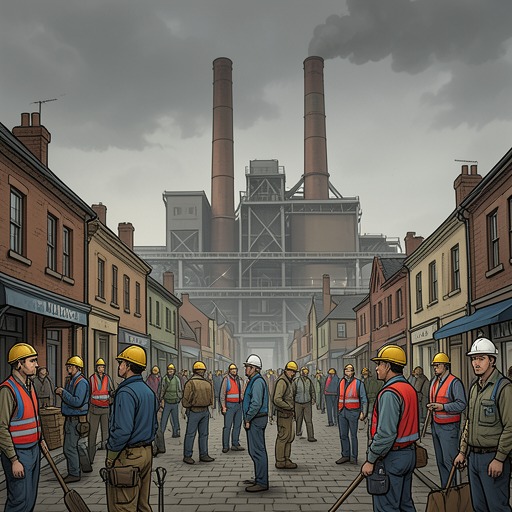
Statenville's boomtown prosperity
Dead ShotStatenville's boomtown prosperity is the central public justification for the town's corrupt order. Under Mayor Nathan Gold, Statenville survives a weak national economy and presents itself as a thriving small town, but the prosperity rests on Cloverdale Industries' money, purchased institutional loyalty, suppressed information, and the concealment of deaths connected to drugs. The town's success is therefore both material reality and political alibi: it gives residents employment and comfort while denying them the knowledge needed to judge what they are being asked to accept.
Economic Foundation and Political Design
Statenville's prosperity is presented as the result of Nathan Gold's long political stewardship. When Gold first assumed office twelve years earlier, recession was not yet a governing principle in local, state, or federal decision-making. Over the following decade, however, his consolidation of the Statenville Police Department with the Brooks County Sheriff's Department made him look prescient. Some residents regarded him as visionary; others saw the arrangement as controlling. It reduced the number of officers and consolidated resources in a town where most people obeyed the law, while giving the mayor a more centralized structure through which authority could operate.
The consolidation also made Gold popular because it appeared efficient rather than coercive. Sheriff Hunter Jones welcomed the additional assets and control, and the town's enlarged budget made administration easy: Gold told people what to do, and they generally did it. The arrangement thus linked economic confidence to institutional concentration. A law-enforcement system sold as sensible austerity also gave local power fewer independent centers and made the protection of Statenville's public image easier to coordinate.
Cloverdale Industries supplied the prosperity's most visible engine. Its major export business was turning Statenville into a boomtown while neighboring cities struggled to survive. The contrast made the town's political choices seem self-evidently correct. Employment, public money, and the appearance of stability encouraged residents to evaluate Gold by the town's prosperity rather than by the hidden costs of the system producing it. Statenville could look like a successful version of a small-town refuge even while its economic dependence narrowed the range of acceptable questions.
Prosperity as a System of Loyalty
The wealth circulating through Statenville does more than create jobs. It purchases silence. Guy Thompson, the newspaper editor, is paid every month to treat the town as sleepy and harmless: a brown paper bag appears on his back porch containing exactly one hundred twenty-dollar bills. He understands that a secret exists and that someone he suspects to be its mastermind wants him not to investigate. Guy rationalizes the arrangement because retirement savings are inadequate and because leaving would only mean hoping another town's secret was less toxic. When whispers reach him, he pretends not to hear them; his silence gradually makes him part of the community's circle of complicity.
The same logic extends into law enforcement. Nathan Gold has placed every local law-enforcement officer on the Cloverdale Industries payroll, paying them weekly in cash laundered through unmarked envelopes. The payroll is an emergency reserve of obedience as much as compensation. When Gold needs help, the institution is already prepared to provide it. Prosperity therefore appears in two forms at once: legitimate-looking civic abundance and private payments that convert public authority into a protective service for the enterprise sustaining the town.
This structure is not described as a simple exchange in which every resident knowingly consents. Gold and his inner circle deliberately restrict knowledge because fewer informed people mean fewer conscientious objectors. Those who understand the secret are paid handsomely, and the money can buy an idealized life elsewhere, a kind of Mayberry West. The town's prosperity consequently depends on selective visibility. Most people see jobs, happiness, and a flourishing community; only a smaller circle sees the bargains, threats, and blood behind them.
The Human Cost of the Boom
The prosperity's moral cost becomes clear when three young men die within a twenty-four-hour period. Sheriff Jones insists that the deaths are simple drug overdoses rather than murders, even though Cal Murphy finds the timing suspicious. Methamphetamine is found at all three scenes, while toxicology reports are said to be pending in Boise. The official language narrows the event before the evidence is complete, converting a troubling pattern into a manageable category and protecting the town from the disruptive implications of a murder investigation.
The suppression operates through everyday administrative decisions as well as dramatic violence. Kevin Mendoza is pressured to cancel or recast the toxicology process after indicating that the young men did not ultimately die from drug overdoses. The reporters' investigation is answered with fabricated legal trouble: Cal is arrested on charges of possessing an open container and driving under the influence, although he knows the charges will not withstand scrutiny and maintains that he had not been drinking or driving with alcohol in the car. The arrest is intended as bullying, and it teaches him that the secret he is approaching threatens powerful people more than it threatens the town's public reputation.
The contrast between the town's tranquil appearance and its concealed damage is especially sharp in the Reid household. Devin Reid, the son of Jim Reid, is identified as the third victim. The Reid home is a sprawling brick ranch on a ridge overlooking the Snake River, with a vegetable garden and a hay shed; its apparent solidity and domestic order stand against the family's grief. Mrs. Reid weeps while eleven-year-old Katie consoles her, and the scene makes the cost of the town's hidden economy personal rather than statistical. The boom's benefits may be distributed as employment and comfort, but the harms fall on families who were never given the information necessary to consent to the bargain.
Image, Space, and Enforcement
Statenville's prosperity is reinforced by an image of peaceful normality. The town has little serious crime in its public memory, and its jail usually holds drifters and drunks for no more than twenty-four hours while serious criminals are transferred to Boise. That apparently calm civic landscape makes the arrest of Cal a rupture: the machinery normally reserved for public safety is turned against a reporter investigating whether public safety has been compromised.
The geography surrounding Statenville also helps sustain the arrangement. The Reid property overlooks the Snake River, while Devil's Canyon provides miles of dirt hills, caves, and difficult routes where vehicles struggle and dirt-bike riders later gather. Cal's knowledge of the canyon and his Honda 280XR dirt bike give him a route through a landscape that can conceal fugitives, but the nearby chain-link perimeter of the Cloverdale Industries facility marks a harder boundary. The same remoteness that offers cover also protects the industrial operation from easy scrutiny. Roads, fences, offices, and concealed rooms become part of the prosperity's political geography: movement is enabled for the people who control it and obstructed for those who investigate it.
Even the apparent informality of local administration carries this dual function. Deputies can be sent to a supposed disturbance at Buddy Walker's house and then learn that the real objective is to arrest Cal and Kelly. Their response is framed as routine police work, yet the call is based on a tip and trumped-up charges. At Walker's barn, dry-erase boards covered with chemical equations reveal that spaces associated with rural life can conceal technical activity connected to the larger operation. The town's wholesome surface and its hidden infrastructure occupy the same physical world.
Collapse of the Prosperity Narrative
Gold's private reasoning exposes the ideology that holds the boom together. After Riley Gold's death, Nathan and his wife know that their son had begun experimenting with drugs, but they had ignored the warning signs and never expected him to die. Gold nevertheless continues to defend the secret as a necessary price for Statenville's prosperity. He tells himself that people are employed, happy, and living a genuine dream, and asks whether they care where the money comes from. Yet the people who bear the costs never receive the chance to decide whether the arrangement is worthwhile. Gold decides for them, treating residents as pawns in a get-rich scheme and treating those who question it as obstacles to be bought or removed.
That justification becomes increasingly untenable as Cal and Kelly refuse to accept the coroner's report and investigate the deaths. Their reporting makes the whole town read every edition of the newspaper, demonstrating that the press is not merely selling copies but challenging the information system on which the prosperity depends. Gold recognizes Cal as an exception to the general pattern of purchased compliance. He orders action against the two reporters and prepares for their bodies to be disposed of, having learned that a quiet crime draws less attention than a visible murder. His arrival to meet Yukon on a dirt road, with truck headlights growing larger and dust rushing past his car, turns the abstract cost of the boom into an immediate threat against the people trying to expose it.
Statenville's boomtown prosperity thus changes meaning over the course of the narrative. At first it explains Gold's popularity, the law-enforcement consolidation, and the town's confidence in Cloverdale Industries. Later it is revealed as the language used to excuse secrecy, bribery, manipulated investigations, drug-related deaths, and threatened violence. Its decisive irony is that the prosperity is real enough to persuade people: the town is not merely pretending to have jobs and money. But those tangible benefits are inseparable from a system that withholds the truth about their source and assigns the danger to people with the least power to refuse it.