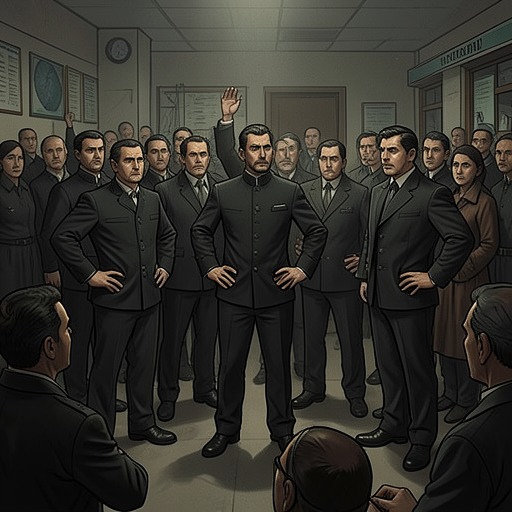
Statenville's corrupt power structure
Dead ShotStatenville's corrupt power structure is the town's governing conspiracy: a network in which political authority, consolidated law enforcement, local media, economic prosperity, and organized crime reinforce one another. Its defining achievement is not merely that it hides wrongdoing, but that it makes wrongdoing appear to be the price of public order. The town is prosperous, employed, and outwardly peaceful because powerful people decide what citizens may know, what official records may say, and which lives can be sacrificed to preserve the appearance of success.
Political and Economic Foundation
The structure begins with Mayor Nathan Gold's consolidation of the Statenville Police Department and the Brooks County Sheriff’s Department. Gold had entered office twelve years earlier, when recession was scarcely part of official decision-making, and the merger later made him look either visionary or controlling. It reduced redundant officers and concentrated resources in a town where most residents obeyed the law, making the arrangement popular. Sheriff Hunter Jones welcomed the additional assets and authority, even though the consolidation also placed more power within a system Gold could influence.
That political consolidation was strengthened by Cloverdale Industries, Statenville's major export business and the engine of its boomtown prosperity. While neighboring cities struggled during a weak economy, Statenville continued to thrive. Gold could therefore present his decisions as practical stewardship rather than as the construction of an instrument of control. Economic success supplied the public justification; centralized policing supplied the enforcement capacity; the town’s dependence on Cloverdale Industries supplied a reason for influential people to protect the system rather than question it.
Gold's private reasoning exposes the structure's moral bargain. He knows that Statenville's hidden secret requires continual suppression, but he also sees the money as the source of employment, happiness, and a life resembling an idealized “Mayberry” town. The people benefiting from the prosperity were never allowed to decide whether its source was acceptable. Gold made that decision for them, treating ordinary residents as pawns in a get-rich scheme and assuming that nearly everyone had a price.
Control Through Law Enforcement
The corruption operates through ordinary discretionary decisions as much as through spectacular violence. When three young men die within a day, Sheriff Jones insists that the deaths were simple drug overdoses rather than murders. He identifies Devin Reid as the third victim and says that methamphetamine was found at all three scenes, while simultaneously retreating behind the claim that official knowledge must wait for toxicology reports from Boise. The combination gives the authorities a usable public explanation and a procedural excuse to resist further questioning.
The same mechanism appears in the handling of medical evidence. When Kevin Mendoza reports that the victims may have bled to death, an unnamed caller orders him to state that they overdosed on drugs and to cancel the toxicology screens. The command does not merely falsify a conclusion; it attempts to control the flow of knowledge before scientific testing can establish a competing account. Professional language about reports and evidence becomes a shield for the decision already imposed from above.
Cal Murphy's arrest demonstrates how the structure turns investigation into criminality. The charges—possession of an open container and driving under the influence—are trumped up, and Cal knows they would not withstand scrutiny in a genuine court. Yet Statenville's institutions can still use them to remove him from circulation. Jake Dawkins books him, takes his mug shot, and mocks him throughout the process, while Sheriff Jones treats the arrest as a bullying tactic against a reporter who is nearing the town's secret. Law is therefore not abandoned; it is selectively interpreted and deployed against the person trying to make it accountable.
Gold's relationship with Jones makes the chain of command explicit. Gold enjoys ordering the sheriff around because Jones owes him everything, and Jones habitually responds to Gold's commands as though the mayor were the true authority behind the badge. Jones resents being treated as subordinate, but resentment does not produce independence. Instead, when Gold loses control of Cal Murphy, Jones is drawn into the effort to contain the problem, showing how institutional power survives through a mixture of dependence, humiliation, and shared complicity.
Bought Silence and Media Control
The conspiracy also depends on information management outside official law enforcement. Guy Thompson left The Tribune seven years earlier because he wanted relief from crime, corruption, libel anxiety, and the pressure of daily journalism. Statenville offered him a quieter life of Rotary Club dinners, Garden Club events, and mayoral elections. That peace was purchased. Each month, a brown paper bag containing exactly one hundred twenty-dollar bills appeared on Guy's back porch. He counted the money every time, understood that it was payment for not investigating the town's secret, and accepted it because retirement savings were inadequate and moving elsewhere offered no guarantee of a cleaner place.
Guy's silence gradually changes his place in the community. When whispers reach him—the very kind of information he once wanted in Salt Lake City—he pretends not to hear. Townspeople suspect that he knows the secret, and that suspicion increases their respect for him because it marks him as one of them. Complicity becomes a form of belonging. The conspiracy is consequently maintained not only by fear but also by comfort, money, status, and the social reward of being recognized as someone who understands the local rules.
Joseph Mendoza, publisher of The Register, represents a more hardened version of the same surrender. He once cared about truth, but lies pay better. From the only walled office in the newsroom, he receives Nathan Gold's call and is ordered to find his employees. Mendoza promises that they will no longer be employed, and when Gold asks whether that includes Mendoza's niece, he answers that it especially includes her because he refuses to give her the newspaper. His response reveals both economic control and family betrayal: the paper's ownership and its employees' livelihoods are treated as tools for suppressing independent reporting.
Gold then threatens Mendoza directly, demanding that he locate the reporters and shouting that failure will bring consequences. Mendoza is frightened because Gold's paranoia now threatens not only his employees but his own way of life. The newspaper is thus not a neutral observer standing outside the conspiracy. Its publisher has been absorbed into the same system that the reporters are trying to expose, while Guy hesitates over whether obedience will leave Cal Murphy and Kelly Mendoza dead. The newsroom becomes a contested institution in which truth, employment, inheritance, money, and physical survival are inseparable.
Violence, Surveillance, and Hidden Spaces
When persuasion and institutional pressure fail, the structure turns to force. Gold is troubled when an attempt to silence Cal Murphy goes wrong: Cal survives the roadside attack and disappears. Gold demands that his agents find him and says he does not want to lose more sleep over the problem. The language of loose ends and containment shows that violence is treated as administrative maintenance. A person is not confronted as a citizen with rights but managed as a threat to the stability of the secret.
The town's geography assists this management. The Reid home stands on a ridge overlooking the Snake River, reached by a long dirt driveway and surrounded by a vegetable garden and a hay shed. The apparently domestic rural landscape becomes a crime scene guarded by Brooks County Sheriff’s Department vehicles, with Elliott Mercer taking notes while the Reid family grieves. Elsewhere, Devil’s Canyon provides caves and difficult dirt terrain where fugitives can hide, while a nearly two-mile fence marks the back perimeter of Cloverdale Industries. These spaces divide public visibility from concealed movement: roads, fences, caves, offices, barns, and remote canyon routes determine who can be seen, trapped, or removed.
The same spatial logic shapes the pursuit of Cal Murphy and Kelly Mendoza. Dawkins and rookie deputy Willie Warren are sent to Walker's house under the pretext of investigating a disturbance, although Sheriff Jones privately tells Dawkins that the real purpose is to arrest the fugitive reporters on more fabricated charges. Dawkins initially takes his time because he believes the situation is harmless, while Warren circles behind the house with his gun drawn to make the fugitives understand that the threat is serious. Official procedure and covert surveillance operate simultaneously, each disguising the other.
The apparent rescue site in Walker's barn reveals how deeply the criminal system has penetrated hidden domestic space. The room is a twenty-by-twenty-foot former tack room with dirt floors, wooden walls, and a mirror framed in an old saddle. Its most revealing objects are the dry-erase boards covering the walls, marked with chemical equations and rudimentary molecular structures. The barn is not merely a refuge; it contains signs of scientific activity that connect rural concealment to the organized drug operation. The conspiracy's spaces are therefore functional as well as symbolic: production, detention, pursuit, and concealment are distributed across places that outwardly belong to ordinary town life.
Crisis and Structural Exposure
The deaths of the three teenagers destabilize the system because Cal Murphy and Kelly Mendoza refuse to accept the coroner's report. Three youths overdosed on the same batch of drugs, and the reporters recognize that the pattern demands investigation rather than passive repetition of the official account. Their pursuit is not motivated simply by the hope of selling newspapers. The entire town reads every edition, and the reporters' persistence threatens the shared story on which Statenville's prosperity depends.
Gold responds as a custodian of the structure rather than as a grieving public servant. Riley Gold's death has not come as a complete surprise to the Gold family because Nathan and his wife knew for months that Riley had begun experimenting with drugs, yet they ignored the warning signs and never expected death. Gold suppresses his grief while calculating the danger posed by the investigation. His private conflict is not between innocence and guilt; it is between the emotional cost of the system and his conviction that the system's rewards make it worthwhile.
His solution is to eliminate evidence and witnesses. Gold has learned that disposing of bodies is a precaution against becoming a suspect if outside law enforcement begins a murder investigation. Five years earlier, he had slipped by inserting a gold coin into a victim's mouth, but he now avoids carrying such coins because he does not want the Federal Bureau of Investigation searching his property. His governing principle is that a quiet crime is the best crime. The phrase captures the structure's preference for invisibility: controlled reports, staged explanations, paid silence, and disappearances are safer than public corpses or overt institutional seizure.
The crisis reaches its most revealing stage in Cold River Canyon, where Cal learns that Buddy Walker is not the FBI agent he had believed him to be and that Gold is actually Carmen DeAngelo, a former top captain in the Scarelli crime family who disappeared years earlier after leaving Boston. Mercer throws Cal's iPhone into the canyon, stripping away a means of communication, and the vehicle stops on a remote dusty road near the Idaho wilderness. The discovery reclassifies Statenville's corruption. What had appeared to be a local conspiracy protected by a mayor and sheriff is connected to a larger criminal history and to operatives willing to impersonate federal authority.
Statenville's corrupt power structure is significant because it makes corruption systemic rather than exceptional. Gold's political office, Jones's badge, Mendoza's newspaper, Guy's monthly payment, the manipulation of medical findings, and the use of fabricated charges all perform different tasks within one information-and-enforcement regime. Cloverdale Industries supplies the prosperity that legitimizes it, while violence protects the secret when money and respectable institutions no longer suffice. The resulting town is neither simply peaceful nor simply criminal: its peace is the visible product of hidden coercion, and its prosperity is the reward offered for accepting a reality that most residents were never permitted to examine.