Statenville's dependence on Cloverdale Industries
Dead ShotStatenville's dependence on Cloverdale Industries is not merely an economic preference but the foundation of the town's public order, prosperity, and corruption. Cloverdale's money turns a struggling rural community into a boomtown while binding its mayor, police, newspaper, and workforce to an illicit enterprise whose costs are displaced onto drug users, families, and anyone who attempts to expose it.
Economic Foundation and Civic Prosperity
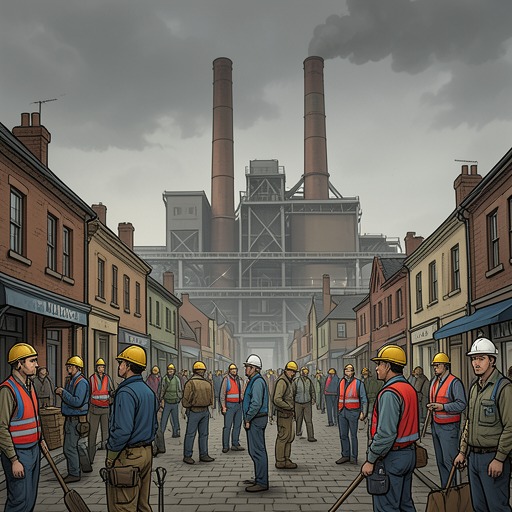
Statenville's dependence develops under Mayor Nathan Gold, whose consolidation of the Statenville Police Department with the Brooks County Sheriff's Department is presented as an efficient response to economic pressure. By eliminating supposedly needless officers and concentrating resources, Gold gains popularity in a town where most residents obey the law. The arrangement also gives the mayor greater control over local law enforcement, while Sheriff Hunter Jones welcomes the additional assets and authority. The town's favorable economic image rests on the same structure: Cloverdale Industries is Statenville's major export business, and its expansion makes the town a boomtown even as neighboring communities struggle during a weak economy. The resulting prosperity functions as both material benefit and political justification. Gold can point to employment, municipal strength, and the town's survival while treating the source of the money as a secondary question. In his reasoning, a ghost town has been avoided, people have jobs, and residents are happy; the prosperity therefore appears to validate the decisions that produced it. Yet the benefits are not neutral or collectively chosen. Gold determines what the public is allowed to know, making Statenville's economic success a condition imposed on the town rather than an arrangement its residents have meaningfully consented to.
Money as Control and Silence
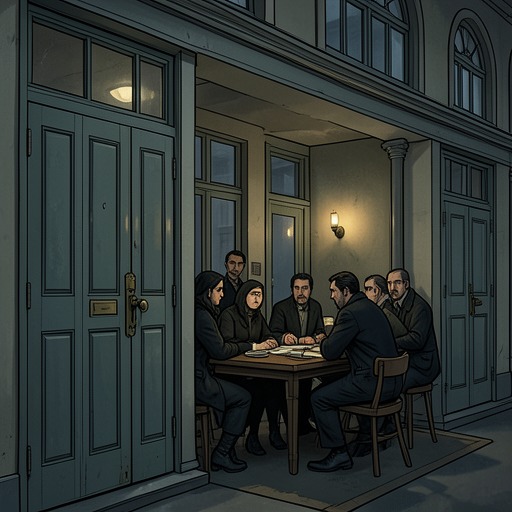
Cloverdale's dependence is maintained through direct financial capture rather than through employment alone. Gold's inner circle pays people who know the town's secret, reasoning that the fewer informed people there are, the less likely a conscientious objector will expose the operation. Those payments purchase not only silence but a moral vocabulary: participants can describe their complicity as necessary for the common good, because the money preserves a prosperous town. The arrangement resembles a local political economy in which private criminal revenue is redistributed just enough to make obedience appear practical, even benevolent. The same logic reaches the press. For years Gold keeps The Register under his influence by buying off editors and maintaining the publisher's loyalty. That control makes information another dependent resource: the newspaper can exist, but its ability to investigate the town's economic patron is restricted. Cal Murphy's arrival exposes the weakness in this system. Gold has assumed that reporters at The Register would be unable to develop a complex story, but Cal's skill and persistence show that professional journalism can interrupt an economy built on managed perception. Gold recognizes this as a rare and dangerous miscalculation, not simply as an editorial inconvenience. Law enforcement is incorporated into the same network. Gold adds local officers to the Cloverdale Industries payroll through a cash system using laundered money, delivered weekly in unmarked envelopes. The payments give him extra help whenever he needs it and convert public authority into a private enforcement arm. The consolidated department thus carries a double meaning: it is advertised as efficient government, but its personnel can also be mobilized to protect Cloverdale's business and suppress threats to the secret. The town's dependence is consequently institutional, reaching from municipal administration to policing and publishing.
The Hidden Cost of Prosperity
The secret beneath Statenville's prosperity is the illicit drug operation associated with Cloverdale Industries. Cal Murphy and Kelly Mendoza discover that a bottle labeled Clean and Clear contains white crystals rather than cleaning liquid; Kelly identifies the substance as crystal methamphetamine. The object makes the economic structure tangible. Cloverdale's product is not an abstract source of revenue but a concealed shipment capable of entering ordinary domestic space under a harmless label. The most destructive consequence is connected to CPZ, a chemical intended to mark drugs and reveal a dealer's distribution network. A former Federal Bureau of Investigation research program envisioned using markers to alert the Centers for Disease Control and Prevention to unusual cases and help map the spread of dealers. Field tests in 2008 in Seattle, Los Angeles, and Phoenix were abandoned after each tainted-drug user died. The program was not ethically safe for human use, yet the idea reappears inside Statenville's dependent economy through unauthorized experimentation. Walker, operating undercover at Cloverdale Industries, resumes the chemical work despite the bureau's earlier findings. Animal testing had already shown catastrophic effects: monkeys nearly tore themselves apart, and dogs scratched and clawed themselves to death. Walker's chemistry background makes him confident enough to challenge the professional conclusion that the compound should not be tested on humans. He and Mercer eventually insert the marker into drug batches, but Walker cannot control how the treated portion will circulate. He then places the compound in drugs taken from Riley Gold's car, viewing Riley and his teammates as accessible subjects because the coaching staff knows some players have begun using drugs. The experiment turns the town's economic dependence into a chain of human consequences. Walker wants a signal large enough to appear on the CDC's radar, but the substance kills people he expects merely to observe. Riley and two other teenagers die after taking the contaminated batch, and the deaths become the starting point for Cal and Kelly's investigation. Their refusal to accept the coroner's report breaks through the town's preferred explanation that the teenagers simply overdosed and that no larger question needed to be asked. The prosperity that Gold presents as a collective achievement is therefore sustained partly by harms that the community is prevented from recognizing as connected.
Crisis, Exposure, and Aftermath
Gold's dependence on Cloverdale makes every investigation an existential threat. He tells himself that destroying the operation would return Statenville to the economic decline affecting other small towns, but he recognizes that this argument mainly serves to quiet his conscience. The operation is not truly for the people of Statenville; it is also a private system of wealth and power. Gold's own account of drug dealing reduces it to supplying a demand for profit, while the need for secrecy adds the coercion, bribery, and violence that make the enterprise stable. The threat becomes acute when the Federal Bureau of Investigation's deep-cover operation places agents inside Cloverdale Industries. Gold had created rigorous background checks because employees understood that exposure could cost them their paychecks and send them to federal prison. Walker nevertheless passes the screening, and Gold learns that he has been working with another agent. Gold responds by relying on the payroll he has built among local law enforcement and by authorizing violent measures against the agents and the two reporters. The economic network thus reveals its final function: it is not only a source of revenue but an apparatus for defending revenue through secrecy and force. Gold's dependence also explains why he treats Cal Murphy and Kelly Mendoza as more than troublesome journalists. Their investigation links the deaths of three teenagers to a contaminated drug supply and threatens to reveal how Cloverdale, local officials, law enforcement, and the newspaper have been connected. Gold arranges for the reporters to be eliminated and personally prepares to oversee the final operation at Cold River Canyon. His fear of losing the empire is expressed through the language of civic preservation, but the narrative makes clear that the town's welfare is an excuse layered over personal power, criminal wealth, and a desire to avoid responsibility. The collapse of the structure becomes visible when Cal and Kelly return to The Register after the federal intervention. Employees applaud them, but the planned special edition exposing the truth will never be printed. Guy Thompson is gone, and Federal Bureau of Investigation agents search the publisher's office for evidence tying the paper to Gold and Cloverdale Industries. Joseph Mendoza is expected to lose control of The Register because of his connections to Gold, while Sammy Mendoza may face imprisonment. The newspaper, once used to protect the dependent economy, is itself damaged by the exposure. The aftermath leaves the town with a different set of possible arrangements rather than an uncomplicated restoration. Daniel Richardson proposes restructuring the newsroom, with Kelly Mendoza as publisher and Cal Murphy as executive editor. The proposal suggests that The Register might become a trustworthy source of information again, but it also forces a personal and civic decision about whether Cal and Kelly will remain in Statenville. The question of staying is inseparable from the town's dependence: a life built around Cloverdale's money has collapsed, yet the community still needs institutions capable of replacing the false prosperity and controlled information that shaped it.
Narrative Significance
Statenville's dependence on Cloverdale Industries exposes the political fiction that economic growth is automatically evidence of good governance. Gold's policies produce visible benefits—jobs, money, law-enforcement resources, and resistance to regional decline—but those benefits are purchased through rent-seeking power: laundered cash, payroll loyalty, media control, drug distribution, and violence. The town's prosperity is therefore productive in appearance but extractive in operation, because its wealth depends on concealing who bears the danger. The state also shows how corruption becomes durable when coercion is mixed with consent. Many people accept the money because it is better than unemployment or the disappearance of the town; others are paid to avoid asking questions. Gold's justification works by making dependence feel like common sense. But the deaths of the teenagers, the chemical experiment, the compromised newspaper, and the threatened reporters reveal the price of that arrangement. Once Cal Murphy and Kelly Mendoza restore the connection between those separate facts, Cloverdale's economic dominance can no longer pass as the uncomplicated source of Statenville's good fortune.