The Cloverdale Industries infiltration
Dead ShotThe Cloverdale Industries infiltration is the decisive investigative break-in carried out by Cal Murphy and Kelly Mendoza. What begins as an attempt to find evidence behind three supposedly ordinary drug overdoses becomes a life-threatening encounter with Cloverdale Industries’ armed security and a discovery inside the company’s warehouse: a bottle labeled “Clean and Clear” that contains crystal methamphetamine rather than cleaning liquid. The infiltration changes the case from a local mystery into evidence of an organized drug operation protected by violence, secrecy, and institutional complicity.
Causes and Background
The break-in grows out of the deaths of three young people in Statenville within a 24-hour period. Sheriff Jones insists that the victims died from simple drug overdoses rather than murders, while acknowledging that meth was found at all three scenes. He presents the discovery as evidence already sufficient to justify the official account, even though the toxicology reports have not yet returned from Boise and will not be available for at least two weeks. Cal and Kelly’s questions expose the gap between a convenient law-enforcement explanation and a fully established cause of death.
The town’s wider structure makes such a gap consequential. Nathan Gold and his wife had known that their son Riley Gold had begun experimenting with drugs, but they ignored the warning signs and never expected him to die. Nathan Gold’s authority over Statenville depends on keeping the town’s dark secret contained; the fewer people who know, the less likely anyone is to object, and those who do know are paid handsomely. Guy Thompson has accepted a monthly brown paper bag containing exactly one hundred twenty-dollar bills in exchange for treating Statenville as a sleepy town and refusing to search for the secret he suspects exists. The infiltration therefore enters a community where official statements, financial dependence, and fear reinforce one another.
Entry and Immediate Threat
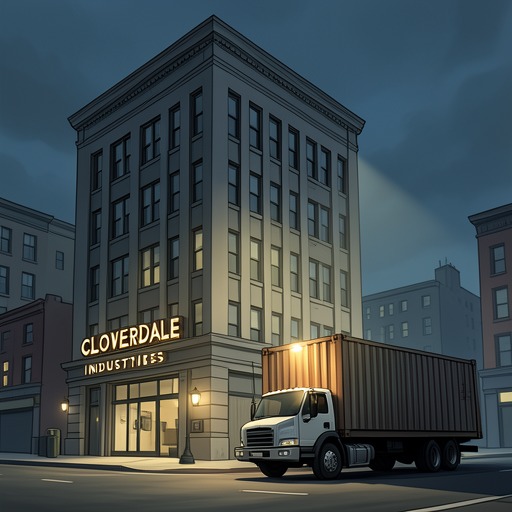
Cal and Kelly reach the Cloverdale Industries facility as outsiders whose intentions have already been recognized as hostile. After Cal is wounded, they scramble through an open bay door into a warehouse that is less full than he expected but extends into darkness for at least 300 yards. Stacks of empty wooden pallets line the back wall, and a janitor’s closet stands about 30 yards away. With the burning sensation in Cal’s arm and the closet close at hand, he chooses concealment there rather than attempting to hide on top of a storage rack.
Inside the facility, Cloverdale security fans out in search of the two suspects. Mel Davis, the head of the security operation, is told by an executive that a man and a woman have breached the perimeter and do not have good intentions. The order is shoot to kill. Davis is accustomed to strict security despite Cloverdale’s public image as a mid-level marketing company, and managers routinely explain the precautions as necessary protection against corporate espionage. He accepts the paycheck and follows instructions, although he has often doubted whether he could actually pull the trigger against the supposed spies.
The threat becomes explicit while Cal and Kelly remain hidden. Four or five employees approach the closet, warn one another that reporters have broken into the facility, and invoke the company’s Golden Rule. They are assigned overnight destinations: Seattle, Portland, and San Francisco. The instructions are to keep a low profile, obey the speed limit, and avoid attracting attention to the product. The speakers then receive the final order: if they see the reporters, they are to shoot them, after which another team will clean up the scene and provide a cover story. The warehouse doors open, forklifts begin moving, and ordinary commerce resumes around a planned killing.
The Physical Discovery
For more than 30 minutes, Cal and Kelly sit motionless in the janitor’s closet while the warehouse operates around them. Each set of approaching footsteps produces the possibility that they will be discovered before anyone has to account for their bodies. When the last audible footsteps fade, Cal presses his face against the cold concrete floor and peers into the warehouse. He sees no feet, but notices a stack of boxes only 10 feet from the closet.
Cal abruptly leaves cover, takes a small box bearing the Cloverdale Industries logo, and returns before re-securing the door. Kelly whispers that he is insane, but Cal explains that if the men intend to kill them, he wants to know why. Using his house keys, he cuts through the packing tape as quietly as possible. The box contains a bottle labeled “Clean and Clear”; instead of cleaning liquid, it holds white crystals. Kelly identifies the substance as crystal methamphetamine. The everyday packaging becomes the crucial object in the investigation: the company’s public identity as a producer of cleaning supplies is contradicted by the material concealed inside its own branded container.
Cal has seen drug use at college parties, though never beyond marijuana, and recognizes the danger of possessing enough crystal methamphetamine to expose himself to a possible 20-year prison sentence if police enter the closet. He asks what the facility really is. Kelly says she has heard that Cloverdale Industries manufactures cleaning products and vitamins as a cover for its drug operation, a rumor she had dismissed because relatives work at the company and do not fit her image of criminals. The bottle supplies what the rumor lacked: direct physical evidence.
Cal then asks Kelly to photograph the crystals. He plans to pour the contents onto the floor and preserve the image while avoiding the risk of carrying the substance out of the facility. The distinction matters because the infiltration produces both evidence and vulnerability. A photograph can support a report without leaving Cal in possession of the drugs, while the bottle itself makes the supposed marketing company materially legible as a distribution point.
Connection to the Marker Program
The discovery later connects Cloverdale’s operation to the FBI’s abandoned CPZ marker research. The program was designed to use CPZ as a chemical marker in drugs, allowing investigators to identify users and major dealer distribution networks. Unusual cases would alert the Centers for Disease Control and Prevention, from which the Federal Bureau of Investigation could obtain basic information about the spread of a dealer’s network.
The program had been field-tested in 2008 by undercover operatives in Seattle, Los Angeles, and Phoenix. In each city, the tainted individual dosage was followed by the user’s death, although the report did not specify the cause. The FBI disbanded the program because the deaths created unacceptable publicity, even though the technique might have served its investigative purpose. The infiltration’s bottle thus points toward a technology that was supposed to generate information about criminal networks but instead became associated with lethal experimentation.
The ethical failure is sharpened by the earlier animal testing. Monkeys reportedly tore at themselves and died, while dogs scratched and clawed themselves to death. Officials concluded that the marker might work in theory but could not ethically be tested on human beings. Walker nevertheless used his chemistry minor to challenge the bureau’s professional judgment. He inserted marker chemicals into drug batches, then placed the chemical in drugs found in Riley Gold’s car because Riley and other players on his team were known to be experimenting with drugs. Walker expected to observe the distribution and trigger the CDC’s detection system, but failed to account for the possibility that the compound would kill people. The infiltration’s discovery therefore reveals not only Cloverdale’s concealment but also the collision between criminal distribution, covert federal research, and unauthorized human experimentation.
Consequences and Significance
The immediate consequence is that Cal and Kelly learn they are not merely trespassers facing arrest. They are targets of an organized effort to eliminate them and fabricate an explanation afterward. The warehouse conversation confirms that Cloverdale’s workers transport a hidden product to several cities, while the kill order demonstrates that secrecy is enforced through planned violence rather than corporate discipline alone. The operation’s scale extends beyond Statenville, and the reporters’ investigation becomes dangerous precisely because it threatens the flow of product and the story that protects it.
The infiltration also alters the meaning of the three deaths. Sheriff Jones’s claim that the victims simply overdosed is no longer an isolated official judgment. Methamphetamine appears at all three scenes, Cloverdale’s warehouse disguises crystal methamphetamine as household merchandise, and the later account of Walker’s marker experiment explains how a contaminated batch could have produced deaths that looked like overdoses. What had seemed to be local misfortune becomes evidence of a chain involving Riley Gold, Cloverdale Industries, CPZ research, and the people responsible for hiding the consequences.
Finally, the break-in exposes the architecture surrounding the company. Nathan Gold finds it difficult to manage even ordinary city affairs while preserving Statenville’s secret; his protection system includes background checks, paid employees, concealed enforcers, and a willingness to use a secluded rocky quarry when persuasion fails. Yet the system is vulnerable to infiltration from within. The Federal Bureau of Investigation places Buddy Walker and Elliott Mercer inside Statenville under deep cover, and Mercer eventually learns the town’s central secret after passing a deliberately designed trust test. The reporters’ entry and the federal operation converge on the same fact: Cloverdale Industries is not simply a suspicious business but the visible facility of a drug network whose survival depends on controlling information, moving product across state lines, and treating witnesses as disposable. The infiltration is therefore the narrative moment when the hidden economy becomes physically and morally undeniable.