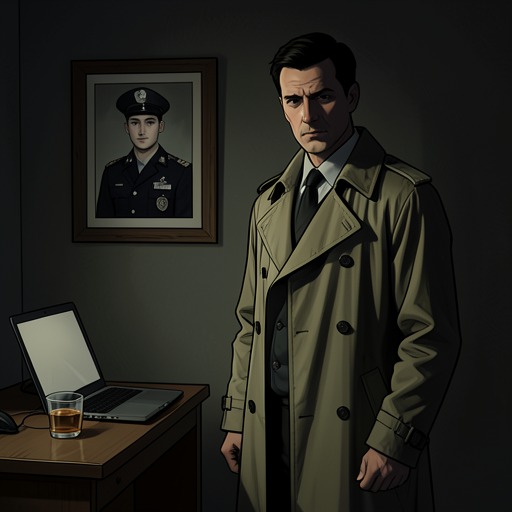
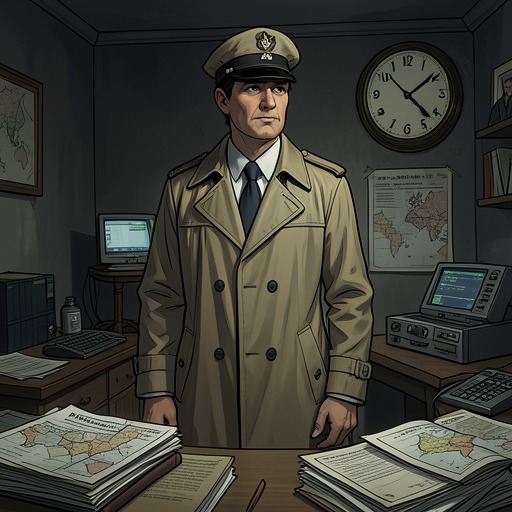
The FBI's deep-cover operation in Statenville
Dead ShotThe FBI's deep-cover operation in Statenville is the federal investigation that embeds Buddy Walker and Mercer in Statenville to penetrate Gold’s Cloverdale Industries drug cartel, identify its full network, and assemble prosecutable evidence against everyone involved. Its decisive significance lies in the collision between patient surveillance and impatient intervention: the operation seeks a comprehensive takedown, but Walker’s attempt to force a breakthrough through chemically marked drugs causes deaths, threatens the investigation, and makes control of the evidence as important as the evidence itself.
Origin and Strategic Design
The operation begins after the Federal Bureau of Investigation links Gold to a distinctive murder signature used first in Boston and later in Portland. The Portland victim was the nineteen-year-old son of U.S. Senator Tom Brazenworth, a case too prominent to disappear, and investigators traced Gold’s new alias back to Statenville. Rumors described an Idaho drug plant operating on a commercial scale, supported by vehicles that moved product throughout the Northwest while remaining difficult to detect. Once Gold’s identity was confirmed, federal agents placed Walker and Mercer in Statenville under deep cover, giving each a false but carefully vetted history, including minor encounters with the law intended to keep Gold from becoming suspicious.
The assignment was broader than arresting Gold alone. Over five years, Walker and Mercer accumulated an extensive body of information about the location and movement of Cloverdale Industries. The Federal Bureau of Investigation wanted Gold, his associates, suppliers, street sellers, and the people moving Cloverdale’s drugs across state lines. The operation therefore treated the cartel as a network rather than a single criminal target: the objective was an expansive sweep capable of dismantling the organization’s regional reach and producing a major public case.
The Cost of Remaining Undercover
Walker’s cover required him to perform ordinary local roles as a basketball coach and part-time janitor. The disguise gave him access to Statenville and to the people connected with Cloverdale Industries, but five years of performance had exhausted his patience. He wanted to leave the town and complete the assignment, while also imagining the impact of a massive news response that would expose Statenville’s hidden drug economy. The fact that he might receive no personal credit mattered less to him than seeing the town disappear behind him.
His frustration was also institutional. Not everyone at the Federal Bureau of Investigation’s Salt Lake field office approved of his tactics, and Walker’s willingness to depart from protocol, use unorthodox methods, and cross legal boundaries made him vulnerable when Chris Cooper began making career-ending accusations. Walker understood that his latest misstep could cost him his job, particularly if he failed to remove the evidence of what he had done. The deep-cover role thus placed him between two forms of exposure: Gold’s suspicion from within Statenville and professional scrutiny from the bureau outside it.
The CPZ Experiment and Its Human Consequences
The operation becomes ethically compromised when Walker begins experimenting with chemical markers intended to identify drug distribution. The Federal Bureau of Investigation had previously considered using CPZ as a marker that could be placed in drugs, allowing unusual cases to alert the Centers for Disease Control and Prevention and enabling investigators to map the spread of a dealer’s network. The idea was tested in 2008 by undercover operatives in Seattle, Los Angeles, and Phoenix, but each tainted dosage was followed by the drug user’s death, after which the program was abandoned.
The danger was not merely bureaucratic caution. Research animals exposed to the marker compounds suffered horrific deaths: monkeys nearly tore themselves apart, while dogs scratched and clawed themselves to death. Officials concluded that the method might work in theory but failed the ethical standard required for human testing. Walker nevertheless believed his minor in chemistry gave him enough knowledge to challenge the bureau’s professional chemists. He persuaded Mercer to help insert the chemicals into drug batches, despite Mercer’s warnings and initial reluctance.
The early batches did not contain enough marker to reveal an entire shipment’s distribution route, and Walker could not control where the treated drugs would travel. He then found a batch of drugs in Riley Gold’s car and chose it as a more concentrated opportunity. Because the coaching staff knew that several players had recently begun using drugs, Walker viewed Riley as an accessible target whose behavior could be observed. He failed to account for the possibility that the compound would kill the people who consumed it. The experiment transformed a surveillance technique into an uncontrolled intervention and made Mercer the surviving witness to both incriminating information about Gold and the role of the undercover agents in the death of Gold’s son.
Secrecy, Gatekeeping, and Exposure
The operation unfolds within a town where official and institutional actors repeatedly restrict information. Jones the Sheriff describes the deaths of three youths, including Devin Reid, as simple drug overdoses rather than murders, while acknowledging that methamphetamine was found at all three scenes. He presents suspicion as insufficient without evidence, but the limited disclosures also prevent Cal Murphy and Kelly Mendoza from examining the larger pattern. Joseph Mendoza similarly tells Cal that the community wants to discuss only funeral arrangements and flowers, a claim that helps convert public silence into an apparent local consensus.
The Register’s editor, Guy Thompson, reinforces the same boundary from inside the news organization. After Cal and Kelly continue digging, Guy orders Cal to visit the sheriff’s office, yet later replaces the hoped-for investigation with a reaction piece. The reassignment reduces the reporter’s work to collecting public responses and leaves the underlying story without the prominence Cal had expected. When Cal and Kelly are threatened, the warning letter identifies them as potential allies while ordering them to remain silent, invent a cover story, and conceal the truth from Kelly and Guy. It promises national attention if they comply with the unknown senders’ timetable and threatens further persuasion if they refuse. The operation’s secret therefore exists alongside a broader struggle over who may know, publish, or suppress the facts.
Cal eventually discovers physical evidence that cuts through these controlled narratives: a box contains a bottle labeled “Clean and Clear” but filled with white crystals that appear to be crystal methamphetamine. Later, his reporting reaches publication in two newspapers. The contrast between the hidden federal operation, the town’s managed explanations, and the final newspaper account shows that information moves through competing channels—surveillance, official statements, intimidation, physical evidence, and journalism—before becoming public knowledge.
Breakdown, Disclosure, and Legacy
Walker’s impatience produces the operation’s central breakdown. Although Mercer tries to separate himself from Walker in public and within the Federal Bureau of Investigation, he also needs Cal to tell a story that presents him as a hero rather than a participant in heinous acts. Mercer’s self-protective position exposes the moral instability of the operation: he possesses vital evidence, but he is not an impartial observer of the deaths or of the experiment that caused them.
The operation is finally disclosed to Cal through Mercer’s revelation that he is not who he appears to be and has been working undercover with Buddy Walker. Mercer also confirms that Walker is dead and warns that Gold intended to add Cal to the growing list of victims. The disclosure changes Cal’s understanding of the people around him and converts his investigation into a precarious collaboration with a compromised federal witness. Even after Cal believes the most dangerous part is over, Dave Youngman tells him that the story is not yet ready and that there remains a criminal to bring down.
As a state rather than a single completed incident, the FBI's deep-cover operation in Statenville is defined by duration, concealment, and accumulation. It survives through false identities and routine local roles, gathers force through years of evidence, and then becomes unstable when one agent tries to manufacture the decisive proof. Its legacy is consequently double-edged: it brings federal attention to Cloverdale Industries and helps make the hidden cartel narratable, but it also reveals how secrecy, ambition, institutional pressure, and unregulated experimentation can corrupt the very investigation intended to expose criminal power.