The attack on Cal and Kelly at Cal’s apartment
Dead ShotThe attack on Cal and Kelly at Cal’s apartment is the decisive ambush that turns an atmosphere of incomplete information into an open campaign of violence. Two masked, armed men arrive in a black van, pursue them across the parking lot, and fire at them as they escape. Cal’s improvised motorcycle flight succeeds, but the attack leaves the pair displaced, hunted, and forced toward Devil’s Canyon, where the wider danger surrounding Cloverdale Industries becomes inseparable from their immediate struggle to stay alive.
Causes and Background
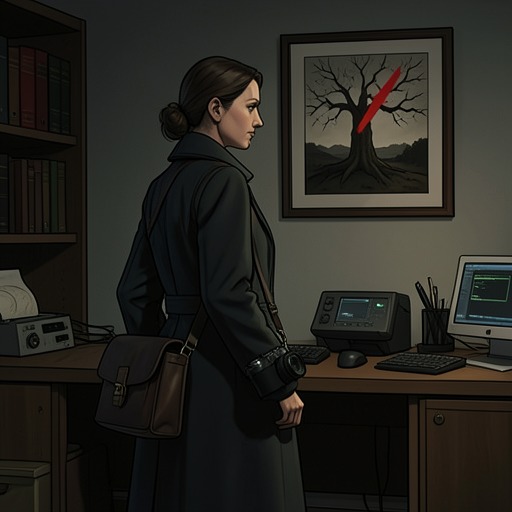
The attack begins at a moment when Cal is already weighing whether to follow a mysterious note’s advice and do nothing. He has deposited the dishes in the sink and is trying to distinguish what he knows from the blanks still surrounding the case; the result is not clarity but near-total uncertainty. Kelly’s return interrupts that hesitant pause. She comes through the front door in hysterics after seeing a black van across the parking lot and reporting that the driver is wearing a ski mask. The threat is therefore first perceived indirectly, through a vehicle, concealment, and a witness’s alarm, before Cal confirms its physical presence.
The attack’s timing gives it special force. Cal is not preparing for a confrontation or equipped for a planned defense. He is sitting at home, attempting to think through an unresolved investigation, when Kelly’s warning turns the apartment into a temporary trap. The mysterious note has encouraged passivity, but the arrival of the van makes inaction impossible. The event thus exposes the cost of trying to remain still in a conflict whose opponents already possess surveillance, weapons, and the initiative.
The Assault and Immediate Threat
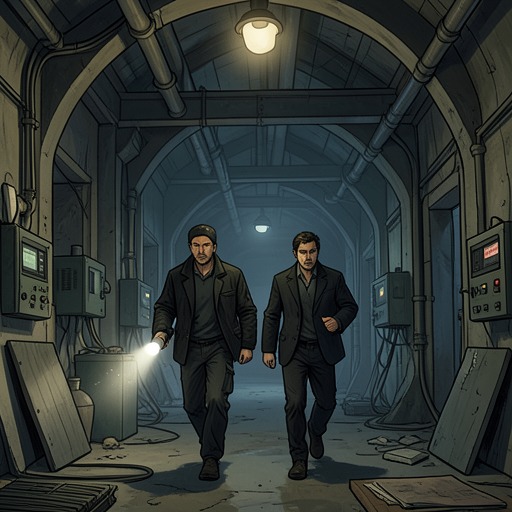
Cal looks from the window and sees two men dressed entirely in black running across the parking lot toward his apartment building. Their assault weapons make the danger unmistakable, while their clothing and masks deny them ordinary identities. The men are not merely approaching to intimidate the occupants; they are organized attackers moving directly on the building. Cal reacts by taking Kelly’s hand and formulating an escape plan rather than waiting to learn what the intruders intend.
Kelly grabs her bag but deliberately leaves the notepad behind. The near-blank paper may persuade the pursuers that Cal and Kelly know little or nothing, so the abandoned object becomes a small act of deception within the larger flight. It also reveals the pressure under which they are operating: even an apparently trivial possession must be judged for whether it could expose their knowledge or prolong the pursuit.
Cal leads Kelly out through the back door toward the small private garages behind the apartment unit. He fumbles for his keys while running, manages to insert the key on his first attempt, and slams the garage door behind them. The movement is hurried but purposeful: the apartment’s exits and the attackers’ approach leave no time for explanation, and Cal’s practical knowledge of the garage supplies the pair with an alternative route when the front of the building is compromised.
Inside, Cal uncovers a Honda 280XR dirt bike. Kelly does not initially understand why he has brought her there, but Cal identifies the motorcycle as what will save their lives and tells her to get on. He pushes it near the door and stomps on the foot crank. The engine starts on the second kick, giving the escape a narrow but crucial opening. The bike is not the fastest machine, yet its zero-to-sixty acceleration is exactly suited to the immediate need: they require a rapid burst away from the building, not a long contest of speed.
Escape Under Fire
Cal anticipates that the two attackers will split up, with one coming around the front and the other along the near side of the building. He points the motorcycle toward the far side and opens the engine wide. The escape is not a blind reaction; it is a quick tactical calculation based on the attackers’ likely positions and the building’s layout. Cal chooses the route that gives the pair the greatest chance of reaching the farthest exit before the men can close the gap.
The danger peaks when Cal looks back and sees one attacker aiming an automatic assault weapon. Bullets pass near their heads, and Kelly screams in terror. Cal suppresses his own desire to scream, banks left around the building, and heads toward the distant exit. The scene compresses thought, physical movement, and fear into the same instant: Kelly’s scream registers the human terror of the attack, while Cal’s controlled riding converts that terror into action.
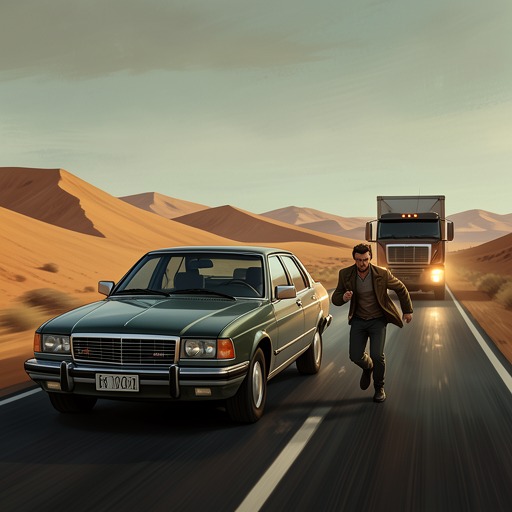
After another thirty seconds of riding, Cal’s strategy works. The two men disappear from sight; the last image he has of them is a frantic dash back toward their truck. Cal knows that the distance he has created will allow him to be gone before they can resume the chase. The value at stake shifts from apparent safety to imminent death and then, provisionally, back toward survival. The apartment no longer represents shelter, and the motorcycle becomes the instrument of escape that makes continued resistance possible.
Devil’s Canyon and the Wider Pursuit
Cal tells Kelly that he knows a place where the attackers will never find them. When she asks where, he names Devil’s Canyon. The destination is not chosen at random. Devil’s Canyon is a dirt-bike enthusiast’s haven, made up of rolling dirt hills extending for miles without man-made objects. Four-wheeled vehicles perform poorly there, with even Land Rovers and Jeeps struggling across the terrain, while caves provide hiding places if someone spots the fugitives.
The timing of the flight matters. It is two o’clock, and the canyon is quiet, but by four o’clock it will be filled with the buzz of two-stroke engines as riders arrive. Cal and Kelly therefore need to disappear before the ordinary activity of the area begins. The same setting that offers concealment also imposes a deadline: once the canyon fills with riders, their presence may become harder to control, and the opportunity for a discreet hiding place may narrow.
Cal’s dirt-biking skills give him an advantage in this terrain, extending the escape beyond the apartment and into a landscape designed to defeat pursuit by road vehicles. Yet the canyon is not an absolute refuge. A long chain-link fence forms a surprisingly secure perimeter around the back property of Cloverdale Industries, nearly two miles away. Cal recognizes that riding toward it would be pointless, and the fence marks the boundary between a temporary hiding place and the industrial power connected to the danger pursuing them. His route away from the apartment therefore also carries him toward the larger geographic and institutional presence of Cloverdale Industries, even as he avoids crossing its perimeter.
Consequences and Significance
The attack changes Cal and Kelly’s status from investigators trying to fill gaps in a troubling case into fugitives whose survival depends on movement, concealment, and tactical judgment. Before the assault, Cal can still consider doing nothing because the facts remain incomplete. After masked men with assault weapons fire at them, uncertainty itself becomes evidence of danger: someone is willing to act against them before they understand the full structure of the threat.
The event also establishes the partnership under pressure. Cal takes command of the escape, but Kelly contributes alertness, follows his instructions, retrieves what she can carry, and leaves behind the notepad as a calculated misdirection. Their survival depends on complementary responses rather than on a single heroic gesture. Cal supplies planning and technical skill; Kelly’s warning makes the plan necessary, and her immediate choices help preserve their chance of disappearing.
Narratively, the black van and ski mask create an initial layer of terror before the attackers are fully seen; the later image of two men in black carrying assault weapons converts that unseen threat into visible horror, and the bullets passing their heads make the danger physically immediate. The attack’s strongest consequence is not simply that Cal and Kelly escape. It is that escape becomes the governing condition of what follows. The Honda 280XR dirt bike, the private garages, the far exit, the missing pursuers, and Devil’s Canyon form a chain of practical decisions through which the story crosses from investigation into open conflict, with Cloverdale Industries waiting beyond the canyon’s fence as a larger and more dangerous horizon.