The rescue at Walker’s barn
Dead ShotThe rescue at Walker’s barn is the decisive reversal in the pursuit of Cal Murphy and Kelly Mendoza. Sheriff Jones sends Jake Dawkins to Buddy Walker’s property under the pretense of investigating a disturbance, but the real objective is to arrest the two reporters on more fabricated charges. Instead, Dawkins’s forced entry leads him to a bound Federal Bureau of Investigation agent, while Cal and Kelly are released from captivity and later found by Guy Thompson. The episode changes the value at stake from the reporters’ immediate imprisonment to a dangerous, uncertain freedom and reveals that the apparent local crime story is entangled with a federal operation.
Causes and Background
The raid grows out of the campaign against Cal Murphy and Kelly Mendoza after they continue investigating the suspicious deaths of three young men despite official insistence that the victims merely overdosed. Sheriff Jones dismisses the deaths as drug overdoses, identifies Devin Reid as the third victim, and says methamphetamine was found at all three scenes; he nevertheless insists that suspicion is not evidence. The official account is therefore presented as settled before toxicology reports return, while the reporters’ questions threaten the town’s preferred version of events. The pressure reaches Cal directly when he is arrested on trumped-up charges of possessing an open container and driving under the influence. Cal knows the charges will not withstand scrutiny: he rarely drinks and had not been driving with alcohol in his car. He understands the arrest as a bullying tactic intended to stop his inquiry, and his confinement makes clear that the secret he is approaching is more threatening to powerful people than the supposed offenses themselves. The Register is also part of the pressure system. Guy Thompson first orders Cal to go to the sheriff’s office and report back, insisting that Kelly remain with him so the paper can obtain a dominant photograph for Wednesday’s edition. Later, however, Guy complains that the town wants only funeral arrangements and flowers for the dead boys’ families, and he orders Cal to write a reaction piece instead of the investigative story he is pursuing. The rescue thus follows a conflict over both physical liberty and control of information: Cal and Kelly are being obstructed by the sheriff’s department while their own editor is being pushed toward a safer, less consequential version of the news.
The Raid on Walker’s Property
Jake Dawkins arrives at Walker’s house with rookie deputy Willie Warren after Sheriff Jones radios about a supposed disturbance. Dawkins and Warren have just been eating ribs from Ray-Ray’s when the call comes, and Dawkins initially has no reason to believe the situation is dangerous. Only after he is in the patrol car does Jones tell him that the disturbance is actually the location of Statenville’s most wanted fugitive, Cal Murphy, and that Cal and Kelly are about to be arrested on another set of fabricated charges. The law-enforcement response is staged as intimidation as much as procedure. Dawkins takes his time leaving the car, while Warren circles behind the house to prevent escape. Because Warren does not know Cal or Kelly, he draws his gun so the fugitives will understand that the deputies are serious. The scene turns the ordinary machinery of a local arrest into an armed confrontation, even though the officers have been given no evidence that the occupants pose a danger. Inside the house, Cal and Kelly hear pounding on an exterior door. Their mouths are covered, their movement is restricted, and their muffled screams continue while Dawkins waits outside. Dawkins becomes concerned that the prolonged tension may cause Warren to do something foolish, so he retrieves a battering ram. He needs three heavy blows to break open the door, then rushes inside with his weapon drawn; Warren follows, handling his gun as if this is his first potentially combative situation, which it is. The officers search the house after hearing what sounds like two minutes of pleas for help. They find no one in the rooms on either side of the hall, and the search becomes a tense sequence of delay, uncertainty, and misdirection. When Dawkins finally flings open the relevant door, Cal and Kelly do not know whether the person entering will be their savior or another tormentor. The text holds their fear at the threshold, making rescue itself an ambiguous prospect before the identity of the captive is disclosed.
The Federal Agent and the Reversal
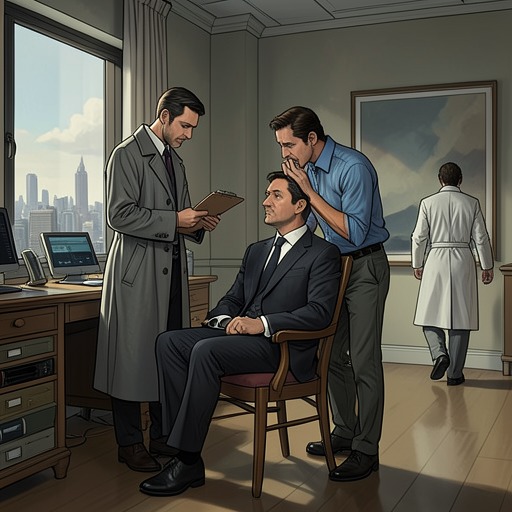
Dawkins finds an unfamiliar man lying on the floor in darkness. The man is bound with duct tape at the hands and feet, and another strip covers his mouth. Dawkins removes the tape and asks who he is and what he is doing there. The man identifies himself as special agent Chris Cooper from the Federal Bureau of Investigation and demands help getting up. This discovery abruptly changes the meaning of the raid. Dawkins had arrived believing he was pursuing Cal and Kelly as local fugitives, but the person he finds restrained inside Walker’s house is a federal agent. The supposed disturbance is therefore connected to an operation larger than the sheriff’s stated purpose. Cooper’s presence also complicates the distinction between rescuer and prisoner: the raid liberates an agent who may know more than the deputies, but it does not immediately explain whether Cooper was investigating Walker, working with him, or using the property for another purpose. Dawkins refuses to accept Cooper’s request without an answer to his second question. Cooper later leaves in a Cadillac Escalade, and Dawkins watches the vehicle’s taillights disappear from the front yard. The agent’s arrogance angers him, particularly because Cooper has mocked, lied to, and humiliated him after Dawkins untied him. Yet Dawkins does not need a definitive confession to grasp the crucial fact. He realizes that Walker is also a federal agent. The rescue therefore supplies not a neat resolution but a new map of the conspiracy, with federal identities concealed inside the same setting where local authorities are attempting to silence reporters.
Cal and Kelly’s Release
While Dawkins and Warren are trying to locate the source of the screams, Cal and Kelly remain immobilized and uncertain about what will happen next. Cal chooses not to fight Buddy Walker, deciding that pleas for mercy are more useful than lectures about his mistreatment. Walker appears interested in removing the reporters temporarily from the investigation rather than killing them, since he has had opportunities to cause greater harm but repeatedly chooses restraint. That apparent mercy puzzles Cal, because it does not fit the violence and coercion surrounding their abduction. The value shift occurs when the door opens and the threat of continued captivity is broken. The evidence presents Dawkins’s intervention as the immediate cause of the reporters’ release, even though the person he encounters first is Chris Cooper rather than Cal or Kelly. Their confinement has been made part of a layered deception: local officers believe they are conducting an arrest, the reporters fear another assault, and the federal presence is hidden in the house. The result is freedom without safety, because the rescue exposes the existence of forces that remain beyond the reporters’ control. The event also places Cal and Kelly’s relationship under pressure without separating them. They are held together, hear the same pounding, endure the same uncertainty, and face the door as a pair. Their shared captivity reinforces the investigative partnership that authorities and their opponents are trying to disrupt. Escape from the room does not end the danger; it confirms that their questions have drawn them into a conflict in which arrest, abduction, and official investigation can be made to look alike.
Aftermath and Narrative Significance
The immediate aftermath produces two different kinds of rescue. Dawkins frees Chris Cooper from physical restraints, while Guy Thompson later frees Cal and Kelly from the same coercive scene. Cal has been frightened throughout the day about his next encounter with Guy, but when Guy bursts through the door, fear gives way to relief. Guy tears the duct tape from both reporters’ mouths, and Cal embraces him in gratitude even though Guy does not seem to welcome the embrace in the tense circumstances. Guy’s arrival restores the pair to the newspaper, but not to their former assumptions about the institution that employs them. His first response is to ask what they have gotten themselves into, recalling that he had earlier demanded a harmless reaction piece and warned them against producing an investigation that might anger the sheriff and publisher. The rescue therefore does not erase the editorial conflict; it brings the endangered reporters back into the information system that has already tried to contain them. The event’s larger consequence is its connection to the later public circulation of Cal’s reporting. A story by Calvin J. Murphy appears in two newspapers the next day, showing that the reporters’ experience eventually reaches print despite arrests, threats, captivity, and editorial resistance. Earlier, an anonymous letter had warned Cal to keep the events of the previous night secret, avoid telling Kelly or Guy, and create a cover story, while promising national attention if he obeyed and threatening other forms of persuasion if he did not. Against that demand for silence, the rescue becomes part of the chain by which concealed violence and competing authorities move toward publication. As an event in the novel’s discourse, the raid is presented through interrupted perspectives and withheld recognition. Cal and Kelly hear the rescue before they see its agent; Dawkins enters expecting a fugitive arrest but finds a bound federal operative; Cooper’s identity answers one question while creating another about Walker. The sequence converts an apparently local police action into evidence of systemic concealment. Its final significance lies in that reversal: the authorities who claim to be restoring order instead reveal that order has been constructed through false charges, controlled narratives, hidden agents, and the forcible removal of witnesses.