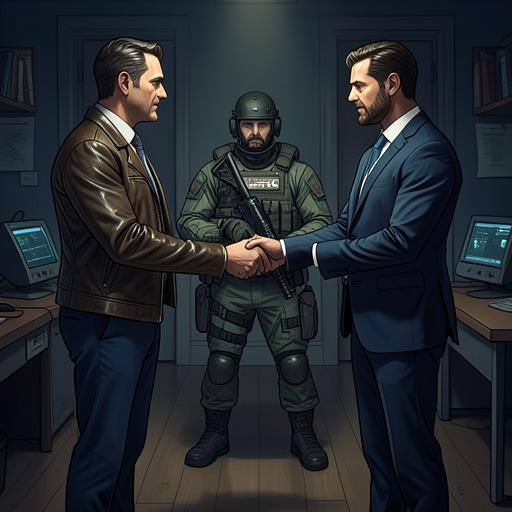
Yukon Grant
Dead ShotYukon Grant is the professional grifter and enforcer employed by Nathan Gold to protect Statenville’s hidden drug operation. Once unable to secure ordinary work even with a GED, Yukon had turned to crime and served time in jail; Gold later found a use for the skills Yukon acquired in prison. The arrangement gives Yukon money, status, and a way out of petty theft, but it also makes him disposable whenever his usefulness ends.
Criminal Background and Place in the Network
Yukon’s past is defined by economic desperation and criminal adaptability. He had already been to jail after resorting to crime to make ends meet, and his failure to find legitimate work in Statenville left him with few prospects. Gold’s organization transformed those liabilities into assets: Yukon became capable of intimidation, pursuit, abduction, and murder, while the town’s illicit economy rewarded him far better than ordinary employment could have done.
He operates below Gold in the hierarchy but is more than a casual thug. Gold relies on him for work that cannot be entrusted to respectable officials or openly connected employees. The organization’s secrecy depends on payments, silence, and violence, and Yukon supplies the last of these. His employment also reveals how the network absorbs people who have been excluded from conventional economic life, offering them prosperity in exchange for becoming instruments of concealment.
Pursuit of Cal Murphy and Kelly Mendoza
After Cal Murphy and Kelly Mendoza begin moving closer to the truth about the three suspicious deaths, Gold expects Yukon to correct the danger. Yukon drives a black Ford F-250 and searches the road from Statenville toward Salt Lake City, scanning the approaching headlights for the motorcycle he believes Cal and Kelly are using. Blood on his hands reassures him that the remaining task is within reach, while the possibility that the reporters might broadcast their account makes the stakes clear: their survival could expose the entire operation.
Yukon’s intention is not merely to frighten the reporters into silence. He imagines killing them and leaving their bodies in Cold River Canyon, his preferred dumping ground. The thought of repeating the violence gives him confidence, and he believes that this time he will finish the job. His language and behavior place him firmly on the side of the organization’s shadow economy: the reporters are obstacles to be removed, not people whose allegations might require an answer.
At the restaurant, Cal recognizes the roar of Yukon’s engine as the sound associated with the earlier road ambush. Yukon emerges from the Ford F-250, strikes Cal, and confronts him while Kelly is seized. He grabs Kelly with one hand and carries a crowbar in the other, then forces Cal toward the rear of the parking lot and the truck. Cal wants to resist and protect Kelly, but he understands that Yukon’s physical advantage makes a direct fight impossible.
Yukon loads Kelly into the pickup bed, tears away her backpack, and confiscates the evidence she has been carrying. He binds her feet, ties her arms against her body with rope, and gags her; Cal receives the same treatment. He then covers both reporters with a tarp and secures it with bungee cords at all four corners. The procedure is practical and methodical, turning the truck into a temporary transport and concealment chamber while Yukon celebrates the belief that his way of life has been saved.
Failure at Cold River Canyon
Yukon reports the capture to Gold, expecting the delivery of two helpless prisoners. Gold travels to Cold River Canyon to see the reporters die himself, but when Yukon pulls back the tarp, the captives are gone. Four sacks of potatoes remain beneath the lower tarp, while the upper tarp has disappeared. The failed deception immediately changes Yukon’s position: an operation he believed was complete becomes a security breach capable of exposing Cloverdale Industries.
Yukon recognizes that his failure has allowed a manageable situation to become more dangerous. Cal and Kelly are now harder to locate, and the evidence may still reach the outside world. Gold responds not with concern for Yukon but with rage and a direct ultimatum: Yukon must find the reporters or not return to Statenville. The command makes the organization’s internal morality unmistakable. Yukon is valuable only while he produces results; the moment he fails, payment, protection, and belonging disappear.
Loyalty, Fear, and Withdrawal
Gold’s order does not inspire renewed loyalty. Yukon realizes that even success will not guarantee another payment, and he refuses to launch a search stretching across multiple counties toward the Idaho border. Instead, he decides to go home, pack his bags, and disappear. His experience as a professional grifter makes escape seem possible; he assumes that another town may contain an employer willing to pay for the same services.
This withdrawal is not a moral conversion. Yukon does not repent of the violence against Cal and Kelly or reject the drug operation because it harms Statenville. He leaves because Gold has exposed the limits of their bargain and because the organization has become dangerous to him personally. He wants to avoid both death and prison, abandoning the reporters, Gold, Cloverdale Industries, and Statenville together.
Narrative Function and Significance
Yukon functions as the visible edge of a much larger structure. Local officials can disguise deaths as drug overdoses, suppress evidence, and arrest Cal on fabricated charges, while Gold directs the broader system from political authority and Cloverdale Industries supplies its economic foundation. Yukon converts that hidden power into immediate bodily threat. His black truck, crowbar, rope, tarp, and pursuit across the highway give the secret a physical form.
His trajectory also contrasts with the organization’s more deeply embedded participants. Guy Thompson accepts regular payments to ignore Statenville’s secret, and Gold justifies concealment as a defense of the town’s prosperity; Yukon is less capable of sustaining such civic language. His motives remain bluntly material: money, survival, and the freedom to avoid returning to prison. That directness makes him a useful instrument for Gold but an unstable member of the network.
The failed abduction finally exposes the network’s disposable logic. Yukon begins as the man expected to erase the danger created by Cal Murphy and Kelly Mendoza, yet his mistake turns him into another liability that Gold is prepared to discard. His decision to vanish is therefore both an escape and a sign of structural fracture. The system can command violence, but it cannot create genuine loyalty among the people it purchases; when protection becomes conditional on perfect usefulness, even its enforcer chooses flight.