Howard Wagner
Death of a SalesmanHoward Wagner, the thirty-six-year-old son of the company's founder Frank Wagner, is the president of the Wagner Company and the man who terminates Willy Loman's employment after thirty-four years of service. He represents the new, impersonal face of American business—a world of wire recorders, bottom-line calculations, and a complete absence of the personal loyalty and gratitude that Willy believes he is owed. His cold efficiency in dismissing Willy marks a decisive turning point in the play, stripping Willy of his last source of income and pushing him further toward his final, desperate act.
Identity and Position
Howard Wagner is a young, modern executive, described in the stage directions as being thirty-six years old. He is first seen wheeling on a small typewriter table on which sits a wire-recording machine, a new technological toy that fascinates him. He is intent on threading the machine and only glances over his shoulder as Willy appears. His office is the setting for the pivotal confrontation, and his demeanor throughout is that of a busy man who has no time for sentiment. He is the son of Frank Wagner, the old man Willy revered, but he shares none of his father's apparent warmth or sense of obligation. Howard's world is one of gadgets, efficiency, and the cold logic of business.
The Confrontation and Dismissal
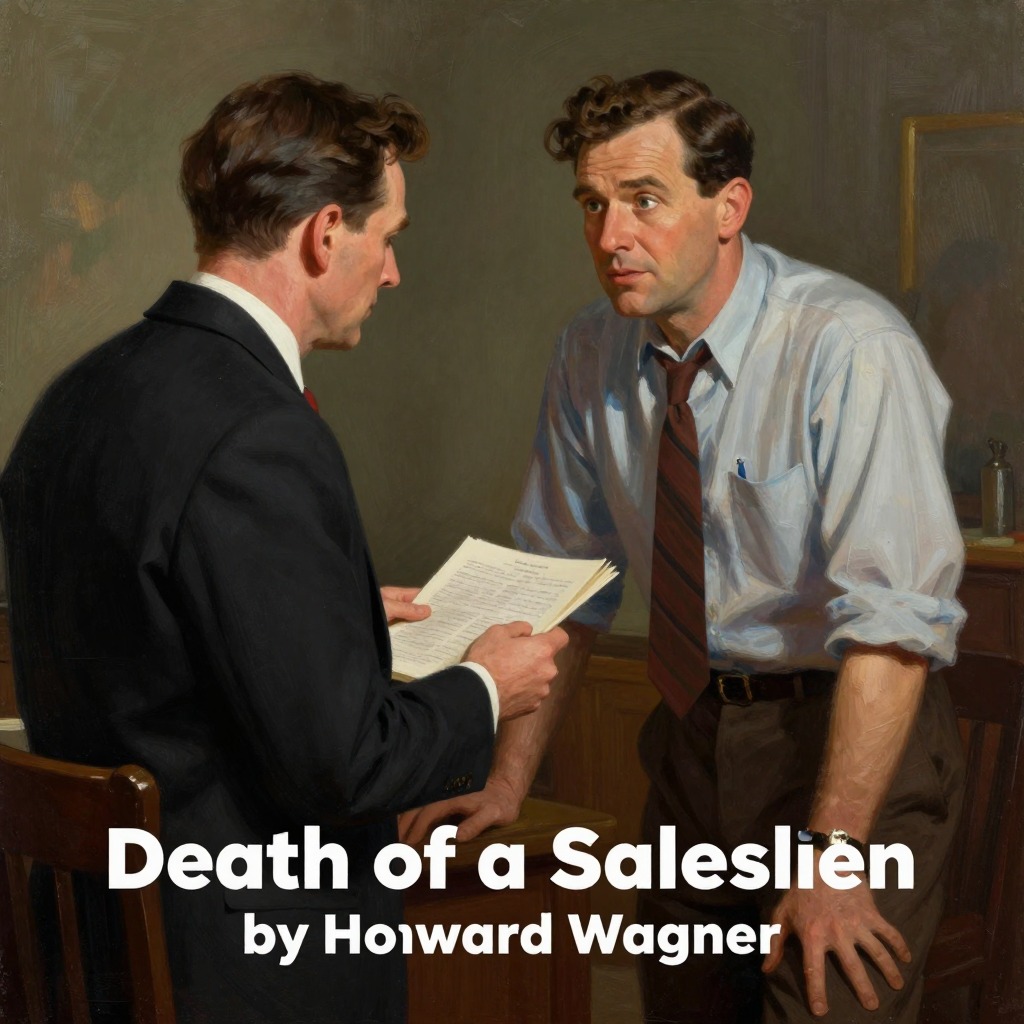
Willy comes to Howard's office to ask for a transfer to a non-traveling job in New York, pleading that he is tired and can no longer handle the road. Howard, however, is barely interested. He first insists on demonstrating his new wire recorder, playing back recordings of his daughter whistling, his son reciting state capitals, and his wife's awkward silence. This display of domestic technology, which Howard calls "the most fascinating relaxation I ever found," cruelly underscores his indifference to Willy's desperate situation. When Willy finally manages to state his request—to work in town for sixty-five dollars a week—Howard dismisses it flatly: "I couldn't think of anything for you, Willy." He insists that "everybody's gotta pull his own weight" and that "business is business." Willy, growing desperate, recounts the story of the eighty-four-year-old salesman Dave Singleman, who inspired him to choose selling as a career, and reminds Howard of the promises made by his father. Howard remains unmoved. When Willy raises his voice, Howard tells him to "pull yourself together" and, in a final blow, fires him: "I don't want you to represent us. I've been meaning to tell you for a long time now." He tells Willy he needs "a good long rest" and instructs him to drop off his sample cases. The firing is delivered with a chilling, bureaucratic finality.
Significance and Thematic Role
Howard Wagner is the embodiment of the corporate system that has discarded Willy Loman. He is the direct opposite of the idealized, personal business world Willy remembers, where a man like Frank Wagner would put his hand on a salesman's shoulder and make promises. Howard's world is one of wire recorders, not human connection; of "business is business," not loyalty. He is the agent of Willy's final professional humiliation, and his casual cruelty—suggesting that Willy's sons should support him—reveals a complete lack of understanding of Willy's pride and his desperate need to be a provider. Howard's function in the play is to demonstrate that the American Dream of success through personal charm and being "well liked" has been replaced by a ruthless, impersonal capitalism that has no use for a tired, sixty-three-year-old salesman. He is the final, official confirmation that Willy's life's work has been for nothing, and his dismissal is the immediate catalyst for Willy's final, fatal decision to trade his life for the insurance money he believes will give Biff a future.
The character of Howard Wagner has appeared in numerous adaptations of the play across different media. In the 1951 American film adaptation, Kevin McCarthy portrayed Howard and received an Academy Award nomination for Best Supporting Actor. The role was also played by Gene Wilder in the 1966 CBS television film, by Brian Davies in the 1966 BBC production, and by Stephen Lang in the acclaimed 1985 television film directed by Volker Schlöndorff. Other notable portrayals include Ted Koch in the 2000 television film and Richard Thompson in the 2015 BBC radio drama directed by Howard Davies. These varied interpretations have consistently emphasized Howard's role as the impersonal face of corporate capitalism, a figure whose cold efficiency contrasts sharply with Willy Loman's nostalgic view of business relationships.