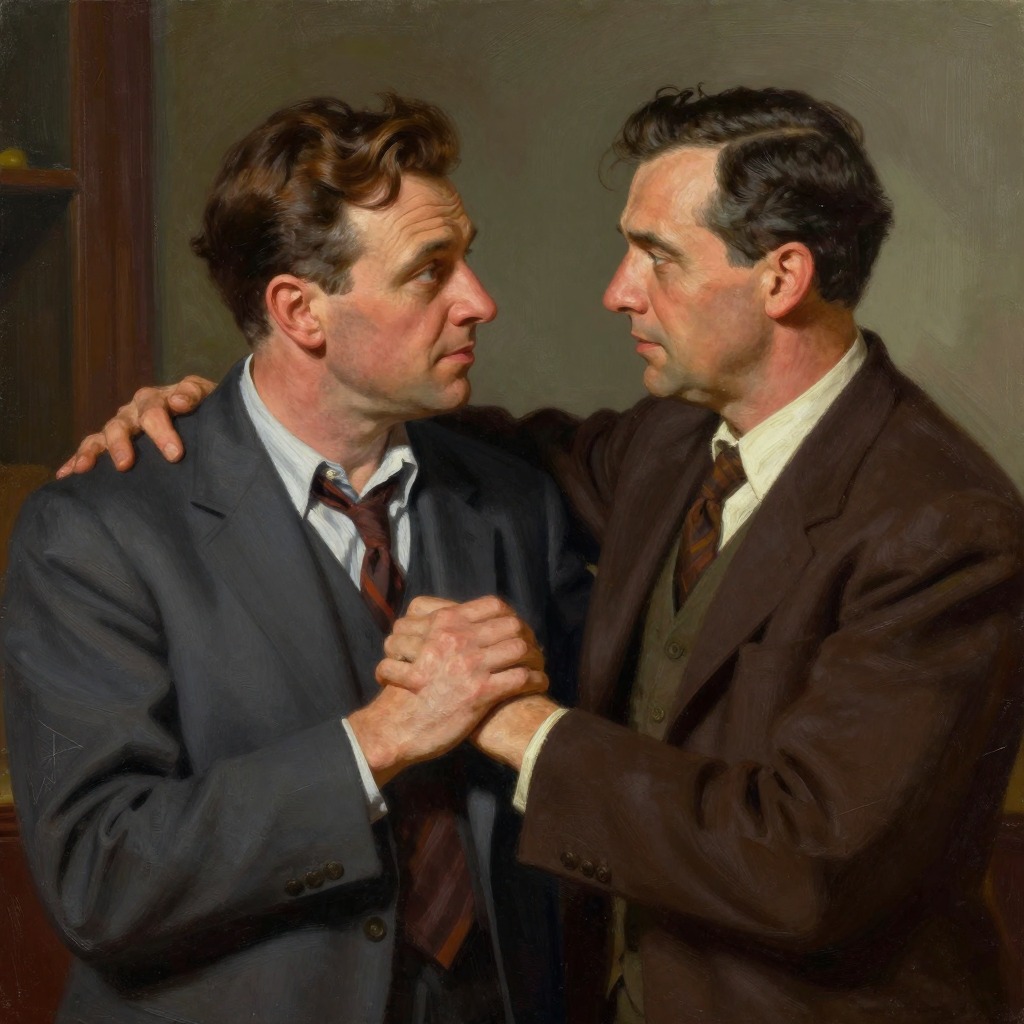
Never fight fair with a stranger
Death of a SalesmanNever fight fair with a stranger is a principle of survival and success delivered by Uncle Ben, the embodiment of raw, unapologetic ambition in Arthur Miller's Death of a Salesman. The rule is not merely stated but physically enacted during Ben's single visit to the Loman home, when he challenges the teenage Biff to a boxing match. After sparring briefly, Ben suddenly trips the boy and stands over him with the point of his umbrella poised at Biff's eye, declaring, "Never fight fair with a stranger, boy. You'll never get out of the jungle that way." The lesson is a brutal, theatrical demonstration of a worldview in which conventional ethics are a liability and victory is the only measure of worth.
Origin and Context
The rule emerges from Ben's own life story, which he recounts as a parable of self-made fortune. He tells Willy and the boys that at seventeen he walked into the jungle, and at twenty-one he walked out rich. The "jungle" is both literal—the African diamond mines where he made his wealth—and metaphorical, standing for any competitive arena where the weak are devoured. Ben's philosophy is one of total self-reliance, unencumbered by sentiment, loyalty, or fairness. He has no time for the niceties of social approval; his only concern is the outcome. This stands in direct opposition to the values Willy has been instilling in his sons: that being "well-liked" and having "personality" are the keys to success. Ben's rule is a cold corrective to Willy's dream, suggesting that the world is not won by charm but by a willingness to exploit any advantage.
The Lesson and Its Recipient
The immediate recipient of the lesson is Biff, who is at the height of his high-school glory, confident and adored. Ben's challenge is a test, and Biff's failure to defend himself—he is easily tripped and pinned—reveals his unpreparedness for a world that does not play by the rules of the football field. Linda, watching, is frightened and protests, "Why must he fight, dear?" but Willy is thrilled, seeing the encounter as proof of his son's manliness. The irony is that Willy misreads the lesson entirely: he celebrates Biff's willingness to fight, but Ben's point is that one must fight unfairly. The rule is a gift of hard knowledge, but it is one that Willy, in his desperate optimism, cannot truly accept or pass on.
Contrast with Willy's Philosophy
The rule "Never fight fair with a stranger" forms a stark binary with Willy's core belief that "the man who makes an appearance in the business world, the man who creates personal interest, is the man who gets ahead." Willy teaches his sons that doors open to those who are liked; Ben teaches that survival depends on being ruthless. The two philosophies are never reconciled in the play. Willy admires Ben's success but cannot adopt his methods, clinging instead to the fading hope that his own charm and his sons' potential will eventually pay off. Ben's rule haunts the margins of the play, a reminder of a path not taken—a path that might have led to wealth but would have required abandoning the very human connections Willy craves. In the end, Willy's adherence to his own, gentler code leaves him with nothing, while Ben's legacy is one of cold, unassailable achievement.
Thematic Significance
As a rule, "Never fight fair with a stranger" functions as a compressed statement of the play's critique of the American Dream. It exposes the gap between the dream's public face—merit, hard work, fair play—and its private reality, which often demands a Darwinian struggle. Ben, who has succeeded by this code, is a figure of awe and envy for Willy, but he is also a figure of moral emptiness. He has no family ties, no loyalty, no warmth; he is a machine for generating wealth. The rule, therefore, is not just a piece of advice but a diagnosis of a society that rewards the predator and discards the gentle. Willy, who cannot bring himself to live by this rule, is left defenseless, a man who has bet everything on being liked in a world that has stopped smiling back.