Stanley
Death of a SalesmanStanley is a young waiter at Frank's Chop House on Forty-eighth Street near Sixth Avenue in New York, where the Loman family has arranged a celebratory dinner. He appears only in Act Two, during the restaurant scene that caps the day of Willy Loman's firing by Howard Wagner and Biff Loman's disastrous attempt to secure a loan from Bill Oliver. Though a minor character with few lines, Stanley serves as an unwitting witness to the family's unraveling, his professional cheerfulness and casual observations throwing the Lomans' desperation into sharp relief.
Role in the Restaurant Scene
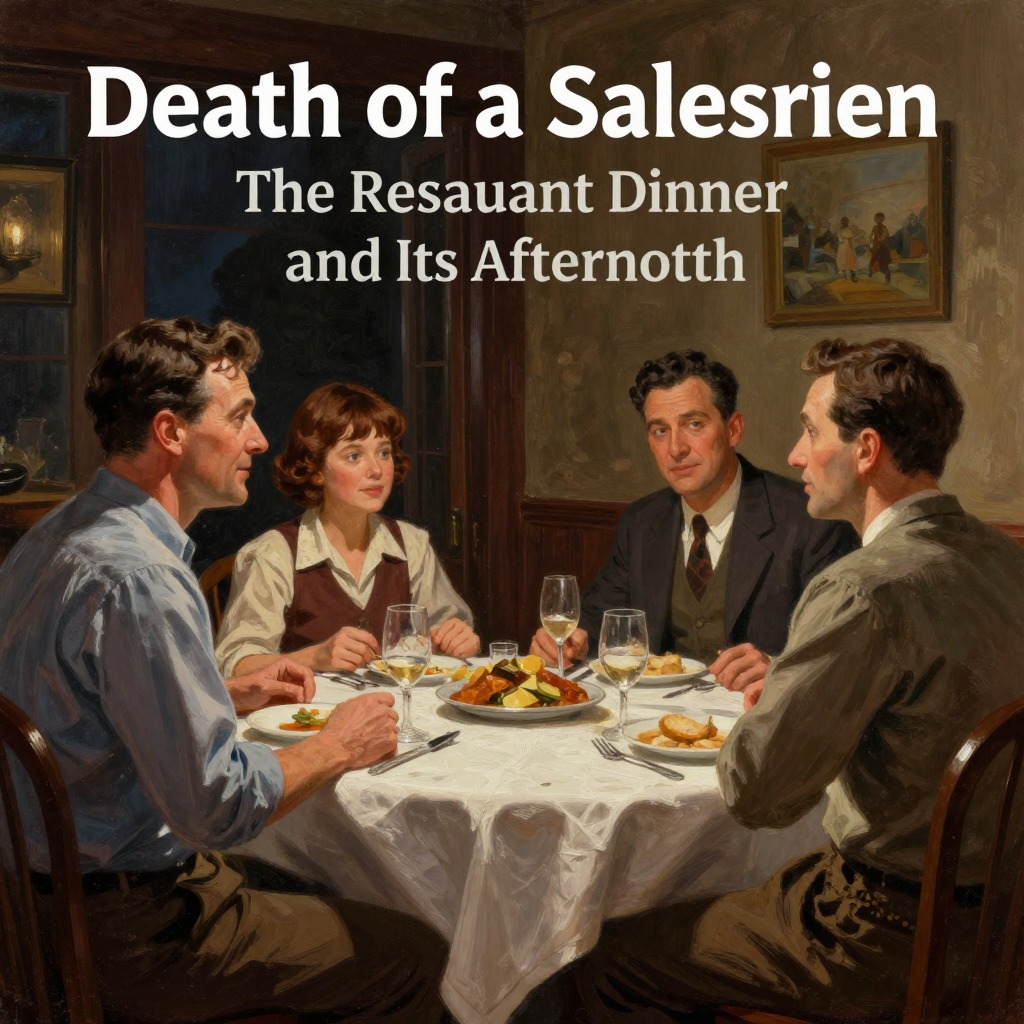
Stanley first enters carrying a table, followed by Happy Loman carrying two chairs, and sets up a private area in the back of the restaurant at Happy's request. He is eager to please, assuring Happy that he can handle the setup himself and that the back section is quieter, away from the noise of the main dining room. He speaks familiarly with Happy, who is a regular customer, and makes small talk about the restaurant business, noting that many people prefer to be in the middle of the action when they go out because they are "sick and tired to stay in the house by theirself." When Happy mentions that his brother Biff is back from the West and that his father is coming too, Stanley responds with enthusiasm, calling a family business "the best" because if someone steals, "it's in the family." He takes Happy's order for lobsters with claws and a special champagne recipe Happy brought back from overseas, and he is visibly impressed when Happy correctly predicts the arrival of a furred, lavishly dressed girl at the next table, exclaiming, "Geez, you got a life, Mr. Loman."
Witness to the Family's Collapse
When Willy arrives at the restaurant, Stanley sets a chair for him and stands by waiting for orders. As the dinner conversation deteriorates into a confrontation between Willy and Biff over Biff's theft of Bill Oliver's fountain pen, Stanley is present but peripheral. The scene shifts into Willy's memory of the Boston hotel room where Biff discovered his affair with The Woman, and Stanley is momentarily forgotten. When the memory subsides, Stanley returns to find Willy shouting and disoriented, having struck Biff and then wandered off toward the washroom. Stanley helps Willy to his feet, telling him, "Your boys left with the chippies. They said they'll see you home." He reassures Willy that he looks all right, flicks a speck off his lapel, and refuses a dollar tip, explaining that Willy's son has already paid. Willy insists on giving him the money, saying, "I don't need it any more," and then asks if there is a seed store in the neighborhood, revealing his intention to plant a garden despite the late hour. Stanley directs him to hardware stores on Sixth Avenue but warns it may be too late. As Willy hurries out, Stanley watches him go, then turns to another waiter who has been staring and asks, "Well, whatta you looking at?" before clearing the table.
Significance
Stanley functions as a representative of the ordinary world that Willy Loman can no longer navigate. His efficient, unflappable professionalism contrasts with Willy's disorientation and the sons' abandonment of their father. Stanley's casual remark that a family business is best because theft stays "in the family" echoes ironically against the Lomans' own internal betrayals—Willy's theft of his wife's trust through his affair, Biff's theft of Oliver's pen, and the family's theft of honesty from one another. His final question to the staring waiter, "Well, whatta you looking at?" suggests that even the restaurant staff recognizes something profoundly wrong, yet Stanley himself remains detached, a functionary who serves and clears without judgment. He is a flat character in E. M. Forster's sense, built around a single idea of competent service, but his presence marks the moment when Willy's private tragedy becomes a public spectacle, witnessed by strangers who will remember only a confused old man asking for seeds.
Although Stanley is a minor character with limited stage time, he has been portrayed by various actors across the play's many adaptations. In the 1951 American film, the role was played by an uncredited actor, while later television productions featured more recognizable performers: James Farentino appeared as Stanley in the 1966 CBS television film, and Owen Teale took on the part in the 1996 television film directed by David Thacker. The 2000 television film featured Richard Thompson in the role, and the 2015 BBC radio drama cast an actor as Stanley under Howard Davies's direction. These portrayals have consistently highlighted Stanley's role as a witness to the Loman family's unraveling, his brief but telling interactions with the family serving to underscore their public embarrassment and the widening gap between their aspirations and reality.