Colonel Race
Death on the NileColonel Race is an investigator pursuing a dangerous political agitator aboard the Karnak when he encounters Hercule Poirot and becomes his partner in examining the crimes on the boat. His parallel investigation eventually identifies Signor Richetti, while his willingness to revisit an attractive but inadequate theory helps bring the murder inquiry toward its solution.
Identity and Background
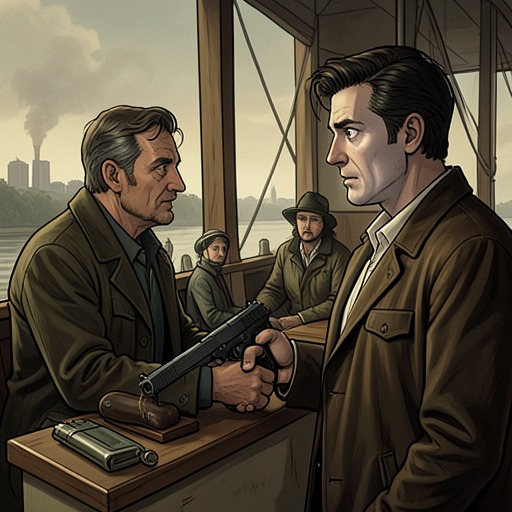
Race is a tall, bronzed man and an old acquaintance of Poirot. They had met in London a year earlier, as fellow guests at an unusual dinner party that ended with their host dead. Their familiarity is immediate when they meet again at Wadi Halfa, and it gives Race someone he can speak to without concealing the purpose of his presence.
His work takes him to troubled outposts of the Empire, where he pursues the people behind political unrest rather than merely the visible leaders of rioters. Race describes a network of three men: one dead, one imprisoned, and a third still at large. The wanted man has several cold-blooded murders to his credit and is an exceptionally capable paid agitator. Race has learned from a decoded letter that this fugitive will travel on the Karnak during February 7–13, but the message gives no name under which he will sail. His uncertainty is therefore practical, not incidental: he is searching for a dangerous man whose identity aboard the boat is concealed.
Two Investigations on the Karnak
Race explains his mission to Poirot soon after their reunion. He has no description that would make the search easy; the information available about the suspect’s American, Irish, and French descent is too broad to distinguish him from other passengers. The boat’s timetable gives the search a narrow setting, while the suspect’s unknown assumed name leaves Race dependent on observation and fresh clues.
At the same time, Race takes an official role in responding to the murder aboard the boat. He tells Poirot that he has some official standing and that the matter has been placed in his hands. Although the Karnak is due to depart within half an hour, he can delay it until he gives permission. He also recognizes that the murderer might have come from shore, keeping that possibility open rather than treating the boat’s passengers as the only possible field of inquiry.
Race and Poirot work together to establish what happened. Race proposes that they leave the cabin and use the smoking-room, which the management has made available, to gather the previous night’s details. He locks the cabin and takes its key, then insists that the first task is to make the facts clear. During questioning, the evidence about Jacqueline de Bellefort, the missing pistol, and the letter J on the wall appears to point toward a straightforward accusation. Race articulates the difficulty: independent witnesses make it unlikely that Jacqueline obtained the weapon, yet someone did retrieve it, someone overheard the earlier scene, and someone wrote the misleading initial. His formulation helps separate what the witnesses actually establish from what the apparent clue invites them to conclude.
Judgment and Collaboration with Poirot
Race is not simply a source of authority or a passive assistant. He tests Poirot’s deductions and says when an explanation does not yet persuade him. When Poirot argues that the pistol’s removal is incompatible with the apparent sequence of events, Race agrees that the detail is odd but initially struggles to see why it matters. Later, as Poirot proposes that their first conception of the murder was wrong, Race recognizes the familiar discipline of abandoning false starts and beginning again. He accepts that investigators can become trapped when they force every fact into a theory and discard whatever fails to fit, even though the mismatching fact may be the important one.
Their different investigations also meet through the telegram clue. Race had been hunting the unnamed political fugitive, but the final identification becomes possible when Dr. Bessner recalls that Simon Doyle described a telegram containing words for vegetables, including potatoes, artichokes, and leeks. Race recognizes the vocabulary as a code previously used in the South African rebellion: potatoes stand for machine guns and artichokes for high explosives. He identifies Signor Richetti, who has been posing as an archaeologist, as the wanted agitator. Race reasons that Linnet Doyle opened the telegram by mistake and that Richetti feared she might repeat its contents. The discovery connects the coded message to the passenger hunt and supplies a motive for Richetti’s violence, distinct from the murder case Poirot has been reconstructing.
Resolution and Narrative Role
At Shellal, in the early dawn, Race reports that the work is done and that he has arranged for Signor Richetti to be taken ashore first. He calls the fugitive elusive, noting that he has escaped capture many times. The remark gives the arrest its weight: identifying Richetti closes a long-running pursuit, not merely a suspicion raised during the voyage. Race also attends to the practical aftermath aboard the boat, recognizing the need for a stretcher for Simon Doyle.
Race’s role is to make the political investigation and the murder investigation converge without collapsing them into one case. He brings official reach, knowledge of coded communications, and a clear sense of the larger danger, while Poirot supplies the patient reconstruction that overturns the first explanation of Linnet Doyle’s death. Their partnership is defined by mutual trust and correction: Race challenges deductions he cannot yet follow, then contributes the recognition that exposes Richetti. Through him, the narrative shows how a second mystery can share the same confined setting while requiring its own clues, expertise, and resolution.