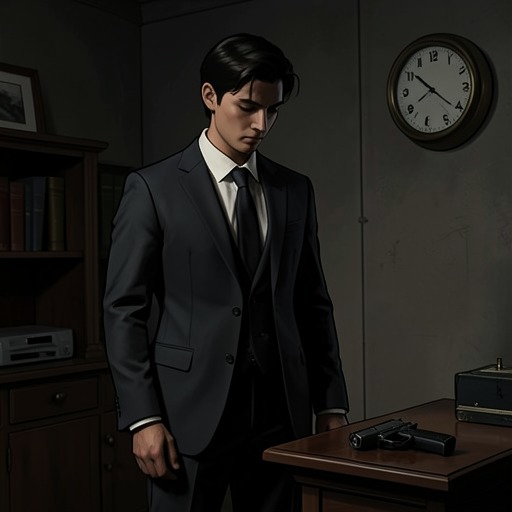
Dr. Bessner
Death on the NileDr. Bessner is a European physician with a large clinic in Czechoslovakia, whose reputation as a fashionable doctor gives him standing among the passengers aboard the Karnak. He contributes to the murder inquiry through his medical examination of Linnet Doyle and, away from the investigation, forms a growing attachment to Cornelia Robson.
Identity and First Impressions
At the temple, Dr. Bessner reads aloud in German from a Baedeker and pauses to translate for Cornelia, who walks beside him listening quietly. Their exchange is interrupted when Miss Van Schuyler summons Cornelia to her side. Dr. Bessner watches her go, then praises her as pleasant and intelligent; Hercule Poirot notices that Cornelia’s place in company seems to be either being instructed or being bullied, rather than speaking for herself.
Miss Van Schuyler’s attitude toward Dr. Bessner shifts after she learns of his large clinic and European reputation. She becomes more gracious, partly because she may need his professional services during the journey. His status is thus practical as well as social: the passengers recognize him as a doctor whose expertise could matter aboard the boat.
Medical Work and the Murder Inquiry
Dr. Bessner’s professional importance becomes immediate after Linnet Doyle is found dead. Examining her, he reports that the bullet entered just above the ear and that the weapon had been held close to her head; he estimates that it was a small-calibre bullet, probably a .22. The medical observation gives Poirot a physical fact against which to test the apparent story of the shooting, rather than treating the conspicuous letter J on the cabin wall as a complete explanation.
Dr. Bessner also becomes part of the inquiry into the timing of the murder through his care of Simon Doyle. After Jacqueline de Bellefort shoots Simon, he remains under the doctor’s attention in Bessner’s cabin. Miss Robson, Jim Fanthorp, and Jacqueline place Simon in the saloon before the shooting, while Bessner’s medical evidence and Miss Bowers’s evidence establish that he could not have left after being wounded. Poirot uses those separate circumstances to reject Simon as the person who could have carried out the murder in the cabin, even though suspicion briefly turns toward Bessner when the maid’s death is associated with a surgical knife. Bessner’s having drawn attention to that detail, and the absence of an apparent motive for him to kill Linnet, weaken the suspicion.
Later, Bessner reports that Simon is recovering well: his pulse is steady and his temperature only slightly above normal. He reassures Jacqueline, whose despair over Simon’s condition contrasts with his practical confidence in the patient’s constitution. His medical judgments therefore serve both the investigation, by establishing limits on Simon’s movements, and the human drama aboard the Karnak, by showing Jacqueline’s continuing attachment to the man she has shot.
Cornelia Robson and the Personal Ending
Dr. Bessner’s attention to Cornelia Robson begins in a familiar imbalance: at the temple he reads from a guidebook and translates for her, while she listens quietly beside him. When Miss Van Schuyler calls Cornelia away, Bessner watches her leave and praises her attentiveness. Hercule Poirot observes that Cornelia is often placed either in the role of listener or under someone else’s authority. Their later attachment changes the meaning of this early scene: Cornelia is not merely a pupil in Bessner’s company but a woman he has come to value.
Bessner’s medical care of Simon Doyle also brings out his practical, unsentimental manner. When Jacqueline de Bellefort despairs over Simon’s temporary fever, Bessner reports that the patient is doing well, with a steady pulse and a temperature only slightly above normal. He finds it difficult to reconcile Jacqueline’s distress with her having shot Simon; Cornelia explains that Jacqueline loves him deeply. Bessner’s response is characteristic of his reliance on sensible judgment, while the exchange makes visible the complicated attachment at the centre of the case.
The relationship between Bessner and Cornelia reaches a decisive point when he proposes to her. Cornelia tells Mr. Ferguson that she is going to marry Bessner and that he asked her the previous night. Ferguson challenges her by asking whether she is marrying him simply because he is rich, but the evidence presents the engagement as Cornelia’s own stated decision. Her choice marks a personal change from the young woman repeatedly summoned, instructed, or spoken for by others: she now announces a future of her own, with Bessner.
Medical Evidence and the Reconstructed Shooting
Dr. Bessner’s examination supplies a physical test for the story apparently written around the murder. He observes scorching beside the bullet wound, evidence that the weapon was held close to Linnet Doyle’s head when it was fired. Later, when Jacqueline de Bellefort’s pistol is recovered wrapped in Miss Van Schuyler’s velvet stole, the fabric bears signs that a shot had been fired through it, apparently to muffle the sound. Poirot recognizes that these traces cannot describe the same shot: firing through the folds would not have produced the scorching Dr. Bessner observed. The medical finding therefore does more than establish how close the pistol was; it exposes a mismatch between the recovered weapon’s apparent use and the fatal wound, forcing the investigation to reconsider its assumed sequence of events.