Hercule Poirot
Death on the NileHercule Poirot is the detective at the center of the investigation in Egypt, where a chain of apparent clues points toward Jacqueline de Bellefort but conceals a carefully planned partnership between Jacqueline and Simon Doyle. His decisive contribution is not simply to identify a suspect: he recognizes that the evidence itself has been arranged to invite the wrong explanation, and that the missing pistol makes the apparent solution impossible.
Identity and Introduction
Poirot is introduced through the recognition of Mrs. Allerton, who identifies him to her son, Tim Allerton, as a detective while they sit outside the Cataract Hotel in Aswan. Their attention follows two retreating figures, including a short man in a white silk suit. The moment places Poirot in the social world of the Nile journey before the investigation begins, as someone already recognizable for his work.
An earlier glimpse presents him in a different setting, dining alone after a restaurant has found him a table despite telling other clients that none was available. The maître d’hôtel, M. Blondin, welcomes him with conspicuous deference and recalls a previous incident involving a dead body, a waiter, Blondin, and a beautiful woman. The details of that case are not supplied, but the recollection establishes that Poirot’s investigations have affected people beyond the immediate circle of a crime. He responds courteously and turns readily to a detailed discussion of his meal and wine.
From Holiday to Investigation
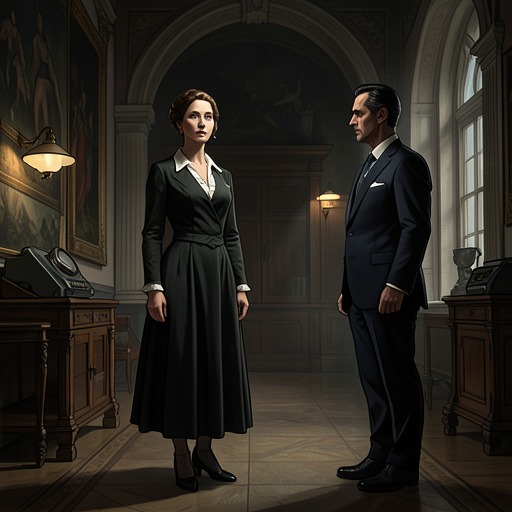
When approached by a woman seeking help, Poirot is taken into a deserted card room at the hotel. She tells him that she urgently needs someone capable and that she believes he may be able to help. Poirot declines: he is on holiday and does not take cases while away. His refusal marks a contrast between his stated intention to rest and the investigative role that the journey will soon require of him.
The investigation develops alongside his working relationship with Colonel Race. During a conversation in the observation saloon, Poirot orders Race whisky and chooses a sweet, double orangeade for himself. The exchange is companionable, but it also establishes the setting for a partnership that becomes central to the inquiry. Later, Race enters Poirot’s cabin without ceremony while Poirot is shaving, bringing news in the tense aftermath of the pistol’s disappearance. Poirot’s work proceeds through discussion and shared examination rather than through solitary pronouncement.
Psychology and the Unsettling Clue
When Dr. Bessner describes Jacqueline as having crept into a dark cabin and shot Linnet Doyle while she slept, Poirot immediately objects that the account does not fit his understanding of Jacqueline. His reaction is psychological: the proposed sequence may appear to explain the physical evidence, but its portrait of the person does not convince him. That distinction keeps an apparent solution from becoming a settled one merely because it seems plausible.
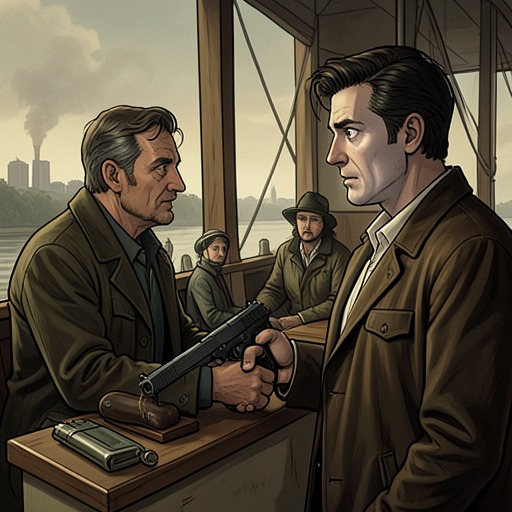
The pistol becomes the test of the case’s logic. Poirot reconstructs the apparent chain: someone wanted Linnet dead, overheard the confrontation between Jacqueline and Simon, retrieved Jacqueline’s pistol, used it to kill Linnet, and marked the scene with the letter J. Those signs seem to accuse Jacqueline. Yet the killer then disposed of the very pistol that would have strengthened that accusation. Poirot insists that this is not a minor oddity: if the weapon was meant to implicate Jacqueline, its removal contradicts the apparent design. He treats that conflict between clue and action as evidence that the first account is wrong.
After Louise Bourget’s death, Poirot tells Race that the case is no longer obscure but illuminated by facts previously misunderstood. His list brings separate details into relation: Jacqueline’s account that someone overheard her conversation with Simon, Tim Allerton’s statement about what he heard and did, Louise’s answers, the different drinks taken by Mrs. Allerton, Tim, and Poirot, two bottles of nail polish, and the pistol wrapped in a cheap handkerchief and a velvet stole before being thrown overboard. He does not present these details as an assortment of curiosities. Their significance emerges through comparison, especially when an object or circumstance fails to fit the first theory.
Reconstructing the Conspiracy
Poirot and Race initially assume the murder was improvised: someone seized an opportunity to kill Linnet and exploit the likelihood that suspicion would fall on Jacqueline. Poirot later identifies this assumption as the source of their mistake. The crime, he explains, was meticulously planned and timed, including the drugging of his wine so that he would sleep heavily and be unable to intervene. Because he habitually drank wine while his companions chose other drinks, his bottle offered a distinct opportunity; the bottles remained on the tables during the day.
The physical details also point toward preparation rather than chance. Simon had red ink and an unmarked handkerchief; Jacqueline’s kick sent the pistol beneath a settee, where it could remain out of sight until it was later removed. Poirot interprets Simon and Jacqueline as the two halves of one murderer: Jacqueline’s shot gave Simon an alibi, while Simon’s insistence that a nurse remain with Jacqueline gave her an alibi. His explanation joins planning to execution, assigning the resourceful design to Jacqueline and the swift practical action to Simon. Their apparent hostility was itself part of the performance: Jacqueline’s pursuit of the couple and Simon’s displayed anger helped sustain the false account.
Poirot’s reasoning also turns outward to Andrew Pennington. With Race, he confronts Pennington over his financial predicament following Linnet’s unexpected marriage, his unsuccessful attempt to obtain her signature on documents, and the boulder dislodged at Abu Simbel that narrowly missed her. Poirot further accuses him of using his revolver to kill Mrs. Otterbourne as she was about to disclose the name of the person she believed had killed Linnet and Louise. Race later reports that Pennington admitted fraud and attempted murder, while distinguishing those admissions from a confession to the killings. Poirot’s brief, assured response that a confession can sometimes be obtained signals that he has a further plan, but the evidence here does not specify its outcome.
Method and Narrative Significance
Poirot’s defining practice in this investigation is the willingness to erase a compelling first explanation and begin again. Race observes that detective work often means abandoning false starts; Poirot expands the principle by warning against forcing every fact into a preferred theory. The facts that resist the theory, especially the pistol’s removal, may be the ones that matter most. His method combines attention to material evidence with judgments about behavior, timing, and the practical needs of a plan.
The final reconstruction changes the meaning of earlier scenes. What looked like Jacqueline’s persecution of Linnet, Simon’s anger, and a convenient opportunity for murder becomes a coordinated deception. Poirot’s role is therefore both analytical and interpretive: he distinguishes a staged appearance from the arrangement that produced it. The investigation turns not on a missing clue but on recognizing that a visible clue—the pistol and its apparent connection to Jacqueline—has been made to tell a misleading story.