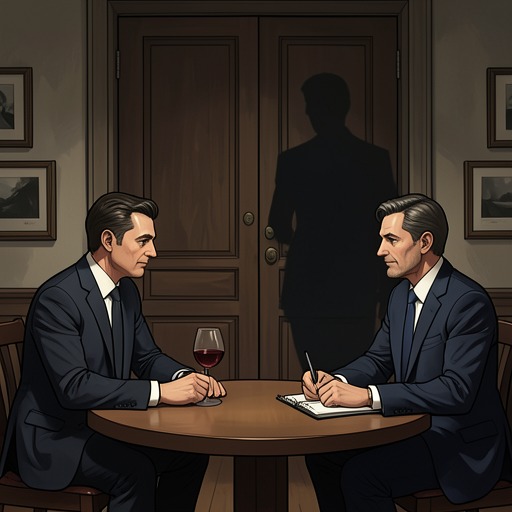
Hercule Poirot–Colonel Race
Death on the NileHercule Poirot and Colonel Race’s partnership is the working alliance at the centre of the murder investigation aboard the S.S. Karnak. Race entrusts Poirot with command, but their collaboration is not simply a matter of one detective issuing instructions: Race contributes observations and questions, tests Poirot’s reasoning, and accepts that the investigation may have to be rebuilt from its foundations. Their trust allows Poirot time to withhold a conclusion while he clears away misleading details, and allows Race to challenge him when an explanation has not yet become convincing.
Roles and Mutual Trust
Race explicitly yields the lead to Poirot, treating the inquiry as Poirot’s responsibility and offering to follow his directions. Poirot responds that he is at Race’s disposal, a courteous exchange that presents authority as shared professional cooperation rather than rivalry. Later, after Dr. Bessner has been to see Simon Doyle, Race again tells Poirot that he is in charge and that he will take his orders from him. Poirot accepts that responsibility and proposes that they hold an inquiry, beginning by checking the account of the previous night.
That deference does not make Race passive. He proceeds straightforwardly with the practical investigation, while Poirot works through the meaning of the evidence. When Poirot’s objections to the apparent sequence of the pistol’s removal become clear, Race does not pretend to follow an argument he has not yet grasped. He acknowledges that the sequence seems impossible, then continues to work with Poirot rather than dismissing the difficulty. The exchange establishes a useful division of labour: Race can keep the inquiry moving, while Poirot insists that a troubling inconsistency must be explained.
Their personal ease is apparent in the way Race calls Poirot his friend and in their familiar, candid exchanges. Yet the friendship does not erase differences in pace or temperament. Race is often ready to ask what Poirot suspects; Poirot appreciates that Race does not press him when he cannot yet speak. He explains that there is still much to clear away. Race’s patience gives Poirot room to develop the case, even when that restraint later begins to wear thin.
Testing the First Theory
At first, the evidence appears to point towards Jacqueline de Bellefort. Someone had overheard a scene involving her and Simon Doyle, recovered Jacqueline de Bellefort’s pistol, used it to kill Linnet Doyle, and left a J on the wall. Poirot identifies the contradiction in this apparently tidy account: if the murderer meant to frame Jacqueline, why remove and throw away the pistol, the very object that most directly implicated her? Race agrees that the action is odd, but Poirot insists that the sequence as they understand it cannot be right. The discarded weapon is not a detail to be forced into their theory; it is the fact that exposes the theory’s weakness.
When Race later returns with an idea prompted by a remark from Simon Doyle about a telegram, Poirot welcomes the lead rather than treating it as a distraction. He lays out a larger set of points for Race to consider: Jacqueline de Bellefort’s report that someone overheard a conversation in a garden at Aswan; Tim Allerton’s account of what he heard and did on the night of the crime; Louise Bourget’s answers; the different drinks taken by Mrs. Allerton, Tim Allerton, and Poirot; two bottles of nail polish; and the pistol’s wrapping in a cheap handkerchief and Miss Van Schuyler’s velvet stole before it was thrown overboard. The list shows how Poirot connects apparently separate statements and objects, while Race’s telegram clue demonstrates that Race continues to contribute fresh avenues of inquiry.
Race admits that he sees only part of what Poirot is driving at and thinks the emerging explanation does not yet work. Poirot answers that they are seeing only half the truth and must start again because their original conception was wrong. Race recognizes this resetting of assumptions as central to detective work: false starts have to be wiped away rather than protected. Poirot makes the same point more sharply, arguing that investigators who discard facts that do not fit a preferred theory lose precisely the evidence that matters most. Their discussion makes disagreement productive: Race tests whether the logic holds, and Poirot uses the resistance to clarify what the evidence requires.
Distinguishing Fraud from Murder
The partnership also shapes their assessment of Andrew Pennington. In questioning him, Race and Poirot elicit an admission of financial fraud and an admission that he had attempted murder. Race later says that they have got as much as they can from him, distinguishing those admissions from a confession to the actual murders. Poirot does not treat Pennington’s wrongdoing as proof that he committed every crime under investigation. Instead, he argues that the murder required audacity, speed, courage, indifference to danger, and a resourceful, calculating mind; Pennington, in Poirot’s assessment, was astute but not bold enough for a crime that depended on such risk.
This distinction matters to their joint method. Race respects Poirot’s judgement but still presses for the remaining questions to be answered. Poirot specifically wants the telegram Linnet Doyle read clarified, and, before returning to Simon Doyle, asks to speak with Tim Allerton. Race arranges for Tim to be summoned. His willingness to carry out Poirot’s next step accompanies Poirot’s refusal to let Pennington’s substantial guilt obscure the separate question of who planned the murders.
Reconstructing the Crime Together
After Tim Allerton and Rosalie Otterbourne leave, Poirot asks Race to consent to an irregular arrangement, explaining that he has a high regard for human happiness. Race accepts, though he complains that Poirot has shown little regard for his patience and demands to know whether Poirot knows who committed the three murders aboard the boat. Poirot says that he does. When Race asks why he has been pursuing side issues, Poirot explains his procedure through the image of an archaeological excavation: loose earth and surrounding material must be carefully cleared away until the object can be seen without confusion. For him, questioning the side issues is not evasion but preparation for a truth that can stand on its own.
Race responds by naming people who, by this stage, have been excluded from his suspicion, including Pennington and Tim Allerton, and asks Poirot to identify the culprit. Poirot begins by admitting that he had been mistaken about the pistol. He and Race had assumed that Linnet Doyle’s murder was spontaneous: someone had seized an opportunity after overhearing Jacqueline de Bellefort and Simon Doyle and obtaining the weapon. Poirot now says the crime was carefully planned and timed, including the drugging of his wine to prevent him from taking part in the night’s events. Race’s challenge and Poirot’s admission of error mark a turning point in their cooperation: the investigation advances not by defending the first theory, but by changing it to account for the facts.
Poirot then reconstructs a sequence in which Simon Doyle uses the interval when Cornelia Robson and Jim Fanthorp are away with Jacqueline de Bellefort, retrieves the pistol, and runs along the starboard deck to Linnet Doyle’s cabin. After the shooting, he places a bottle that contained red ink on the washstand, retrieves the velvet stole he had hidden in advance, wraps the pistol with the stained handkerchief, and throws it into the Nile after firing into his own leg. Race calls the account impossible. Poirot counters with Tim Allerton’s evidence: Tim heard a pop, a splash, and the footsteps of a man running past his cabin, although no one should have been running along that side of the deck. Poirot identifies those footsteps as Simon Doyle’s. In this final reconstruction, Race’s demand that the explanation withstand scrutiny and Poirot’s ability to make the clues cohere together bring the partnership to its purpose: not merely to name a suspect, but to show how the apparently conflicting evidence belongs to one planned sequence.