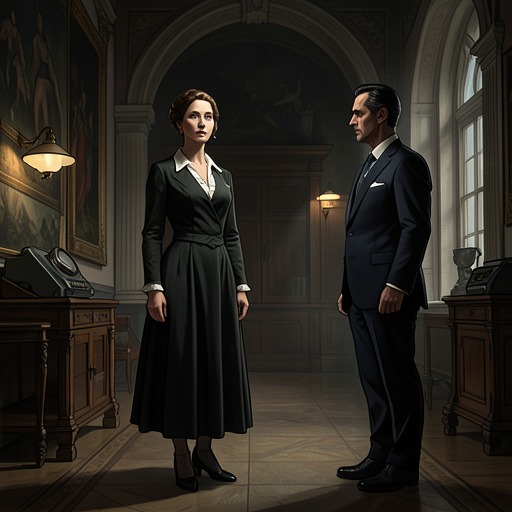
Jacqueline de Bellefort
Death on the NileJacqueline de Bellefort is first introduced as Simon Doyle’s intensely devoted fiancée and Linnet Doyle’s friend; she becomes, in appearance, the relentless pursuer of the couple and, in reality, Simon’s partner in a carefully planned murder. Her story turns on the widening gap between what she displays and what she does: a visible grievance that seems to make her dangerous to Linnet also conceals the partnership that enables the crime.
Identity and early relationship
Before Simon’s marriage to Linnet, Jacqueline goes to Linnet to ask for help. She explains that Simon is out of work and asks Linnet to give him a land-agent position. Her request joins romantic devotion to practical need: she describes herself as unable to imagine life without Simon, while asking her wealthy friend to help secure his future. Linnet’s answer is not included in the evidence here, but the request establishes the friendship and trust Jacqueline will later exploit.
Jacqueline presents the engagement as an overwhelming love, not a convenient arrangement. She describes Simon as simple, boyish, poor, and devoted to country life, and says that they were made for each other. Later, speaking with Hercule Poirot, she explains the break in the relationship through an image of contrast: Linnet was the sun, whose arrival dazzled Simon. Jacqueline attributes his choice to Linnet’s glamour and commanding confidence, while insisting that he would otherwise have loved her. Her account makes Linnet’s wealth and presence seem like forces that have displaced Jacqueline, but the final revelation changes the meaning of that apparent loss.
The pursuit and the visible threat
Jacqueline appears again when the Doyles encounter her at a rocky site. She greets Linnet and Simon as if their repeated meetings were coincidence. Linnet recoils, while Simon reacts with anger. Jacqueline’s manner is outwardly civil, but her presence unsettles the couple and makes their private journey feel persistently watched. The contrast between her pleasant greeting and their alarm becomes central to the picture of harassment she constructs around herself.
In her conversation with Poirot, Jacqueline acknowledges that she bought a small pearl-handled pistol after the engagement broke down. She says she once considered killing either Linnet or Simon, then decided to wait and follow them instead. Her stated aim was to appear wherever the couple travelled, especially when they were far from home and together, and to make Linnet feel pursued. She describes the strategy as effective because it disturbed Linnet while leaving Jacqueline able to maintain an agreeable public manner. The account seems to expose a motive and a capacity for violence; in retrospect, it also shows how deliberately Jacqueline cultivated the impression of a genuine threat.
That performance reaches its most convincing point in the saloon. Jacqueline tells Simon that she had meant her earlier threats and insists that he belongs to her. She draws a pistol and fires as he moves. Simon is injured, and Jacqueline immediately appears shocked by what she has done. The pistol falls, and she kicks it beneath a settee. Simon urges James Lechdale Fanthorp to describe the incident as an accident and avoid a scandal. Jacqueline’s distressed response and Simon’s concern for her seem to support the belief that she acted impulsively and that he is trying to protect her.
The apparent alibi and its reversal
After the shooting, Jacqueline is treated as a potential danger, but the immediate concern attributed to Simon is that she might harm herself. Fanthorp says that Simon did not seem afraid she would attack Linnet; he believed Simon feared Jacqueline might take a rash action against herself. When Poirot later tells her that the evidence proves she did not kill Linnet, Jacqueline breaks down and asks who did. Her distress makes the reassurance appear straightforward. The investigation eventually shows that the apparent separation between Jacqueline’s conduct and Simon’s was itself part of their shared design.
Poirot’s reconstruction identifies them as the two halves of the murder plan. Jacqueline’s staged shooting gave Simon an alibi for the time of Linnet’s murder; Simon’s insistence that Jacqueline not be left alone brought about the supervision that gave her an alibi. The outburst, the shot, the hidden pistol, and Simon’s request to avoid a scandal therefore acquire a second meaning. What seemed to be a violent rupture between former lovers was a timed action on which both depended.
The investigation also reverses the meaning of Jacqueline’s pursuit of the Doyles. Poirot concludes that she and Simon remained lovers and had planned for Simon to inherit Linnet’s money and later marry Jacqueline. Her apparent jealousy and the impression that she was persecuting Linnet served as a diversion. Even Simon’s apparent anger toward Jacqueline had been part of the performance. The public display of possessive conflict disguised a private alliance.
Further crimes and confession
The conspiracy does not end with Linnet’s murder. Louise Bourget has seen Simon return from Linnet’s cabin, and her demand for hush money creates a new danger. Poirot concludes that Jacqueline killed Louise after Simon alerted her to the threat. Jacqueline’s later account confirms the central sequence: she went to Simon, learned what he wanted her to do, pretended to submit to Louise’s demand, and killed her while Louise counted the money. Jacqueline recalls being frightened, but says that, once she acted, the killing seemed frighteningly easy.
A second witness then threatens to expose her. Salome Otterbourne has seen Jacqueline go to Louise’s cabin and approaches to tell Simon and Colonel Race. Poirot explains that Simon’s raised voice was not simply a reaction to nerves: he was warning Jacqueline that she had been seen. She seized Andrew Pennington’s revolver and shot Salome before the disclosure could be made. The quick response repeats the pattern established by the first killing: a witness creates immediate danger, and Jacqueline acts to protect the conspiracy.
In confessing, Jacqueline recognizes that she has opened herself to evil. Her words connect the crimes to fear and to the need to keep Simon’s plan safe, but they do not undo her responsibility. The contrast with her earlier insistence that she and Simon could not live without each other is stark: the loyalty she once described as love has become a reason to silence anyone who might separate them or expose what they have done.
Ending and narrative significance
At the end, Jacqueline speaks to Simon as he is being taken away. She briefly steps aside, then produces a concealed pistol. The shot kills Simon; she then takes her own life. Her ending completes the movement from a woman who once asked Linnet to help Simon find work to a conspirator who has killed to protect their shared future, only to destroy that future herself when the plan collapses.
Jacqueline’s importance to the mystery lies in the credibility of her performance. The visible story—an abandoned fiancée pursuing a rival, then apparently shooting Simon in a fit of anger—supplies both motive and misleading clues. Poirot’s solution depends on recognizing that the apparent opposition between Jacqueline and Simon concealed cooperation. The novel’s reversals make her pursuit, her threats, and even the evidence of her alibi parts of one design: the spectacle of a jealous former lover distracts from the partnership at the center of the murders.