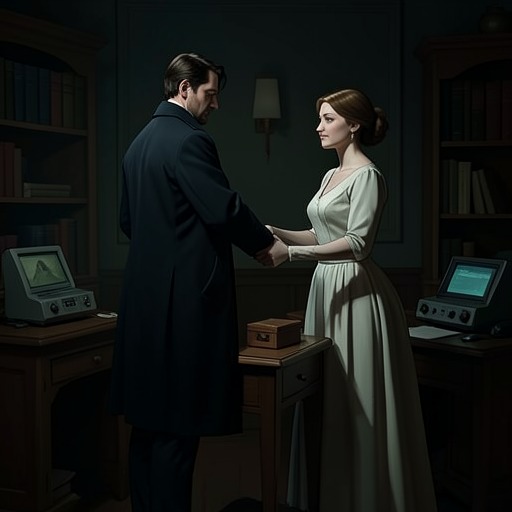
Linnet Doyle’s pearls: substitution and theft
Death on the NileLinnet Doyle’s pearls: substitution and theft becomes a central puzzle in the investigation of Murder of Linnet Doyle. Louise Bourget last saw the pearls on the bedside table after Linnet Doyle wore them to bed; the next morning, the table was empty. Later, Miss Bowers returned a string of pearls to Colonel Race, but Hercule Poirot identified it as an imitation. The return therefore did not settle the question of the missing jewels. It made the apparent solution less credible and forced the investigators to distinguish between the genuine pearls, the copy, and the stories told about their disappearance.
The Pearls Disappear
When Poirot asked Louise about the pearls, she recalled seeing them on Linnet Doyle the previous night and then being told that Linnet had placed them on the table beside the bed, as usual. Louise affirmed that this was the last time she had seen them there. Her account established a clear last known location, but not the moment or means of their removal.
Louise had not checked the table in the morning. She said that she went to the bed, saw Linnet, cried out, and rushed from the room. Poirot, who had observed the room, supplied the fact her distress had prevented her from noticing: no pearls lay on the bedside table. The distinction matters. Louise’s testimony places the genuine string there the previous night, while the absence in the morning is Poirot’s observation; neither account identifies who removed it or when.
The sequence turns an ordinary item of personal routine into a piece of evidence. The table is not merely where Linnet Doyle habitually put the pearls; it is the point that fixes the last reported sighting against their later absence. At this stage, the gap between those two observations remains open. The pearls’ disappearance is certain, but the evidence has not yet supplied a witnessed theft.
A Return That Does Not Resolve the Loss
Miss Bowers came to Colonel Race and, without waiting for further questioning, took a string of pearls from her neat black handbag and laid it on the table. Her action initially appeared to offer a direct answer to the missing-jewels problem: a string had been brought back. Yet Poirot examined the returned pearls and concluded that they were a clever imitation. The object’s appearance had invited recognition, but its material identity contradicted that first impression.
The imitation was not a crude substitute. Poirot judged it a close enough copy to mislead Linnet Doyle, including an exact reproduction of the clasp. In his view, making such a convincing copy required technical skill and could not have been done quickly. Whoever made it must have had a substantial opportunity to study the genuine pearls. This inference shifts the question from who might have taken a string of pearls to who could have obtained access to the original long enough to copy it.
Poirot recalled having admired the genuine pearls during the first evening aboard the Karnak, noting their sheen and lustre. That memory gave him a basis for rejecting the idea that Linnet Doyle had simply brought an imitation instead of the real jewels. Simon Doyle likewise said he was sure she had not done so: she loved the pearls, wore them everywhere, and had insured them against every possible risk. Simon added that their insurance may have made her somewhat careless, but he did not describe a separate string or any planned substitution.
Competing Explanations
Once the returned string proved false, Poirot and Race considered competing explanations rather than treating its return as proof that the loss had been solved. One possibility was that Miss Van Schuyler had taken only the imitation after someone else had already stolen the genuine pearls. Another was that the kleptomania explanation was fabricated: Miss Bowers might be the thief and might have used the return of false pearls to divert suspicion. Poirot also entertained the possibility that the party around Miss Van Schuyler was a group of jewel thieves acting together. These were investigative hypotheses, not conclusions established by the evidence at that point.
Each possibility assigned a different meaning to the same act. If the imitation had been taken in a theft attributed to Miss Van Schuyler, it could have concealed the earlier loss of the real jewels. If Miss Bowers had supplied it knowingly, the return itself could have served as a false resolution. If the party were acting together, the apparent individual explanation would mask a collective operation. Poirot did not claim that any one account had been proved; the exactness of the copy made prior access important, while leaving the identity and motive of whoever arranged the substitution uncertain.
The episode also complicates the investigators’ use of visible evidence. A string of pearls placed on the table can be inspected, but resemblance alone cannot establish that it is Linnet Doyle’s original. The imitation briefly seems to close the case of the missing object, then reopens it on more demanding terms: where is the genuine string, who had the means and opportunity to copy it, and what purpose did presenting the copy serve?
The Puzzle Within the Murder Inquiry
The pearls’ disappearance develops alongside the investigation’s broader problem of misleading appearances. Poirot and Race initially considered a sequence in which Jacqueline de Bellefort had been framed for the murder: a pistol associated with her was used, a letter J was written on the wall, and the pistol was then thrown overboard. Poirot objected that leaving the pistol to be found would have served the apparent framing, whereas disposing of it did not fit that account. The contradiction made him question the sequence rather than force the facts into his first theory.
That same investigative discipline is relevant to the pearl puzzle. The return of a string that looks right cannot be accepted as proof of recovery once its material identity is tested. Nor can the initial account of a theft explain the missing genuine pearls without accounting for the carefully made replacement. Poirot and Race’s discussion of the murder makes their method explicit: when an explanation fails to accommodate an awkward fact, they must begin again instead of discarding the fact. In the pearl case, the unusually exact imitation is just such a complication.
The supplied evidence leaves the actual removal and substitution unresolved. It establishes that the genuine pearls were last reported on the bedside table, that they were absent the following morning, that Miss Bowers returned a string, and that Poirot found this string to be a high-quality copy. It also establishes that making the copy required time and access to the original. The force of the episode lies in the gap between a convincing appearance and a verified identity: the returned pearls look like an answer, but their falsity shows that the real object remains missing.