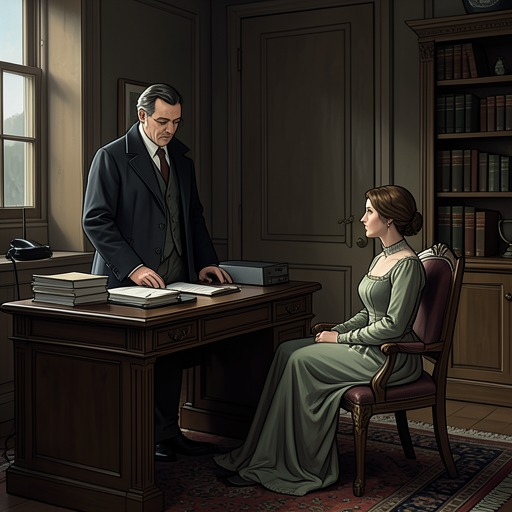
Linnet Ridgeway's heiress status
Death on the NileLinnet Doyle's heiress status is more than a measure of private wealth: it shapes her public image and the reactions of people around her. Inherited fortune appears in the scale of her plans for Wode Hall, the jewels she wears, and the attention paid to her marriage and travels. To some observers it represents opportunity and glamour; to others, its combination with her beauty and confidence seems an intolerable excess.
Inheritance and Public Standing
A social column identifies Linnet as the daughter of Melhuish Ridgeway and Anna Hartz, and says that her immense fortune comes from her grandfather, Leopold Hartz. The inheritance places her at the center of public gossip even before her marriage: the column describes her as the sensation of the moment and reports a rumor that she may become engaged. Her wealth is thus presented not only as a personal resource but as news, circulating alongside speculation about her romantic future.
The scale of that fortune is conveyed through what people say it can accomplish. In the town near Wode Hall, Mr. Burnaby reports that Linnet is to spend thousands on the property: plans include swimming pools, Italian gardens, a ballroom, and the demolition and rebuilding of half the house. He contrasts this projected transformation with the reported sale price of sixty thousand pounds and says that Linnet is expected to spend another sixty thousand before the work is finished. His account makes the estate a public demonstration of inherited money, while his companion observes that the spending will bring money into the town.
Wealth Made Visible
At Wode Hall, Linnet's fortune is embodied in possessions as well as buildings. Joanna Southwood picks up a string of pearls from Linnet's dressing table and asks whether they are real. Linnet says they are worth about fifty thousand, wears them regularly, and notes that they are insured. Joanna admires their matching and beauty, asks to wear them until dinner, and frames possession of them as one more source of the thrill of Linnet's life. The exchange links luxury to intimacy and social display: the pearls are an everyday adornment for Linnet, but an extraordinary object to someone looking at them from outside.
The money also has a social meaning that exceeds its purchasing power. Joanna tells Linnet that she envies her combination of youth, independence, money, looks, health, and intelligence. Linnet is twenty and expects to turn twenty-one the following June, when she plans a coming-of-age party in London. Joanna's inventory makes clear how wealth becomes part of an apparently complete identity, while Linnet's own response to questions about marriage is less certain: she says she does not yet want to marry anyone. The contrast is between a public life easily described through advantages and a private future not yet settled.
Admiration, Envy, and Resentment
The reactions to Linnet's wealth are sharply divided. In the town, Mr. Burnaby's companion calls it unfair that she should be both rich and good-looking; he treats beauty and money together as an excessive share of life's rewards. Joanna's envy is affectionate and openly admiring, while the town observer's envy is grudging. Both responses register the same social fact: Linnet's advantages are conspicuous enough to invite comparison.
Joanna later gives that impression a sharper formulation. She challenges Linnet to name a concrete occasion on which she has failed to get what she wanted, then characterizes her progress as a triumph made possible by money and charm. Linnet asks whether Joanna considers her selfish; Joanna instead calls her irresistible and suggests that what cash cannot buy, a smile can secure. This is an accusation about social power, not merely a count of possessions: Linnet's fortune appears to work in tandem with her personal appeal, making resistance to her seem difficult.
The same pattern reappears when Linnet arrives in Egypt with her new husband, Simon Doyle. Tim Allerton identifies her as the famous heiress, and Rosalie Otterbourne recognizes Simon from newspaper coverage of their marriage. Tim calls Linnet about the richest girl in England; after Hercule Poirot remarks on her beauty, Rosalie bitterly observes that some people seem to have everything. Linnet's polished entrance and assurance reinforce the image of someone accustomed to being watched and admired. Her wealth is therefore carried into the honeymoon as a reputation already formed in public, not simply as a private financial fact.
Fortune and Financial Affairs
On the Karnak, Andrew Pennington approaches Linnet about documents and acknowledges that business is an awkward subject to raise during her honeymoon. Linnet responds at once in a businesslike manner and says that her marriage has made a difference. Pennington says that he will need her signature on several documents and suggests discussing them then; the conversation establishes that her wealth remains connected to practical financial matters after marriage. The scene does not specify the documents' contents or establish that Linnet signs them, but it shows that her new marital status has altered the business context in which her fortune is handled.
Across these scenes, inherited wealth gives Linnet unusual freedom to reshape a house, possess costly jewels, and occupy the center of public attention. It also makes her a focus for other people's judgments: admiration can become envy, and envy can harden into a sense that her advantages are unjust. The fortune's narrative importance lies in this double effect. It secures material choice for Linnet while making that choice—and the social power associated with it—visible to everyone around her.