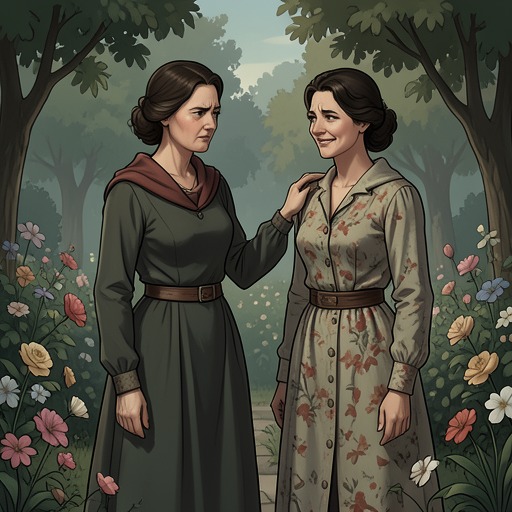
Linnet Ridgeway–Jacqueline de Bellefort relationship
Death on the NileLinnet Ridgeway–Jacqueline de Bellefort relationship is the story of a close friendship undone by a romantic choice. Jacqueline trusts Linnet as her oldest friend and asks her for help securing work for Simon Doyle; later, Linnet acknowledges that Jacqueline trusted her, while Jacqueline says that she loved and trusted Linnet before feeling that Linnet took Simon from her. The rupture turns on more than rivalry for a man: the two women understand the same history through sharply different ideas of loyalty, choice, and entitlement.
Friendship and Unequal Circumstances
Linnet and Jacqueline had known each other since they were together at a convent in Paris. Linnet describes Jacqueline as her oldest friend and recalls her family’s decline: Jacqueline’s father, a French count, left for another woman, and her American mother lost her money in the Wall Street Crash. Jacqueline was left broke, and Linnet says she did not know how Jacqueline had managed during the preceding two years. Their friendship thus continued across a marked difference in circumstance, with Linnet wealthy and Jacqueline struggling to get by.
Linnet says she had wanted to help Jacqueline, but Jacqueline would not accept assistance and was proud. That refusal matters to the shape of their relationship: Jacqueline could turn to Linnet for a personal favor without presenting herself as someone seeking financial support. When Linnet’s friend Joanna Southwood suggests that Jacqueline may want something from her, Linnet defends Jacqueline as no sponge. The exchange exposes how readily Linnet’s wealth makes ordinary friendship look transactional to an observer, and how firmly Linnet resists that interpretation.
Their reunion is warm and immediate. Jacqueline calls Linnet and says she wants to see her; Linnet invites her to come down, and Jacqueline agrees to travel in a dilapidated two-seater she has recently bought for fifteen pounds. The car’s unreliable moods make the journey uncertain, but the exchange conveys familiarity rather than formality: Jacqueline is eager to show Linnet her new possession, and Linnet receives the visit as welcome. The scene establishes an intimacy that makes the favor Jacqueline later asks for feel like a request within an existing bond, not a negotiation between strangers.
The Request That Changes the Friendship
When Jacqueline arrives, she has been doing what she describes as grim jobs and has not written because she dislikes letter-writing. She says she has come to ask for an important favor, then explains that she is engaged to Simon Doyle. She describes him as poor, out of work, and experienced in estate management, and tells Linnet that she cannot bear the thought of not marrying him. The intensity of her attachment is plain: she presents Simon as the person she loves and as someone with whom she cannot live apart.
Jacqueline’s practical request follows directly from that declaration. Since Linnet has bought an estate, Jacqueline asks her to give Simon a land-agent’s position, suggesting that Linnet may need one or even two agents. She offers to accept the consequences if he fails to make good, but is confident that he will succeed. The proposed job would let the couple live in a small house and keep Jacqueline near Linnet. In Jacqueline’s account, the favor would join friendship and love: Linnet could help the couple begin married life while remaining part of Jacqueline’s daily world.
This appeal makes Linnet’s later choice especially painful in retrospect. Jacqueline had entrusted her with both the fact of the engagement and the future she hoped to build with Simon. The evidence does not show that Linnet’s earlier response to the job request determined what followed; it does show that Jacqueline had made her hopes explicit to her friend before the relationship broke. The later betrayal is therefore not merely that Simon chose another woman, but that the other woman was the person to whom Jacqueline had confided her plans.
Two Accounts of the Break
In speaking with Hercule Poirot, Linnet confirms that Jacqueline had trusted her. When Poirot suggests that the friend Jacqueline believed would not let her down was Linnet, Linnet flushes and agrees that she and Jacqueline had been friends. Her response confirms the bond rather than denying it. But Linnet resists Poirot’s framing of her marriage to Simon as taking another woman’s beloved: she argues that Simon was fond of Jacqueline but may already have felt their engagement was a mistake before meeting her.
Linnet’s defense rests on a distinction between engagement and marriage. She says Simon discovered that he loved her, not Jacqueline, and argues that he was not bound to marry someone he did not love merely because they were engaged. In her view, ending a mistaken engagement before marriage was preferable to a union that could make all three unhappy. She admits that the change was hard on Jacqueline and says she is sorry, while treating the outcome as inevitable. Her account recognizes Jacqueline’s pain but places Simon’s freedom to choose, and the consequences of an unwanted marriage, at the center of the moral question.
Jacqueline tells the history in terms of a friendship that had been betrayed. She says that she and Simon loved each other, and that she loved Linnet and trusted her. She describes Linnet as someone who had always been able to buy whatever she wanted and had never denied herself anything; when Linnet saw Simon, Jacqueline says, she simply took him. Her account makes the injury cumulative: Simon is not only lost, but lost to the friend whose trust had seemed secure. Where Linnet emphasizes that Simon made his own choice, Jacqueline emphasizes Linnet’s power and the fact that the choice severed their friendship.
The Friendship Recast as a Moral Conflict
Poirot invokes the biblical story of the rich man who takes the poor man’s one ewe lamb. The allusion gives form to the difference between the women’s accounts: Linnet hears an accusation that she stole her friend’s young man, while she insists that the engagement was not a marriage and that Simon’s feelings mattered. The parable’s contrast between abundance and deprivation also echoes Jacqueline’s description of Linnet’s wealth beside her own poverty. Yet it does not settle the question of agency. Linnet treats Simon as a person entitled to choose; Jacqueline sees Linnet’s choice as repeating a broader pattern in which Linnet can obtain what she wants.
The relationship’s movement is consequently from affection and confidence to incompatible interpretations of the same loss. Jacqueline’s request for help had imagined a future in which Simon’s work, her marriage, and continued closeness to Linnet could coexist. Linnet’s eventual marriage to Simon makes that hoped-for arrangement impossible. Their later words preserve the emotional contrast: Linnet acknowledges that Jacqueline trusted her and regrets the hurt, while Jacqueline names love and trust as precisely what made the injury profound. Friendship remains the measure by which both understand the rupture, even as they no longer agree on what loyalty required.