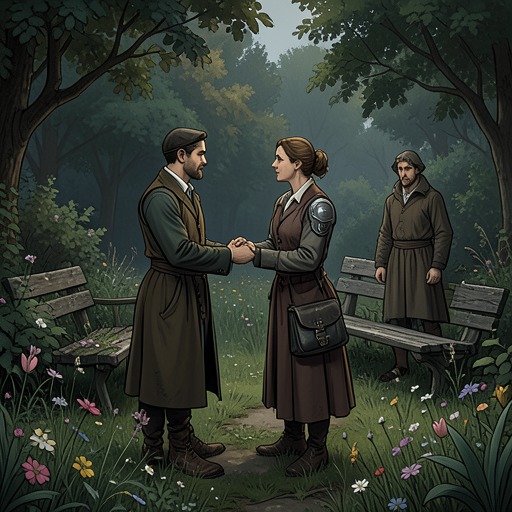
Linnet Ridgeway—Jacqueline de Bellefort
Death on the NileLinnet Doyle and Jacqueline de Bellefort’s friendship collapses when Linnet, in Jacqueline’s account, pursues Simon Doyle after Jacqueline had turned to her for help. Their former intimacy gives the ensuing rivalry personal force, while the visible appearance of that rivalry later helps conceal the women’s connection to the crime’s larger design.
Friendship and the request for help
Jacqueline recalls that she loved Linnet and regarded her as her best friend. When Simon had lost his job and the couple could not afford even their celebration at Chez Ma Tante, Jacqueline went to Linnet hoping she might offer Simon work. She says Linnet responded warmly and invited her to bring him to see her. In Jacqueline’s telling, the request was made in friendship and with no expectation that Linnet’s wealth would become a source of conflict between them.
The rupture over Simon
Jacqueline says Linnet soon set out to win Simon, despite knowing that he was Jacqueline’s fiancé. She describes the change as swift: Linnet had been her friend, but, as Jacqueline remembers it, did not hesitate before pursuing him. Jacqueline also distinguishes Simon’s attraction from any supposed romantic admiration for Linnet: she says he found Linnet attractive but disliked what he saw as her bossiness, while the prospect of her money appealed to him. The relationship thus breaks under the combined pressure of betrayal, Simon’s financial hopes, and Jacqueline’s continuing attachment to him.
Grievance and complicity
In her later account to Hercule Poirot, Jacqueline says that Linnet’s death has not made her sorry for Linnet, even though she had genuinely loved her. The confession holds affection and resentment together: Jacqueline presents the loss of friendship as real, but does not treat it as a reason to forgive the woman she believes took Simon. She also explains that she and Simon developed a plan built around a two-person alibi. Jacqueline wanted suspicion to fall on her rather than Simon if anything went wrong, turning the apparent feud into cover for their shared purpose.
The friendship as a false trail
The history between the women makes Jacqueline’s apparent motive convincing. The blood-written letter J and the use of Jacqueline de Bellefort’s pistol initially seem to identify her as Linnet’s killer. Hercule Poirot first interprets the case through that apparent rivalry, but the removal of the pistol does not fit the theory that a killer simply seized an opportunity and meant to frame Jacqueline. His reconsideration exposes the gap between the genuine emotional rupture and the misleading story constructed around it: their broken friendship supplies the visible motive, while the crime was planned in concert by Jacqueline and Simon.