Linnet and Simon's honeymoon
Death on the NileLinnet and Simon's honeymoon is an Egyptian journey whose promised privacy is repeatedly broken by coincidence, publicity, and Jacqueline de Bellefort's pursuit. Its changing itinerary—from a week at Mena House to a seven-day steamer trip toward the Second Cataract—sets the newlyweds in motion, while each successive encounter makes escape seem less certain.
Itinerary and Expectations
A letter sent from Egypt gives the journey an early, practical outline. Linnet reports that she and Simon have spent a week at Mena House and made an expedition to the Fayum. Their next plan is to travel by steamer up the Nile to Luxor and Aswan, with Khartoum as a possible further destination. The sequence makes the honeymoon look like an organized tour, with named places and onward travel arranged in advance rather than a retreat from other people.
The letter also records an unexpected meeting at Cook's, where the couple went to ask about tickets. Linnet encounters Andrew Pennington, her American trustee, whom she had not known to be in Egypt. He likewise does not know that she is there or that she has married; her letter announcing the marriage appears to have missed him. Pennington is travelling up the Nile on the same trip. Linnet presents this as a coincidence, but the episode gives the honeymoon a second kind of unwanted overlap: even an established business relationship has entered the couple's private journey.
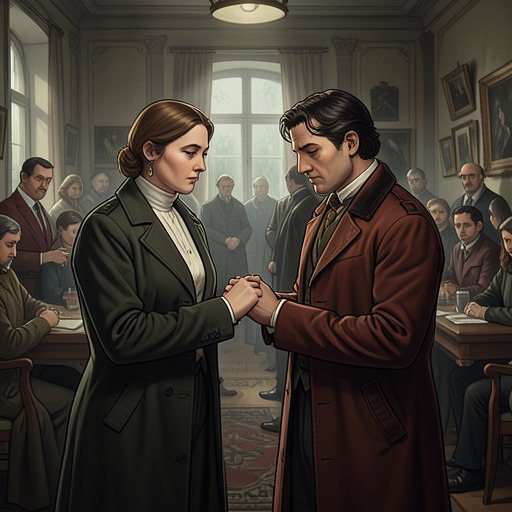
The letter is read by Jim Fanthorp, and William Carmichael takes it from him before he can finish the page. William dismisses the rest as immaterial and asks his nephew what he thinks. Fanthorp judges that the meeting was not a coincidence, and William approves his suspicion. He urges Fanthorp to go to Egypt by air, use his eyes and ears, and act if necessary, calling the matter vital. The honeymoon is thus already being read from outside the couple's perspective as a journey with consequences beyond sightseeing; the letter's ordinary account of tickets and destinations prompts urgent scrutiny.
A Honeymoon in Public View
The couple's marriage and travel are also made public through a newspaper reproduction that Rosalie Otterbourne studies. Its caption identifies Linnet as Mrs. Simon Doyle, formerly the society beauty Miss Linnet Ridgeway, and reports that the Doyles are spending their honeymoon in Egypt. The honeymoon is therefore not only a private trip described in a letter: it is news attached to Linnet's former public identity and immense wealth.
When Tim Allerton recognizes Linnet among passengers coming ashore, the newspaper image seems to meet the living scene. He identifies her as the wealthy woman he has seen reported in the press; Rosalie supplies Simon's name and remarks on Linnet's money. Hercule Poirot, watching with them, observes that Linnet is beautiful. Rosalie replies bitterly that some people have everything, and her expression turns the couple's conspicuous good fortune into a contrast with the observers' resentment. The arrival is ordinary in action—passengers disembark—but it makes the honeymoon visible to strangers who already know what the marriage signifies socially.
Jacqueline's Repeated Appearances
For Simon, the journey is already marked by the difficulty of leaving Jacqueline behind. He tells Hercule Poirot that she appeared first at Venice, where he thought her presence a coincidence. They next found her aboard the boat at Brindisi; believing she was going to Palestine, they left her behind. At Mena House, however, she was waiting for them. The sequence matters because each apparent separation fails to hold: a new destination does not end the encounter, and the couple's assumptions about Jacqueline's onward route prove mistaken.
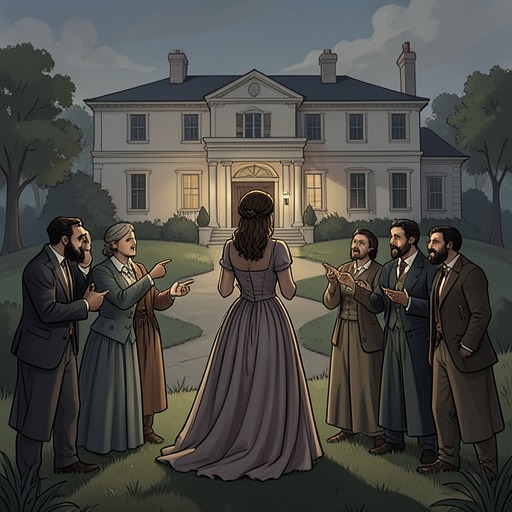
That history shadows the beginning of the Nile voyage. As the steamer draws away from the jetty, Simon tells Linnet that they are off. The couple has begun a seven-day journey to the Second Cataract and back. Then a light, silvery laugh comes from behind them. Linnet turns and sees Jacqueline standing there, apparently amused. The departure that might have marked a clean break instead repeats the honeymoon's governing pattern: the Doyles move on, but Jacqueline is present at the threshold of the next stage.
Significance of the Journey
The honeymoon's itinerary and its interruptions work against one another. Mena House, the Fayum, the planned Nile destinations, and the steamer's seven-day voyage give the trip direction and duration; the meetings with Pennington and Jacqueline make that planned movement porous. The Doyles can arrange tickets and leave one place for another, but their journey does not secure the separation they appear to seek.
The contrast is especially sharp between the public account of a wealthy couple travelling in celebration and the private history Simon recounts to Poirot. In the newspaper, the marriage and honeymoon form a polished announcement. In Simon's account, the same trip is a chain of encounters with a former fiancée who has followed them from Venice to Brindisi and Mena House. At the jetty, the steamer carries the couple toward the Second Cataract, but Jacqueline's appearance prevents departure from functioning as an ending. The honeymoon is significant not simply as travel, but as the setting in which the promise of distance repeatedly gives way to renewed proximity.